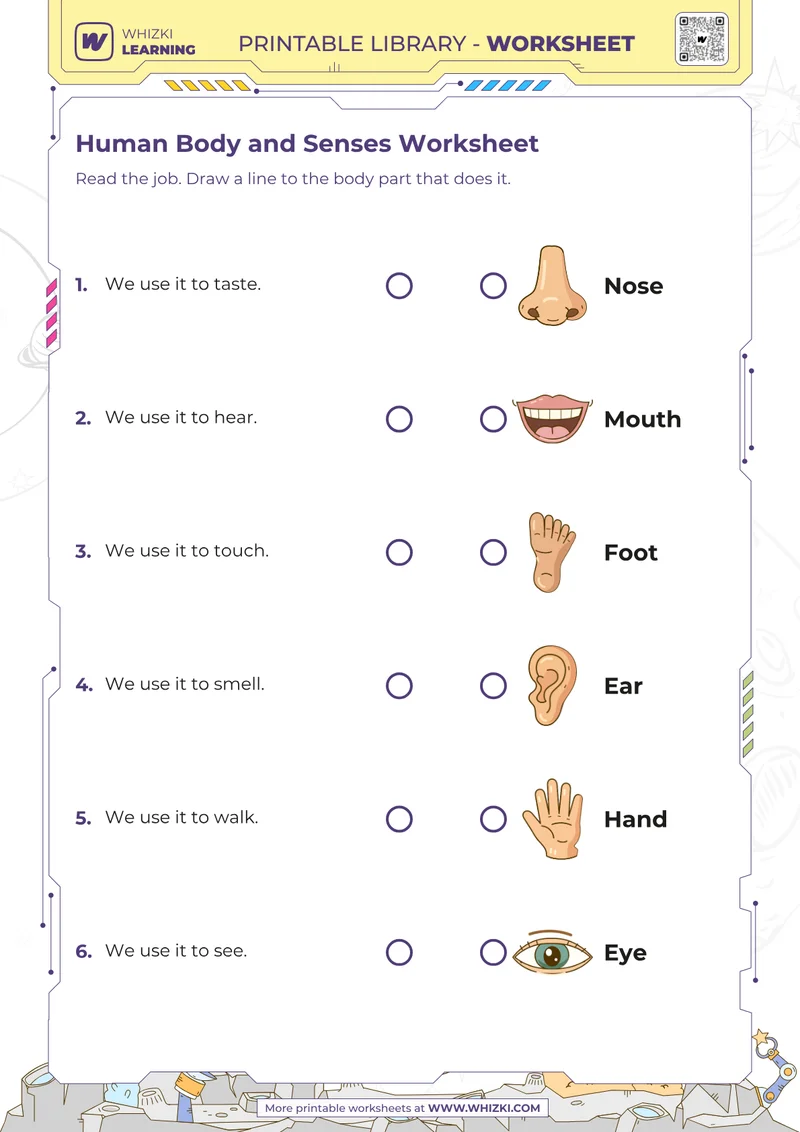
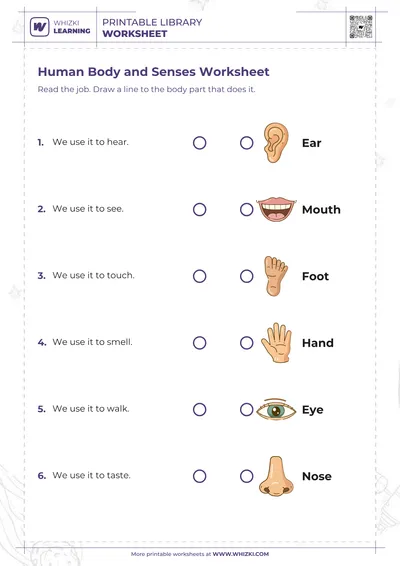
Familiar actions offer a starting point for learning body-part words. This body parts and their jobs worksheet asks children to connect six short sentences with labeled pictures of an eye, ear, nose, mouth, hand, and foot. The actions are seeing, hearing, smelling, tasting, touching, and walking. Read the sentences aloud when needed, then let your child choose the picture that fits each action.
Begin with “We use it to taste.” and find the mouth picture in the other column. Point to the two matching endpoints before drawing a line between their circles. The next sentence is “We use it to hear.,” which connects to the ear. Search the full picture column for each answer; the picture beside a sentence is not necessarily its match. Work one connection at a time and check where each line ends.
The page includes five familiar senses along with walking as a body action. Walking is not a sixth sense. The hand is used as a familiar example of touching, although touch is felt through skin on other parts of the body too. For the mouth picture, explain that the tongue helps us taste. Keep these explanations brief and tied to the printed sentence, without requiring a child to perform an action to demonstrate the answer.
Explore the human body worksheet collection for related vocabulary practice. Save a suitable follow-up in the Family Learning Planner when it fits your week. After checking the six connections, invite your child to describe one familiar action in their own words. An adult can write the sentence down or simply talk through the example. Use everyday language and return to an uncertain word on another occasion.