Learning Outcomes
The Whizki Learning tracing worksheet strengthens pencil control and line accuracy, building measurable pre-writing confidence for six-year-old children during daily early reading and writing practice.
The Whizki Learning tracing worksheet improves visual-motor integration by guiding children to match eye movement with controlled hand movement, increasing successful task completion rates during structured learning activities.
The Whizki Learning tracing worksheet introduces foundational concepts of directional movement and spatial awareness, helping children understand top-to-bottom and left-to-right organization required for fluent reading and writing.

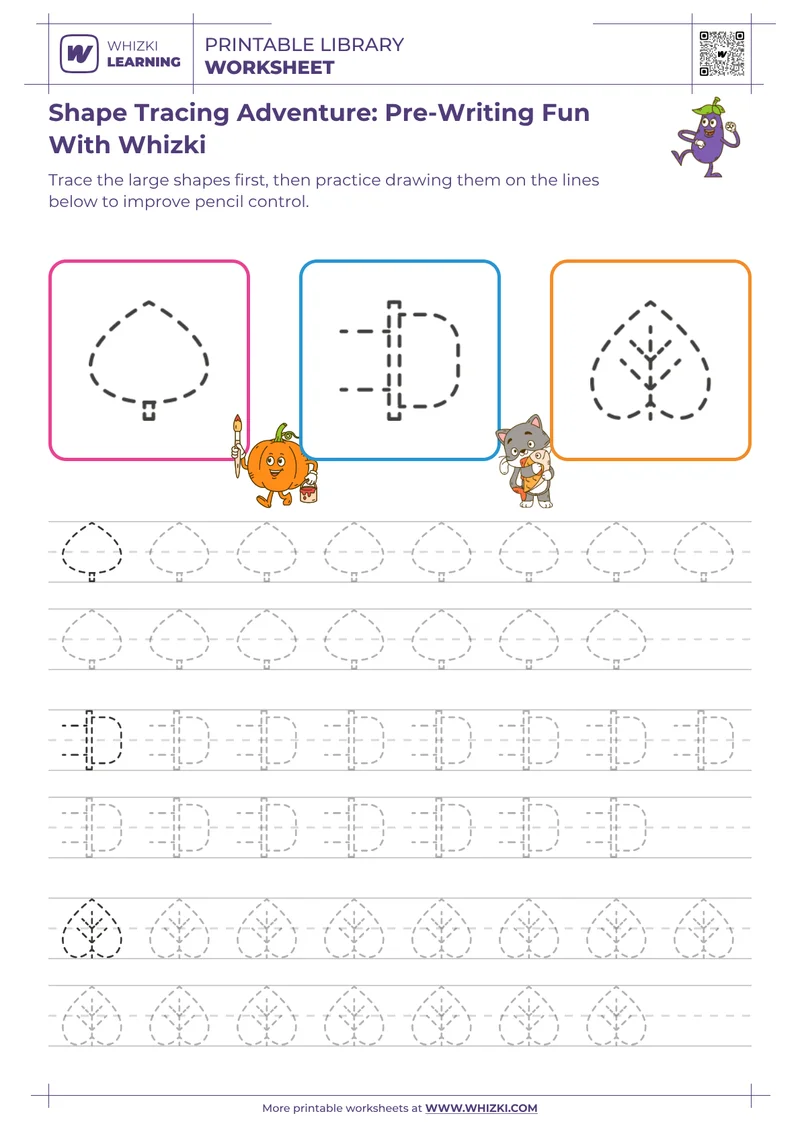
Shape Tracing Adventure: Pre-Writing Fun With Whizki
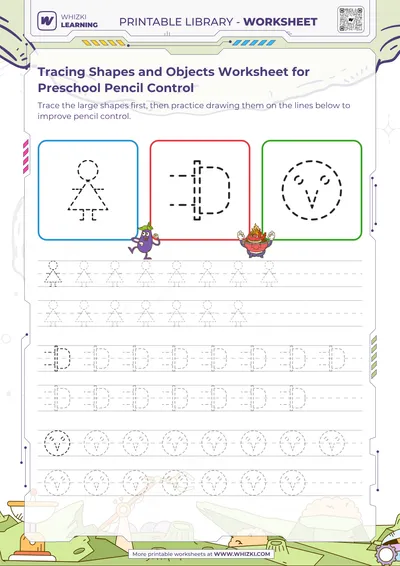
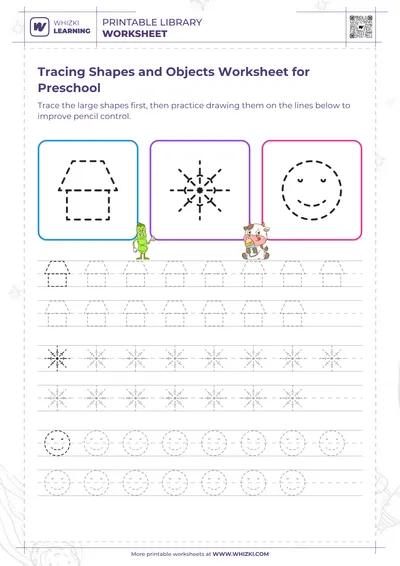
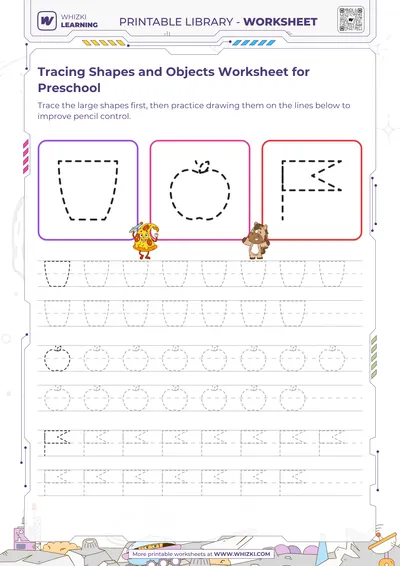
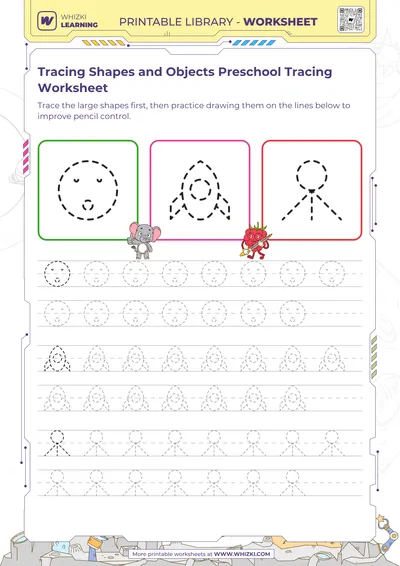
The Whizki Learning Tracing Shapes and Objects worksheet for preschool and kindergarten children creates a playful bridge between early reading readiness and confident pencil use. The worksheet invites six-year-old children to follow bold and dotted lines around familiar shapes and simple objects, strengthening visual tracking and hand-eye coordination. The structured tracing paths guide young learners through consistent practice that encourages focus, patience, and independence, all designed by experienced early childhood educators who specialize in literacy and fine-motor development.
The Whizki Learning Tracing Shapes and Objects worksheet intentionally targets fine motor skills and pencil control, which directly support clear letter formation later on. Repeated tracing of curves, corners, and straight lines trains the small hand muscles that children need for writing legible letters and words. The worksheet encourages children to hold a pencil with a functional tripod grasp, maintain steady pressure, and move from left to right, which supports reading directionality. Educator-developed line thickness, spacing, and progression ensure that each page challenges young learners without creating frustration.
The Whizki Learning Tracing Shapes and Objects worksheet also promotes early literacy foundations by connecting pictures, language, and movement during tracing practice. Caregivers and teachers can name each traced object aloud, encouraging children to repeat the words, clap syllables, and listen for beginning sounds while tracing. That multisensory combination of saying, seeing, and tracing supports vocabulary growth, phonological awareness, and comprehension skills essential for future reading success. The worksheet therefore transforms simple shape tracing into a rich language experience that keeps children engaged and curious.
The Whizki Learning Tracing Shapes and Objects worksheet provides flexible, printable practice for home, classroom centers, or occupational therapy sessions. Families can laminate the pages or place the pages in reusable sleeves for repeated tracing, giving children daily opportunities to refine control and accuracy. Teachers can use the worksheet as a warm-up before handwriting lessons, a focused fine-motor station, or a quick assessment of pencil control. The worksheet reflects research-based best practices from qualified educators, giving parents and teachers a trusted, expert-created resource for nurturing strong pre-writing and early reading skills.
Limited Time Sale
Kids’ Workbooks!
Boost your child’s skills with our discounted workbooks. Engaging activities for preschool, kindergarten, and grade 1 - now at special sale prices!


Fast shipping
Secure Payment
Licensed Teachers
For the planet
Printed in the USA
Find fresh ideas
To help your little learners grow!
Helpful guides for parents and teachers, and tips for making learning at home super fun.

Getting an energetic preschooler to sit still for handwriting practice often results in frustrating power struggles. This educator-approved playbook provides 10 screen-free, proprioceptive calm-down activities designed to regulate a dysregulated nervous system. Learn how heavy work, fine motor warm-ups, and breath control prepare a child's body and mind for successful, tear-free tracing and writing.
Sunny Hedge
When a preschooler complains of boredom, parents often feel immediate guilt and offer digital entertainment. This educator-approved guide explains the psychological mechanism of unstructured time and why boredom is the ultimate catalyst for independent play. Learn how to survive the initial complaining phase and utilize high-quality printed workbooks to bridge the gap between digital stimulation and deep, analog focus.
Sunny Hedge
Many parents panic when their preschooler cannot sit still for more than two minutes, fearing the child is not ready for formal schooling. This educator-tested guide explains why early attention spans are naturally short and provides a step-by-step plan to gently stretch cognitive stamina. Learn how to build a reliable 15-minute focus habit using screen-free, analog activities before the first day of kindergarten.
Sunny Hedge
The kitchen provides a natural, highly engaging mathematics classroom for preschoolers. This educator-approved playbook details 10 easy, screen-free number games using everyday pantry items and snacks. Learn how sorting pasta, measuring water, and counting blueberries builds foundational counting skills, one-to-one correspondence, and deep number recognition without any formal preparation.
Sunny HedgeJoin the Screen-Free Movement.
Get exclusive activities, expert tips, and inspiration for a more meaningful, offline family life.