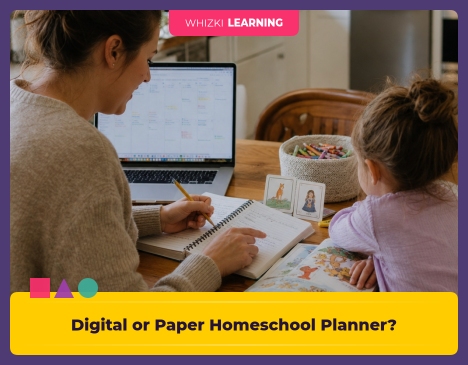
If your planner is making you feel behind before breakfast, try one small test today: put tomorrow’s plan on paper, then decide where the longer record should live. A digital homeschool planner and a paper homeschool planner can both serve a real family, especially when preschool and kindergarten plans change because a child needs more movement, more rereading, or a slower morning.
Reviewed by Whizki Editorial Team, Early Childhood Education Editors.
Start with the job your planner needs to do
The best homeschool planner is the planner that lowers adult mental load while protecting the child’s day from becoming paperwork. NAEYC developmentally appropriate practice guidance reminds teachers and parents that young children learn through play, talk, movement, stories, and responsive routines, so the planner should support those experiences rather than crowd those experiences out.
A homeschool planner online can be excellent for rearranging a week, saving notes, and searching for past work. A simple notebook can be excellent for slowing the adult mind, keeping the day visible, and giving a satisfying physical record without adding screen time.
Comparison table, read row by row: use the following snapshot when deciding where each planning job belongs.
Daily view: paper feels visible on the counter, digital feels easy to move; Frequent changes: digital avoids repeated rewriting, paper shows a quick scratch-out; Several learners: digital keeps separate records cleaner, paper keeps shared rhythm easy to see; Search: digital finds a book title fast, paper asks for flipping; Screen time: paper adds none, digital stays adult-managed when used well; Physical satisfaction: paper gives a record to hold, digital gives reusable records and possible exports.
Where a paper planner really shines
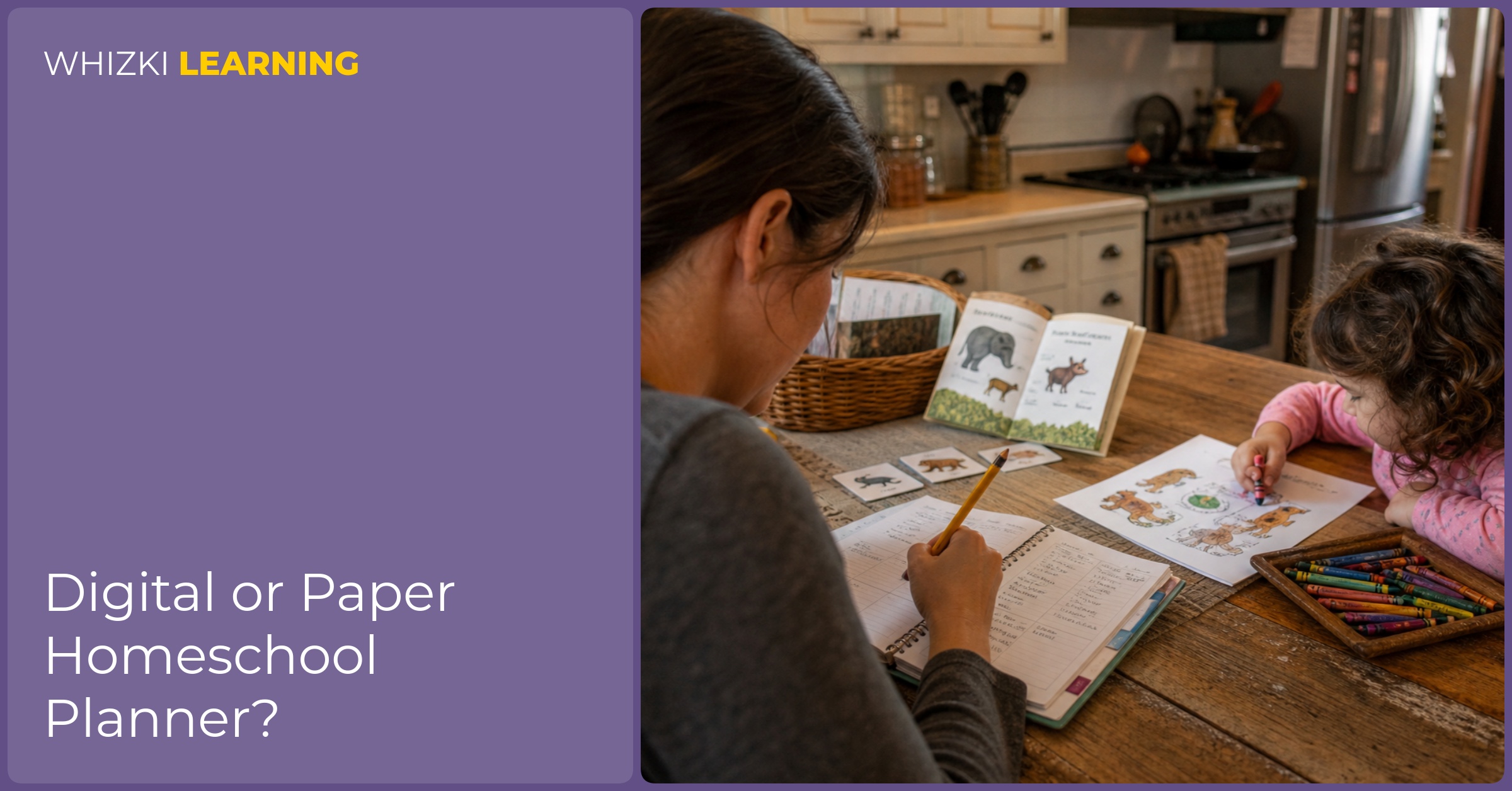
A paper homeschool planner gives the adult hand a place to think. Occupational therapy basics often use the phrase “body before brain” in plain family language, and many adults find that writing with a pencil helps the day feel less slippery because the hand, eye, and page work together.
A printable homeschool planner also keeps planning off the child’s screen. For children ages 3 to 7, paper supports a home rhythm where the child can see the adult plan, choose a crayon, carry a book, or point to a picture without turning the morning into device time.
A simple notebook can be easier to see than the prettiest app. A physical record also feels satisfying at the end of a week because the adult can hold the pages, notice the read-alouds, and remember the muddy nature walk that replaced a worksheet.
Where digital planning earns its place
A digital planner earns the adult’s trust when the family plan changes often. Reggio-inspired observation treats children’s questions and interests as useful information, so a parent may need to move “count apples” to Thursday because Monday became a long block-building investigation.
A digital planner also helps when several learners have different books, therapies, co-op days, or rest needs. Orton-Gillingham teaching is structured and sequential, so a reusable note such as “review short a before adding short i” can save the adult from rewriting the same reminder every week.
Digital records can help with reorganization, search, reusable notes, exports, and printable reports when those features are part of the current plan. Because Free, Plus, and Pro details, export options, and printable-report wording can change, read the current plan comparison before choosing a paid or free option.
For families who want an online homeschool planner for adult organization, the Family Learning Planner is an adult-managed tool for plans and records, not a child-facing screen-learning product. Children do not create accounts or sign in, so the screen stays in the parent or teacher role while learning can stay hands-on.
The honest hybrid: digital records, paper day
The hybrid setup I see work best is digital organization plus paper as the daily thinking surface. Montessori and Reggio traditions both value a prepared environment, and a visible paper plan can help the adult prepare the shelf, table, basket, or outdoor bin before the child arrives.
The daily paper can hold only what the adult needs today: story, sound work, counting game, outside time, rest cue, and one note box. The digital record can hold the week, saved resources, book titles, photos if the parent chooses, and a clean summary of what actually happened.
The trap is keeping two full duplicate systems. When paper and digital both ask for every lesson, every note, and every checkbox, the planner has become a second job instead of a support, and the flexible weekly planning guide can help reduce that repeat work.
A five-question decision tool
The five-question decision tool keeps the choice practical, not perfect. NAEYC guidance asks adults to match tools to children, families, and context, and planner choice belongs in that same common-sense category.
Question one asks, “Do plans change more than twice a week?” Question two asks, “Am I planning for more than one child?” Question three asks, “Do I need to find past book titles or notes quickly?” Question four asks, “Does screen time make my own planning feel scattered?” Question five asks, “Would a paper record make me more likely to notice the good parts of the day?”
If the first three answers are yes, a digital planner may carry the main record better. If the last two answers are yes, paper should stay close, even when the long-term record lives online.
Three family scenarios that make the choice clearer
The one-child preschool home: a parent teaching one 4-year-old may do best with a paper planner, a library bag, and one weekly page on the fridge. Montessori observation favors watching the child closely before adding materials, and paper can keep the adult present during blocks, finger paint, songs, and read-alouds.
The two-learner mixed week: a caregiver teaching a 3-year-old and a 6-year-old may need a digital record for separate reading notes, appointments, and changed plans. Orton-Gillingham-style reading work often needs careful review notes, while the younger child may need sensory play and a nap rhythm that shifts the schedule.
The co-op and grandparent team: a family with a kindergarten co-op day and a grandparent helping on Fridays may need digital organization with one printed daily page. Speech-language pathology practice often values short, clear home notes, and the adult team can use a brief paper handoff without creating a second full planner.
Switching costs, records, and what not to overbuild
Switching planners has a cost because habits live in the body as much as on the page. Occupational therapy routines often start with one small environmental change, so a parent may try a two-week test before moving a full year of plans.
Homeschool record requirements vary by location, and families should check local rules or ask a qualified professional for legal questions. The planner does not provide legal advice, official attendance, or transcripts, and family learning should not be turned into compliance paperwork unless the family’s location actually requires a specific record.
A reading record is one place where simple beats fancy for young children. Use the simple reading-log guide if book tracking keeps falling apart, because a usable log should capture the title, date, and quick note without stealing the pleasure from story time.
Choose the planner that removes the most adult rewriting and protects the most child learning time. Today, write tomorrow on paper, choose one place for the permanent record, and refuse the extra work of maintaining two complete systems.