If time talk turns into “Is tomorrow now?” five minutes before shoes, print or draw a three-box yesterday-today-tomorrow strip tonight and use one real event per box at breakfast tomorrow. Young children age 3 to 7 learn time through repeated routines, body cues, and shared language long before clock hands make sense.
Reviewed by Whizki Editorial Team, Early Childhood Education Editors.
Start with yesterday, today, and tomorrow
The yesterday-today-tomorrow idea works best when the words are tied to one event a child actually remembers. Reggio-inspired teaching starts with the child’s lived experience, so a muddy walk, a library visit, or pancakes at breakfast gives the time word a real hook.
The three-box strip can say, “Yesterday we visited Nana, today we have school, tomorrow we will swim.” A family that already uses days and months routines can keep the same language, but the daily talk should stay short and concrete for preschool and kindergarten learners.
The yesterday box should hold a photo, quick drawing, or child-made mark from a real past event. The today box should show the main event happening now, and the tomorrow box should show one planned event, because three clear anchors beat a crowded calendar every time.
Make a visual daily schedule
A visual daily schedule turns time into something a child can see and touch. NAEYC guidance for early childhood classrooms favors predictable routines because children participate more calmly when the next step is visible before an adult gives another reminder.
The visual schedule should sit at child height near the place where the routine gets stuck, such as the kitchen wall, mudroom door, or bedroom dresser. Occupational-therapy basics call this an environmental support, because the room carries part of the direction instead of the adult repeating every step.
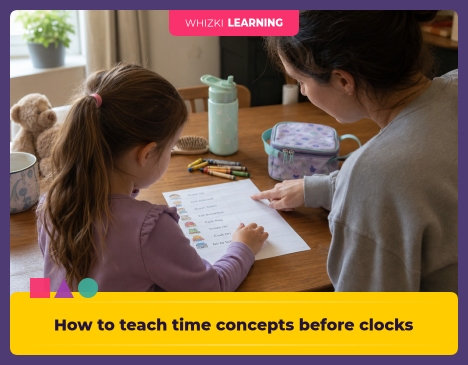
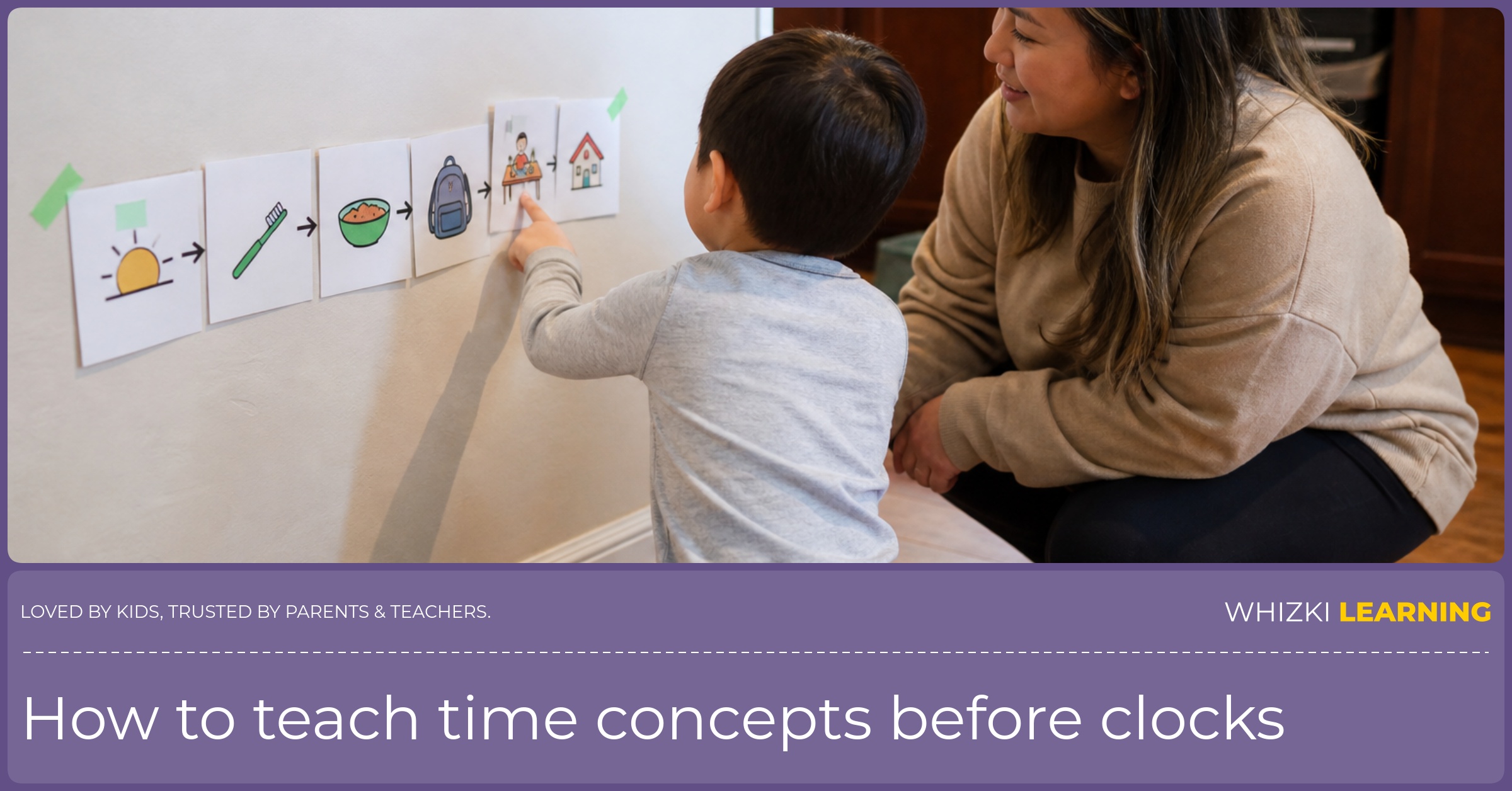
The visual schedule does not need clock times for young children. Four to six pictures are enough for many homes, with one picture for wake up, bathroom, breakfast, dress, shoes, and leave, and the adult can move a clothespin or sticky note as each step finishes.
During the morning rush, print a visual daily schedule from our printable library and tape the page at child height. The printable gives one matching picture for each routine step, so a child can point to the next action before an adult repeats directions.
Use first, then, and last language
Sequencing words are the bridge between daily routines and later clock reading. Orton-Gillingham teaching often uses explicit, multisensory language for order, and the same clear pattern helps children hear where an action belongs in a sequence.
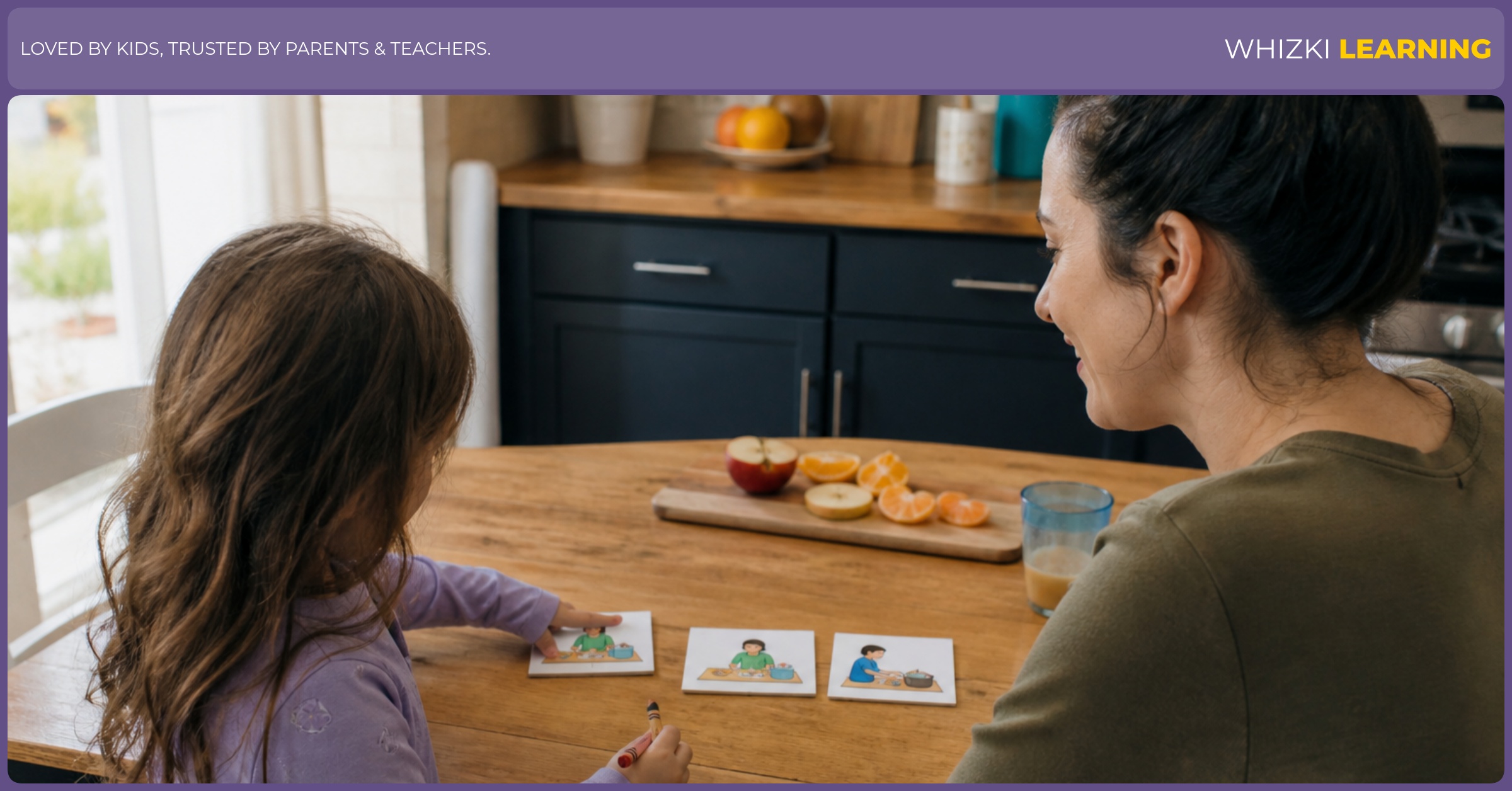
The phrase can be small: “First socks, then shoes, last backpack.” A child can touch each picture or object while saying the phrase, because the hand movement gives the word order a body memory.
Story retelling gives sequencing words another place to grow. After a picture book, the adult can ask, “What happened first, what happened next, what happened last?” and accept drawings, gestures, or short phrases as answers, which lines up with speech-language practice for building narrative order.
Wait on analog clock reading until age 6 or 7
Analog clock reading asks a child to combine number recognition, directionality, skip-counting by fives, and the idea that two hands can show different information at the same time. Montessori practice moves from concrete materials to symbols, and the clock face is a symbolic tool that works better after the concrete time ideas feel familiar.
A kindergarten child can still notice clocks without being expected to read them. The adult can say, “When the big hand is at the top, snack begins,” while the main teaching stays with routines, order words, and today-tomorrow language.
The numbers on the clock matter, but number naming alone is not enough for true clock reading. If a child is still building numeral recognition, the numbers learning hub can support counting and number sense before the adult asks for half past or quarter after.
Build a one-week time routine
A one-week time routine gives a child enough repetition without turning the kitchen table into a lesson plan. NAEYC-aligned practice keeps early math playful and useful, so the best time work happens during meals, getting dressed, errands, and bedtime.
Monday can be picture schedule day, Tuesday can be first-then-last during snack, Wednesday can be yesterday-today-tomorrow at breakfast, and Thursday can be story retelling with order words. Friday can be a quick child-led review where the child points to a picture and tells the adult what happened before or after that moment.
The adult should expect uneven answers because young children often understand routine before children can explain routine with adult words. The goal is steady exposure, not perfect recitation, and the best sign of progress is a child using a time word during real family life.
Time concepts grow from ordinary days: breakfast before shoes, park after lunch, story last at bedtime. A calm visual schedule, a three-box strip, and a few sequencing phrases give children the foundation needed for calendar work and analog clocks later.