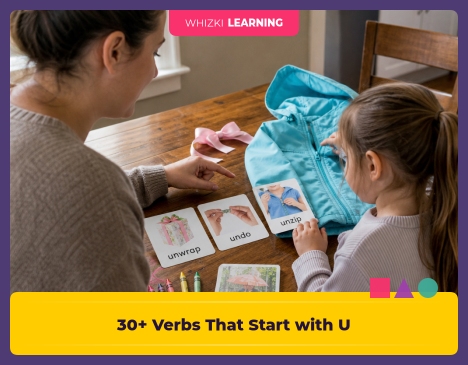
U verbs can feel oddly hard at the kitchen table, so start with one real action today, say the word, do the motion, and let the child copy your body. The letter U shows up in many “un-” words, which is actually helpful because children can see the meaning change when a zipper opens, a ribbon loosens, or a blanket comes off. A short movement routine works better than a long lesson for ages 3 to 7.
Reviewed by Whizki Editorial Team, Early Childhood Education Editors.
How to teach U verbs with movement
The Orton-Gillingham approach starts with sound, sight, touch, and movement together, so a U verb list should be spoken, seen, traced, and acted. The letter U can say /ŭ/ as in up, and many kid-friendly U verbs begin with un-, which often means “take away” or “reverse.” For more letter sound practice, keep our letter U learning page nearby while the child points, says, and moves.
The NAEYC guideline I lean on in preschool is simple, young children learn best through active, playful experiences that match real life. This post stays with verbs, action words a child can do with a body, toy, or household object. If the child needs object words instead, use first words starting with U, and if the child needs color, size, or feeling words, use describing words starting with U.
For a mid-routine helper, print one U vocabulary page from our sight-words printables and tape the page near shoes, coats, or the play table. Point to one action word before snack or cleanup, then let the child act the word with real hands and real objects.
Body actions that start with U
Body verbs are the easiest first set because the child does not need many materials. Occupational-therapy basics remind teachers and parents to pair big movement with small movement, so the child can feel a word in shoulders, fingers, knees, and face muscles. Say the verb once, model the sentence once, then let the child copy without a quiz.
Speech-language practice often uses short, repeatable phrases because children can imitate a phrase faster than a lecture. These example sentences are only three to six words, which keeps the child focused on the action instead of getting lost in extra talk. Use one or two words per sitting if the child is tired.
Body action words
- Unbend: Straighten your sleepy knees.
- Uncurl: Open your tiny fist.
- Undress: Take off your hat.
- Unfreeze: Move after the music.
- Untwist: Turn your wrist back.
- Unwind: Spin your scarf slowly.
- Uplift: Raise both arms high.
- Use: Hold the spoon carefully.
- Utter: Say a silly sound.
- Unclench: Relax your tight hands.
- Unlace: Loosen your shoe strings.
- Unbuckle: Open the seat strap.
- Unmask: Take off the costume.
Household actions that start with U
Household verbs work well because daily routines already include coats, bags, caps, tape, napkins, and baskets. Montessori practical-life work treats these small jobs as real learning, not busywork, because children gain language while using both hands with purpose. A child who opens a marker cap can hear the U verb, see the object change, and feel the hand motion all at once.
Occupational-therapy heuristics also value hand strength, finger control, and two-hand coordination during dressing and cleanup. Keep household U verbs safe and supervised, especially with cords, clips, lids, and small parts. The adult can hold the object steady while the child does the simple action.
Household action words
- Unzip: Pull the jacket zipper.
- Unbutton: Open one big button.
- Untie: Loosen the ribbon bow.
- Unpack: Take snacks from bag.
- Unload: Move blocks from basket.
- Unwrap: Peel paper from gift.
- Unroll: Spread the towel flat.
- Unfold: Open the napkin wide.
- Uncover: Lift the pot lid.
- Uncap: Take marker cap off.
- Unclip: Open the paper clip.
- Unhook: Lift ring from hook.
- Unstick: Peel tape from table.
- Uncrumple: Smooth the wrinkly paper.
Play actions that start with U
Play verbs matter because children often give the best language during pretend play, block play, and loose-parts play. Reggio-inspired teaching starts with observation, so watch what the child already loves, then add the U verb to the moment. A toy road, a cardboard box, or a cape can carry more vocabulary than a worksheet alone.
NAEYC guidance supports playful, child-led practice, especially when adults add language without taking over the child’s idea. The adult can narrate one clear U verb, pause, and let the child keep building the story. The goal is useful vocabulary, not a perfect performance.
Play action words
- Unbox: Take toys from carton.
- Unbag: Tip shells from pouch.
- Unblock: Move blocks from road.
- Unpin: Pull clothespin from cape.
- Unsnap: Open the doll jacket.
- Untangle: Free the yarn ball.
- Upend: Tip the bucket over.
- Upturn: Flip the cup over.
- Uproot: Pull pretend weeds gently.
- Upcycle: Make art from boxes.
- Unite: Put puzzle halves together.
- Usher: Guide teddy to chair.
- Unjam: Free the stuck train.
- Unfasten: Open the toy belt.
Act-it-out U verb charades game
The U verb charades game is a five-minute routine for wiggly children, waiting time, or the end of a reading lesson. Orton-Gillingham lessons often use quick multisensory review, and charades gives the child a reason to connect a printed word with a body action. Use the same small stack for several days so the child can feel successful.
The occupational-therapy rule of thumb is to match the movement size to the child’s energy. Big actions, such as tipping a bucket or raising arms, help a restless child settle into the lesson. Small actions, such as opening a button or smoothing paper, help a busy child slow the hands and look closely.
- Write six U verbs on cards.
- Place safe props in reach.
- Let the child choose one.
- Read the card together.
- Act without extra talking.
- Guess, clap, and switch roles.
The adult can add one sentence after the child acts, such as “Your hands showed that word.” The child does not need to read every card alone for the game to count as literacy practice. Shared reading, acting, and naming build the bridge toward independent word reading.
Trace-the-word tip for U action words
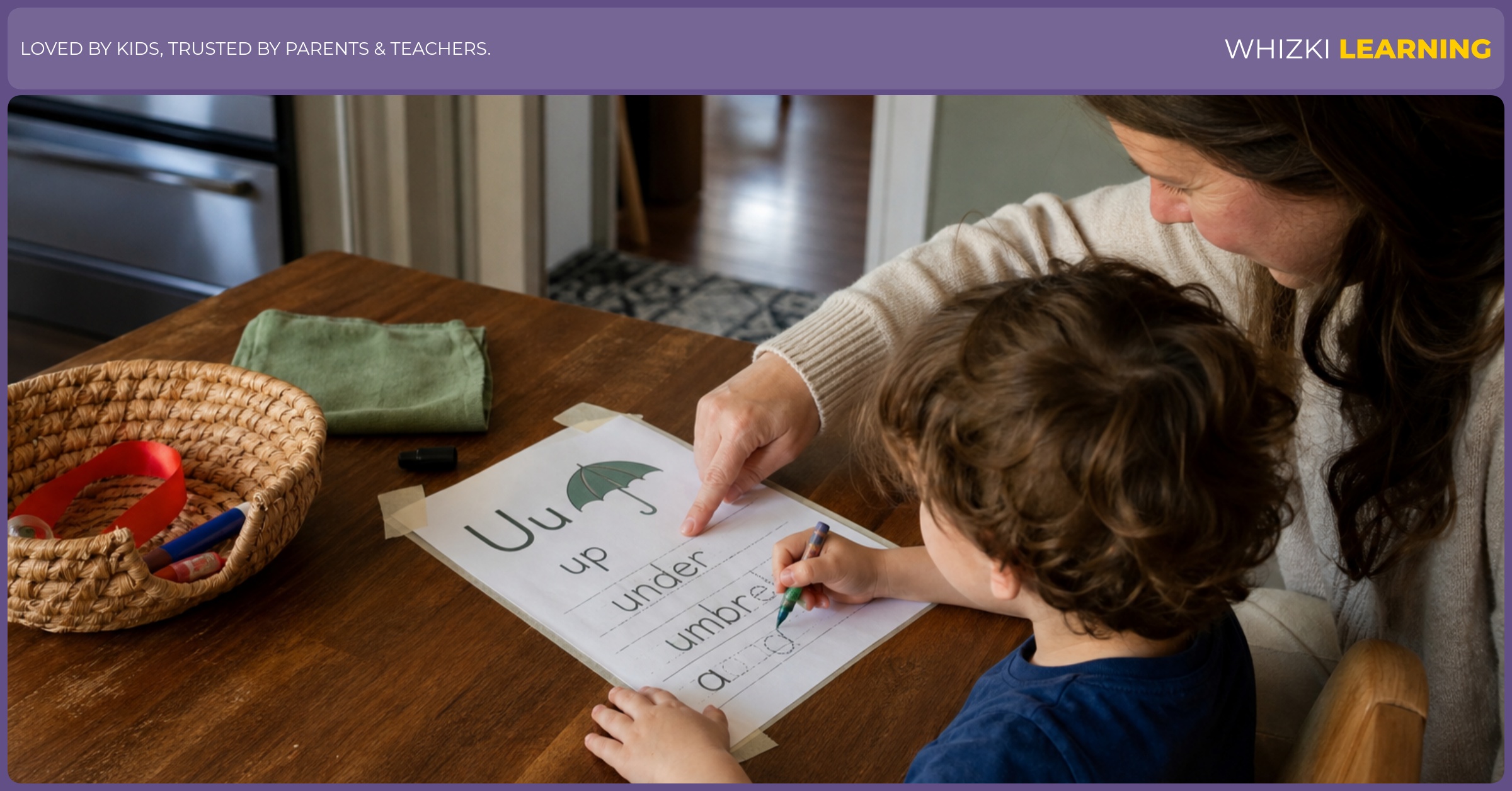
The trace-the-word tip is to trace only one U verb at a time, then act the word right away. In Orton-Gillingham practice, the child says the sounds while tracing because the mouth, eyes, and hand are working together. For a word like uncap, the child can trace the letters, say the word, and take a cap off a marker.
Occupational-therapy basics also matter during tracing, so use a short crayon, a thick pencil, or a broken chalk piece if the child grips too tightly. The adult can place a dot where the child starts, then ask for slow tracing rather than fast scribbling. If the child resists paper, the same word can be traced in sand, shaving cream, or finger paint before pencil work.
U verbs do not need a fancy lesson, and the best practice usually happens during shoes, snacks, blocks, and cleanup. Choose three words from one group, tape the printable where the routine happens, and let the child move first because movement gives the word a place to land.