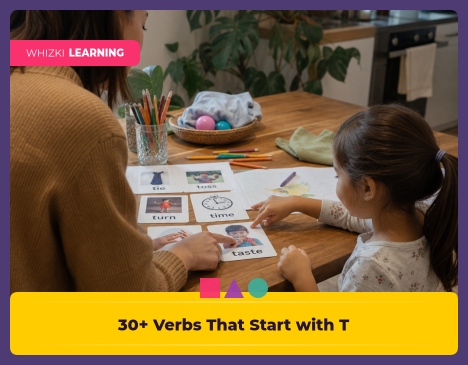
When the word list feels like one more thing to manage during snack crumbs, sibling noise, or a tired bedtime, pick three T action words and act the words out before asking your child to read the print. Young children usually learn action words faster when the body gets a turn first. The letter T has a crisp /t/ sound, so mouth, hand, and eye practice can fit into a two-minute routine.
Reviewed by Whizki Editorial Team, Early Childhood Education Editors.
Start with action before print
The Orton-Gillingham approach starts with clear sounds, touch, movement, and seeing the letter, which matches how many preschool and kindergarten children learn best. Say /t/, tap two fingers, and point to the printed T before naming the action word. For extra letter-sound practice, keep our letter T learning page nearby while your child acts out one verb.
The guide stays with verbs, which means action words your child can do with a body, a toy, or a household object. If your family also wants nouns, use first words starting with T, and if your child is ready to describe size, feel, or mood, save describing words starting with T for another day. A small set of action words is plenty for ages 3 to 7 because repeated play builds memory better than a long drill.
Body actions that start with T
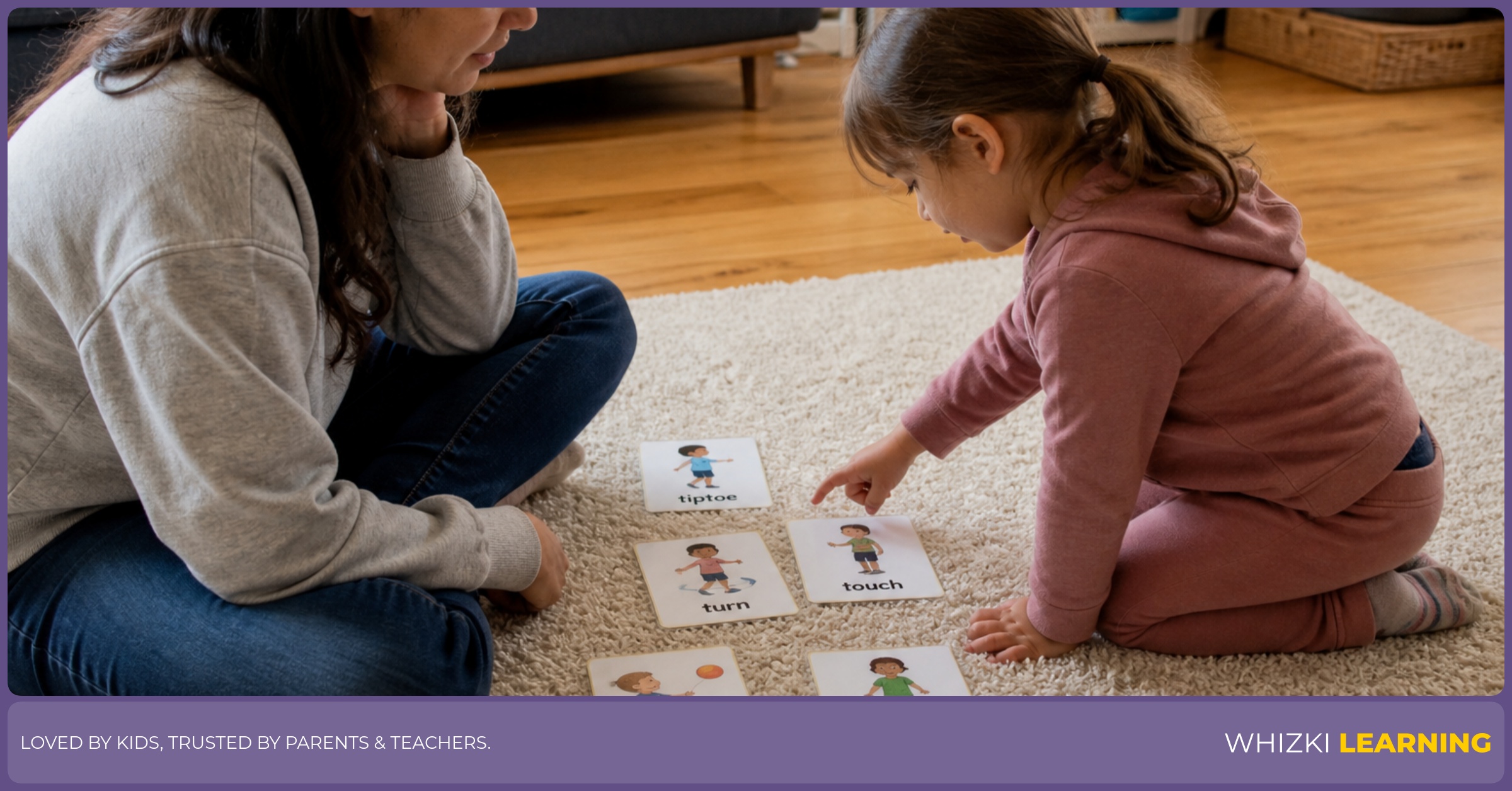
Occupational-therapy basics remind teachers and parents to pair big movement with small finger work, especially for children who wiggle during table time. Body verbs let a child hear T, move a body part, and feel the meaning at the same time. Keep the motion safe, slow, and silly enough to invite a second try.
The body action list works well in a hallway, on a rug, or beside the kitchen table. Read one word, model one motion, and let your child copy before looking back at the print. A kindergarten teacher can use the same routine as a quick transition between circle time and centers.
Body verbs to act out
- Tap: Tap the table.
- Tiptoe: Tiptoe to the rug.
- Touch: Touch your nose.
- Turn: Turn around slowly.
- Twist: Twist your waist.
- Twirl: Twirl like a dancer.
- Trot: Trot like a pony.
- Tumble: Tumble on the mat.
- Tug: Tug the scarf.
- Tilt: Tilt your head.
- Tickle: Tickle your teddy.
- Tuck: Tuck your knees.
Household actions that start with T
NAEYC guidance supports vocabulary practice inside real routines because children learn words best when the word has a purpose. Household T verbs work during snack, laundry, cleanup, and getting dressed. Montessori practical-life work uses the same idea, real hands doing real jobs with calm adult modeling.
The household action list should feel helpful, not like a chore chart. Choose one safe task, say the verb, and let the child do a small piece of the job. Praise the action with the word, such as you tidied the shelf, so speech and movement connect.
Household verbs to act out
- Take: Take one spoon.
- Tidy: Tidy the shelf.
- Tie: Tie your shoe.
- Tear: Tear scrap paper.
- Tape: Tape the picture.
- Toast: Toast the bread.
- Trim: Trim paper strips.
- Towel: Towel your hands.
- Tote: Tote the bag.
- Thread: Thread the beads.
- Thaw: Thaw frozen peas.
- Test: Test the zipper.
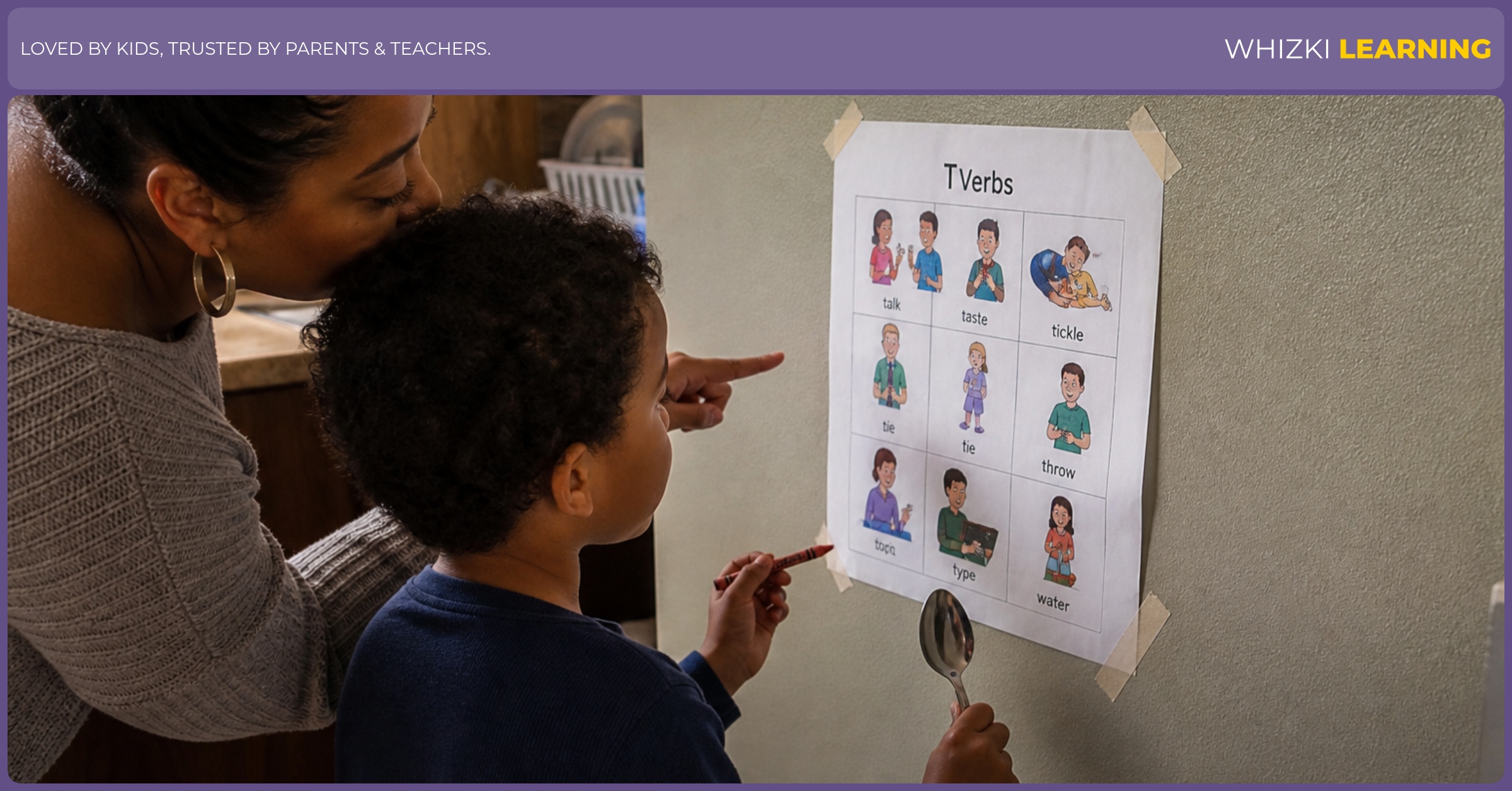
For a quick mid-routine helper, print one page from the sight-words printables and tape the page to the wall where cleanup happens. Point to one T verb before shoes, snack, or bath, then let your child act out the word before moving on.
Play actions that start with T
Reggio-inspired teaching treats play as serious language work because children show what a word means with materials, friends, and pretend scenes. Play verbs are easy to practice with blocks, balls, puppets, and stuffed animals. The adult watches first, then adds the right T word to the action already happening.
The play action list fits preschool centers, homeschool baskets, or a rainy afternoon in the living room. Keep the printed word beside the object whenever possible, because the child can match the action to the letters after the movement. A five-minute play round is enough for most children in the 3 to 7 age range.
Play verbs to act out
- Toss: Toss the beanbag.
- Throw: Throw the ball.
- Tag: Tag a friend.
- Trade: Trade two blocks.
- Try: Try the puzzle.
- Trace: Trace a line.
- Track: Track the marble.
- Talk: Talk to a puppet.
- Tell: Tell a joke.
- Thank: Thank your helper.
- Travel: Travel around chairs.
- Tow: Tow the wagon.
Act-it-out T verb charades game
Speech-language pathology practice often pairs a spoken word with a gesture because the gesture gives the child another way to hold meaning. The T-verb charades game takes three minutes and needs only paper slips or sticky notes. Write six verbs from the lists, fold the papers, and place the papers in a cup.
One player pulls a paper, acts out the T verb without talking, and lets the group guess the word. After the guess, the reader points to the first letter and says T says /t/ in tap. The adult can help a shy child by acting together first, which follows NAEYC guidance for playful, supported participation.
For ages 3 and 4, use body verbs because movement is the easiest clue. For ages 5 to 7, mix body, household, and play verbs so children sort meaning while listening for the same beginning sound. Stop after five turns if attention drops, because a short happy game teaches more than a long tired one.
Trace-the-word tip for T verbs
Occupational-therapy handwriting heuristics usually begin with posture, paper position, and a relaxed grip before letter perfection. The trace-the-word tip is simple: write one large T verb, let your child sky-write the word, then trace the letters with a finger before using a crayon. Finger tracing gives the hand a path before the pencil has to make one.
The Orton-Gillingham approach also favors saying the sound while tracing the letter, so ask your child to say /t/ at the start of the word. Keep one word per page for preschoolers and two or three words per page for kindergarteners. If the pencil grip looks tight, switch back to finger tracing, play dough ropes, or a paintbrush with water on the sidewalk.
The best T verb practice is ordinary family life with one clear word attached. A child can tap, tidy, toss, and tell without a worksheet stack or a long lesson. When the action comes first, print starts to feel useful instead of mysterious.
Pick three verbs for today and repeat the same three tomorrow. Add new T verbs only when your child can act out and recognize the first set with comfort. Small, steady practice is enough for early readers ages 3 to 7.