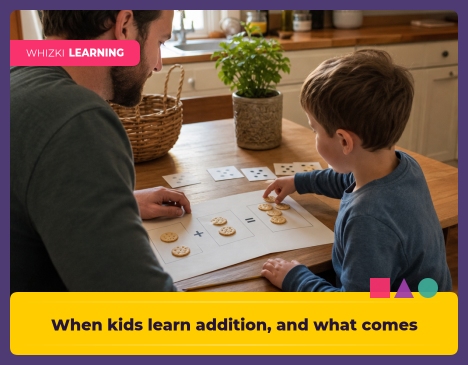
If your child can count to 20 but melts down at 3 + 2, your child is probably missing a rung on the readiness ladder, so tonight make two tiny piles of cereal, count each pile, push the piles together, and count the total. Addition is a new way of thinking about quantity, not a speed contest. In preschool and kindergarten classrooms, I watch children move into addition unevenly, with quick jumps one week and lots of finger counting the next.
Reviewed by Whizki Editorial Team, Early Childhood Education Editors.
The short answer: ages for learning addition
Most children begin real addition between ages 4 and 6, with simple joining problems like 2 and 1 more. NAEYC guidance keeps early math grounded in play, objects, talk, and daily routines because young children need to handle quantity before written symbols make sense. The useful question is not whether a child can say an answer fast, but whether a child understands that two groups can become one larger group.
Three-year-olds often explore more, less, one more, and small groups without formal equations. Four- and five-year-olds often solve tiny joining stories with fingers, blocks, snacks, or toy animals. Kindergarten children, usually ages 5 and 6, begin matching those hands-on stories to number sentences such as 3 + 2 = 5. Six- and seven-year-olds often grow steadier with sums to 10, but many children still need counters while confidence builds.
The readiness ladder before addition
The first rung is stable counting, which means a child says number words in order and knows the count keeps going. The Orton-Gillingham approach reminds teachers to teach in a structured, multisensory order, and early math benefits from the same slow build. A child who skips number words or starts over after every pause may need more counting songs, stair counting, and snack counting before addition worksheets feel fair.
The second rung is one-to-one matching, which means one number word touches one object. Montessori-inspired math shelves use movable beads, counters, and trays because the child can see and feel each counted item. A child who says “one, two, three, four” while touching only two bears is still learning that counting words must match objects.
The third rung is subitizing, which means seeing a small amount without counting every item. If the word is new, I like this clear guide to subitizing explained because the skill shows up in dice games, dot cards, dominoes, and quick glances at fingers. A child who instantly sees three dots has an easier time noticing that three and one more makes four.
The fourth rung is number bonds, which means knowing that a whole number can be split into parts. Reggio-inspired observation helps here because a teacher or parent watches how a child arranges shells, buttons, or blocks instead of rushing to the written answer. For more practice with numerals, counting, and early quantity work, the numbers learning hub gives families a place to revisit the earlier rungs when addition feels wobbly.
Finger counting is useful, not a bad habit
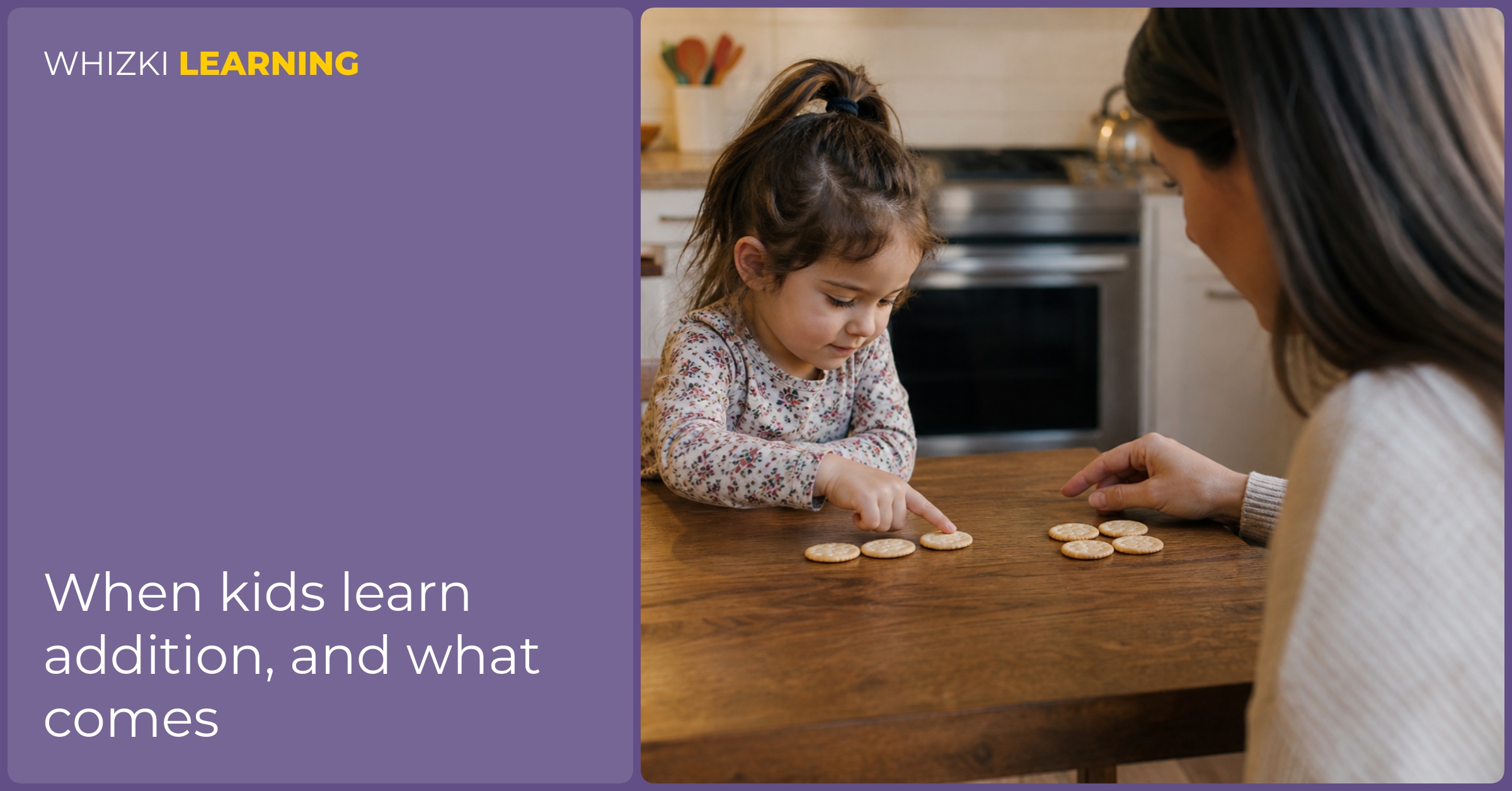
Finger counting is a feature of early addition because fingers make quantity visible and movable. Occupational-therapy basics often start with the body as a learning tool, especially when fine-motor control, body awareness, and attention are still developing. A child who raises three fingers and then two more is building a bridge between touch, sight, and number words.
Finger counting becomes a concern only when a child cannot connect fingers to actual amounts or becomes stuck on every sum long after many hands-on chances. In my classroom, I do not take fingers away; I add other tools beside fingers, such as cubes, dot cards, ten-frames, and quick pictures. The goal is flexible thinking, not hiding hands under the table.
Parents can coach finger counting with calm language that names the math. Say, “You showed three fingers, then two fingers, and now five fingers are up.” The sentence gives the child the addition story while the child still owns the thinking.
First addition formats that work
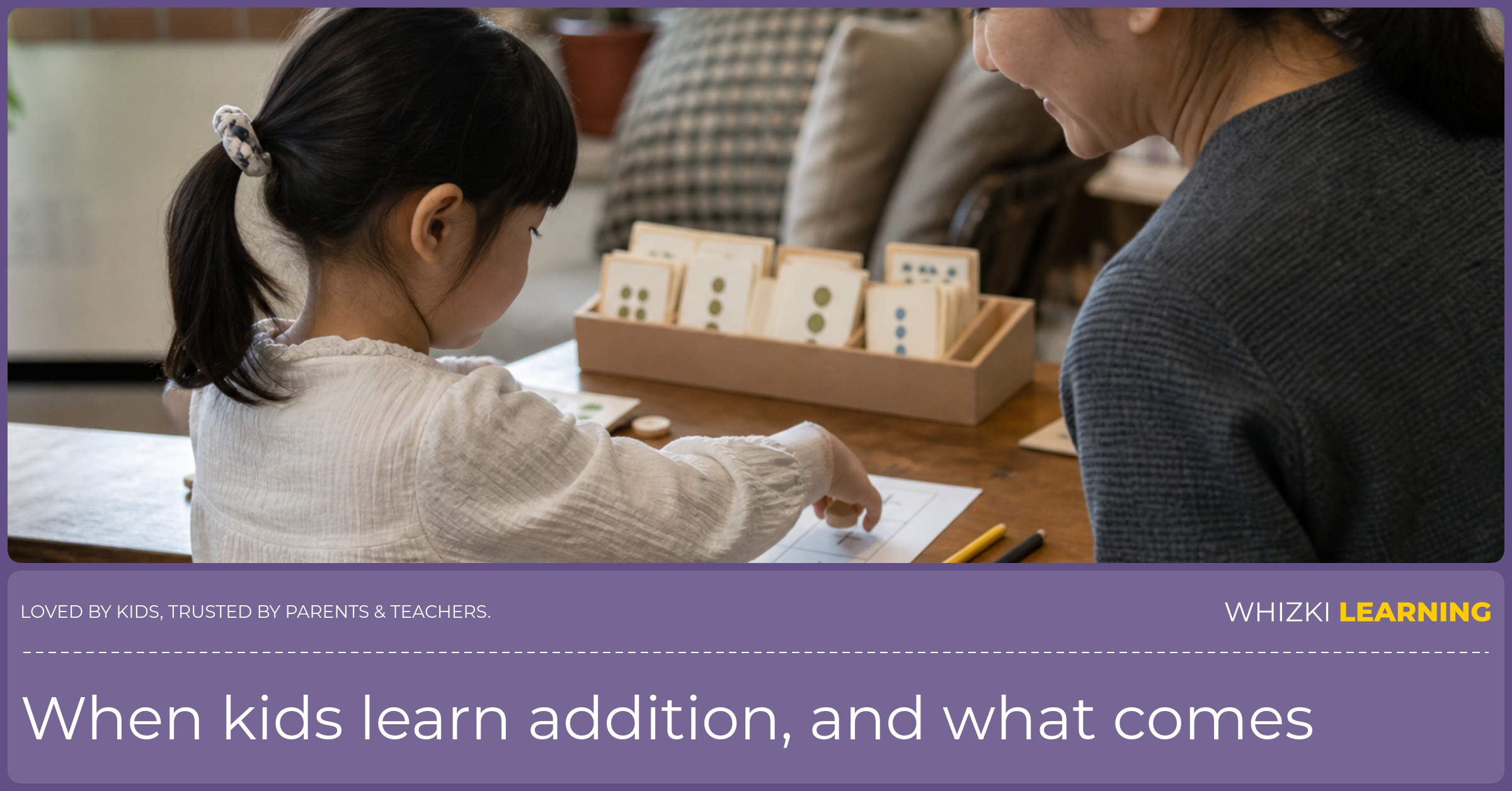
The best first addition format is a joining story with real objects. Speech-language pathology practice often reminds adults to keep directions short, concrete, and tied to visible action, and math stories need that same clarity. Try, “Two cars are in the garage, one car drives in, how many cars are in the garage now?”
The next format is a picture problem where a child circles or points before writing. Picture addition reduces the memory load because the groups stay on the page. A child can count the first group, count the second group, and then count the total without holding the whole story in the air.
The next format is a ten-frame or part-part-whole mat with counters. The ten-frame helps children see five and ten as friendly landmarks, and the part-part-whole mat shows that two parts can make one total. Early childhood teachers often use these mats because the child can move objects before writing numerals.
Written equations come after the child has solved the same idea with objects, pictures, and spoken stories. When paper is useful, choose first addition worksheets that keep sums small, include pictures, and leave enough space for fingers or counters. A good worksheet should feel like recording known thinking, not guessing at symbols.
For low-prep practice, a simple number printable from the numbers learning hub can support counting, numeral recognition, and early addition in one short sitting. Pick one page, use real counters first, and stop while your child still feels successful. Keep the work small enough that the child can finish with a smile and come back tomorrow.
When to slow down or get help
Slow down when addition creates daily tears, guessing, or total shutdown even with snacks, toys, and fingers. NAEYC-aligned practice treats readiness as a range because young children build math through play, language, movement, and repeated routines. A child may need more time with counting, matching, and comparing before addition feels meaningful.
Ask the kindergarten teacher what the child can do with objects, pictures, and spoken stories before worrying about timed facts. Reggio-style documentation can help because the adult records what the child tried, what the child said, and where the child lost the thread. A short note such as “counted both groups but forgot the total” tells much more than “does not know addition.”
Consider asking a pediatrician, school support team, occupational therapist, or speech-language pathologist if counting, language, attention, vision, hearing, or hand use seems to block many everyday learning tasks. Professional guidance is most helpful when the concern appears across routines, not only during one hard worksheet. Early help can be simple, practical, and focused on the next small skill.
Addition grows best from small, repeated moments: three grapes plus one grape, two socks plus two socks, one block tower plus another block tower. For more kitchen-table math ideas like these, join the weekly newsletter.