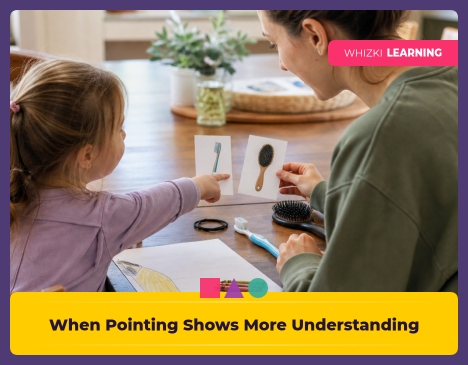
When your kindergartner knows exactly which snack was requested but will only point while Grandma waits for words, accept the point and try a two-choice show-me question today: hold up a banana and crackers, say the two names, and let a point, reach, word, or home-language answer count. Pointing can be a real bilingual response, especially when understanding is ahead of spoken words. A calm adult can learn a lot by watching what a child understands before asking for a perfect sentence.
Reviewed by Whizki Editorial Team, Early Childhood Education Editors.
What pointing can tell you
Receptive language is the understanding side of communication. A child who follows “put the bear in the box” or points to the right shoe is showing receptive language, even when spoken words are quiet or mixed across languages. Expressive language is the output side, including words, signs, gestures, drawings, sounds, and home-language phrases.
Speech-language pathology practice often separates comprehension from production because naming a picture and choosing the picture ask different things from a young child. NAEYC guidance also reminds teachers to honor family language and many ways of communicating during play, conversation, and care routines. A child may understand a request in English, answer in Spanish, and point to settle the moment.
Pointing is information, not misbehavior. A bilingual child may have the idea ready in one language while the mouth is still sorting the other language, the social pressure, or the sound pattern. The adult job is to notice the understanding first, then offer a small model without turning the moment into a speech test.
A five-minute decision tree for today
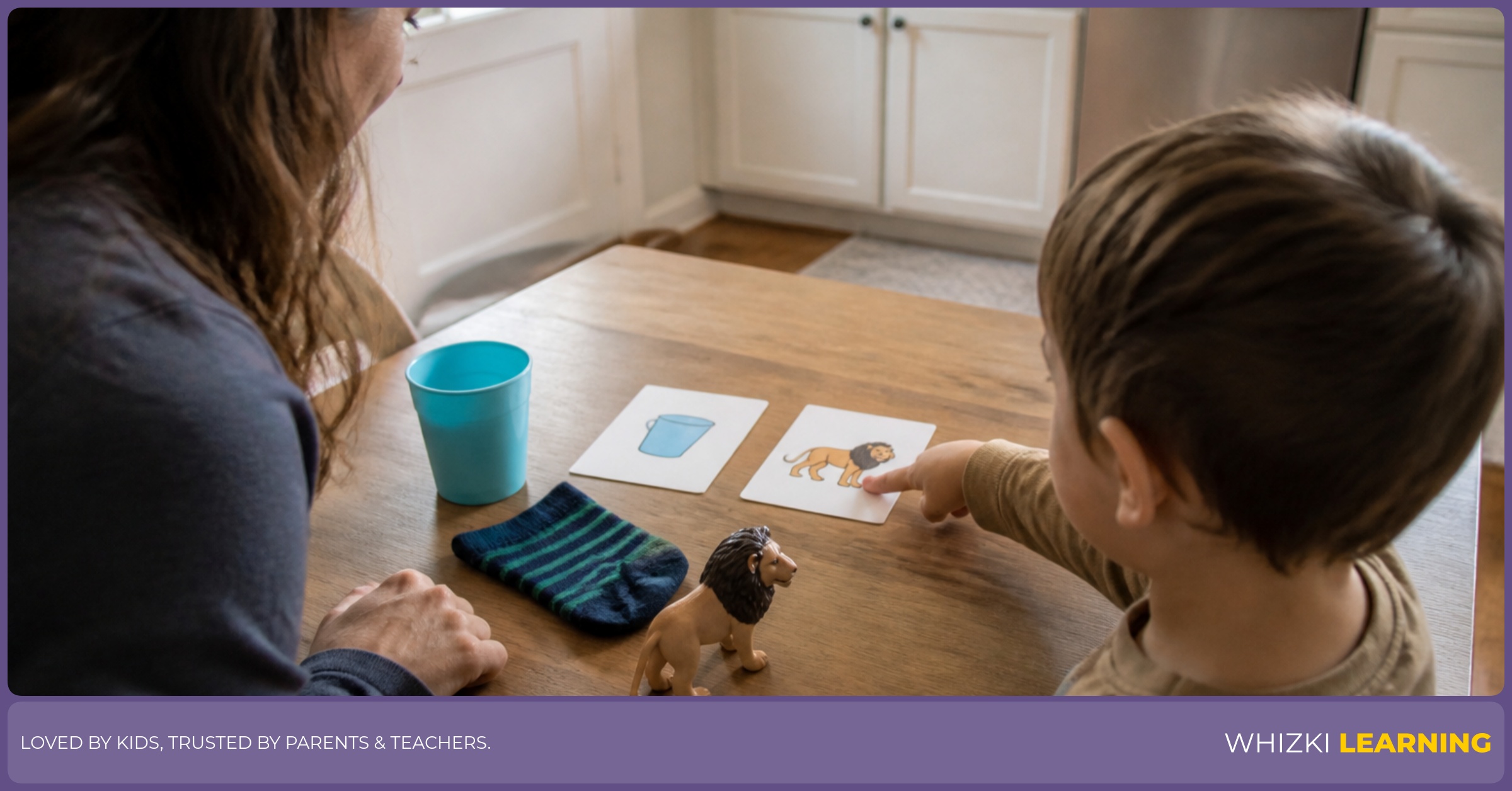
A five-minute decision tree works best with three familiar objects: a cup, sock, and toy animal. Speech-language pathologists often start with meaningful choices because real objects lower memory load and give the child a fair way to show understanding. Place the objects on a table or rug where the child can touch each object easily.
Step one, ask for showing. Put two objects in front of the child and say, “Show me the cup.” Accept a point, reach, gaze, tap, or home-language word as a response. If the child chooses the cup, name the object once and keep the adult voice warm.
Step two, change the response channel. If pointing is easy, ask the child to match the object to a picture, act out “sleep,” draw a quick apple, or answer in the home language. Say the child’s meaning back in both languages when you can, such as “You showed manzana, apple.” The goal is communication plus a model, not a demand for repeat-after-me.
Step three, stop before practice feels stuck. End after six turns or five minutes, even when the game is going well. Young children often show more language when adults leave the door open for later. Families who want to build home labels can use the previous bilingual home guide for a simple picture-dictionary routine.
How to answer without adding pressure
The adult response should tell the child that communication worked before asking for more speech. The Orton-Gillingham approach uses a similar teaching habit in early literacy: separate listening, seeing, saying, and writing so one hard output skill does not hide understanding. Bilingual language practice can follow the same gentle split.
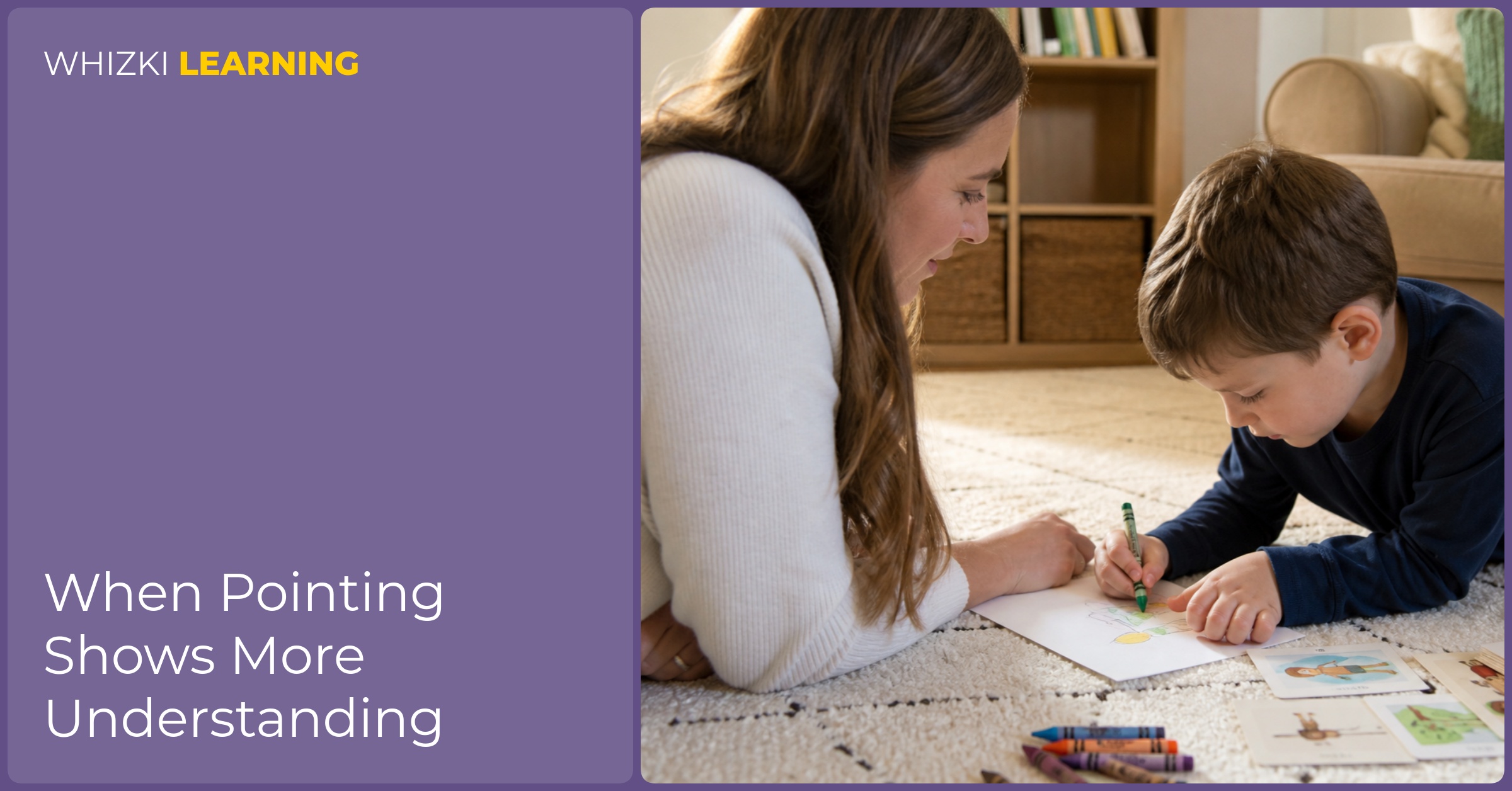
When the child points to the red crayon after “Find red,” say, “Yes, red crayon,” and pause. If the child tries a sound or a word, echo the attempt kindly once. If silence follows, move on to drawing, building, or matching instead of asking again and again.
The adult script can be short: “You showed me the dog. Dog. Perro.” That kind of model gives the child useful language without putting the child onstage. For screen-free picture matching, letter sounds, and number play, use the learning hub as a menu, not as a script.
The picture cards and early literacy pages in the printable library are handy when a parent wants matching, pointing, and drawing choices without making materials at bedtime. Choose one page, cut only the pictures needed, and keep the session under ten minutes.
Age adjustments and honest limits
Age adjustments keep expectations fair for children ages three through seven. Occupational-therapy basics remind adults that pointing, drawing, and cutting depend on body position, hand strength, and a stable place to work. A three- or four-year-old may point, carry an object, or scribble an answer while still showing strong understanding.
For ages five and six, the kindergarten teacher can add matching, sorting, and acting out to the same decision tree. A Reggio-inspired observation lens helps adults document what the child chooses, repeats, avoids, and invents during play. The observation matters more than a pile of completed pages.
For age seven, the adult can invite a fuller response while still accepting a nonverbal answer first. Ask, “Can you show me, draw it, or tell me in either language?” A printable or picture game can support practice, but a printable cannot measure a child’s full language development.
When to ask for qualified guidance
A qualified speech-language pathologist, pediatrician, audiologist, or early-childhood special educator can look at the whole communication picture. Ask for guidance if a child is losing words, rarely responds to familiar voices, seems frustrated by communication often, or has very few ways to communicate in any language. Qualified support is not a label from a stranger, and qualified support can help a family choose the next right step.
Family language should stay in the conversation during any referral or school meeting. NAEYC-aligned early childhood practice values the child’s home language, and speech-language pathology practice looks at all languages the child uses. A provider who understands bilingual development, or works with an interpreter, can give clearer guidance for individual developmental concerns.
Pointing is a bridge between understanding and speech, and a bridge deserves respect. When adults accept pointing, matching, acting, drawing, and home-language responses, children get more chances to show what they know while spoken language keeps growing.