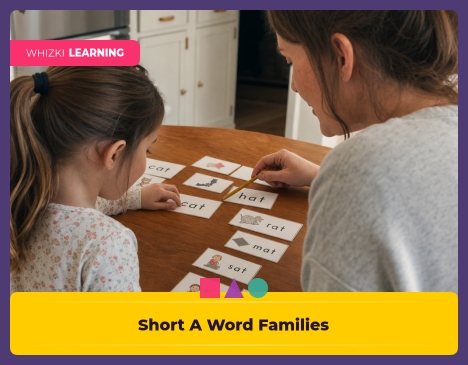
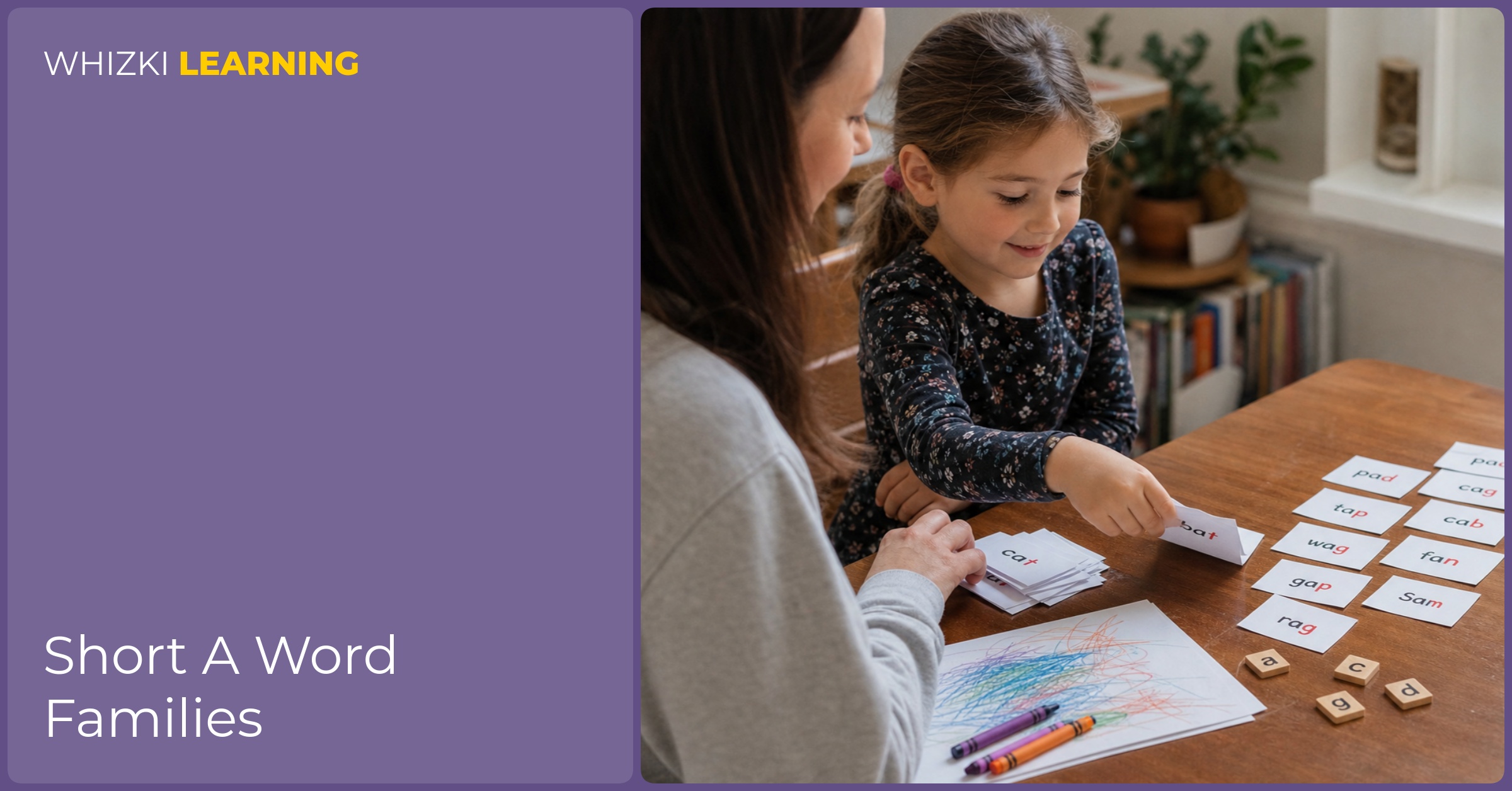
If your child guesses every short A word or freezes at the page, start with one family, slide a finger under each sound, and read five words before adding more. Short A practice feels easier when the vowel stays the same and only one or two consonants change. A small stack of paper word cards on the kitchen table is enough for today's lesson.
Reviewed by Sarah Mitchell, M.S., CCC-SLP, Speech-Language Pathologist.
Why short A word families help new readers
Short A word families give new readers a predictable pattern: the /a/ sound sits in the middle, and the ending chunk carries the rhyme. In the Orton-Gillingham approach, a teacher often keeps one sound pattern steady so the child hears, says, touches, and spells the pattern before moving on. The pattern work is small, and the smallness helps young readers notice what changed.
Word-family practice is different from memorizing a wall of random words. A child who reads one ending has an easier next try, because the mouth and ear already know the rhyme. For a parent-friendly walk-through, read how word families work before printing a full stack.
Short A words also sit inside the larger CVC routine of consonant, vowel, consonant reading. A kindergarten teacher may use word families after a child knows letter sounds but still needs help blending sounds smoothly. If you want the bigger map, keep the full CVC words list nearby and choose only one vowel pattern at a time.
Short A word family reference lists
Short A reference lists are for choosing a handful of words, not for drilling every word in one sitting. Speech-language pathology practice reminds adults to listen for sound awareness first, because clear hearing of the beginning, middle, and ending sounds supports clearer reading. Pick one family, read the words aloud, then invite the child to build two or three words with letter tiles.
Printable practice works best when the child says the sounds, traces the letters, and reads the word on paper. If your child needs mixed review, pair short A cards with our sight-words printables so high-frequency words stay familiar. For hands-on sorting, keep CVC word printables, phonics printables, and alphabet printables in the same reading basket.
The word lists below include mostly simple CVC words, plus a few common short A words with blends or special spelling. An Orton-Gillingham lesson would name those special cases out loud instead of pretending every word follows the same exact pattern. Read the sentence after the child reads the bold word, so the word has meaning right away.
-at word family
- A bat hangs in the dark cave.
- The cat sits by Mia.
- The fat bug crawls slowly.
- My hat fell on the rug.
- The mat is by the door.
- I pat the puppy softly.
- A rat runs under the shelf.
- Nora sat near the window.
- The vat holds soapy water.
- A gnat lands on the leaf.
-an word family
- We ban muddy shoes on the sofa.
- I can hop fast.
- The fan spins above us.
- A man waves from the porch.
- The pan sits on the stove.
- Leo ran to the red gate.
- The tan dog naps outside.
- A van stops by the curb.
- The clan gathers for lunch.
- Please scan the shelf for a book.
-ap word family
- The cap fits my head.
- A book rests on my lap.
- The map shows the park.
- Baby takes a short nap.
- Please tap the drum gently.
- A gap sits between the blocks.
- Sticky sap drips from the tree.
- We clap to the rap beat.
- The bird gives one flap.
- The lid closes with a snap.
-ag word family
- The bag holds three shells.
- We play tag after snack.
- The puppy will wag his tail.
- A red rag wipes the spill.
- The shelf may sag in the middle.
- Do not lag far behind.
- Please do not nag your sister.
- Finn will drag the box closer.
- Rae will brag about her tower.
- The sock has a tiny snag.
-am word family
- I am ready to read.
- The ham is on the plate.
- A ram stands on the hill.
- The yam bakes in foil.
- The dam holds back the stream.
- Sam draws a big sun.
- The clam hides in wet sand.
- Do not slam the door.
- One gram is a tiny amount.
- Please do not cram toys in the bin.
The Short A CVC Word Family Worksheet Set adds cut-and-read cards, picture matching, and one-page family sorts for the patterns in this guide. The complete pack lives in Whizki Plus.
One word-ladder game for short A practice
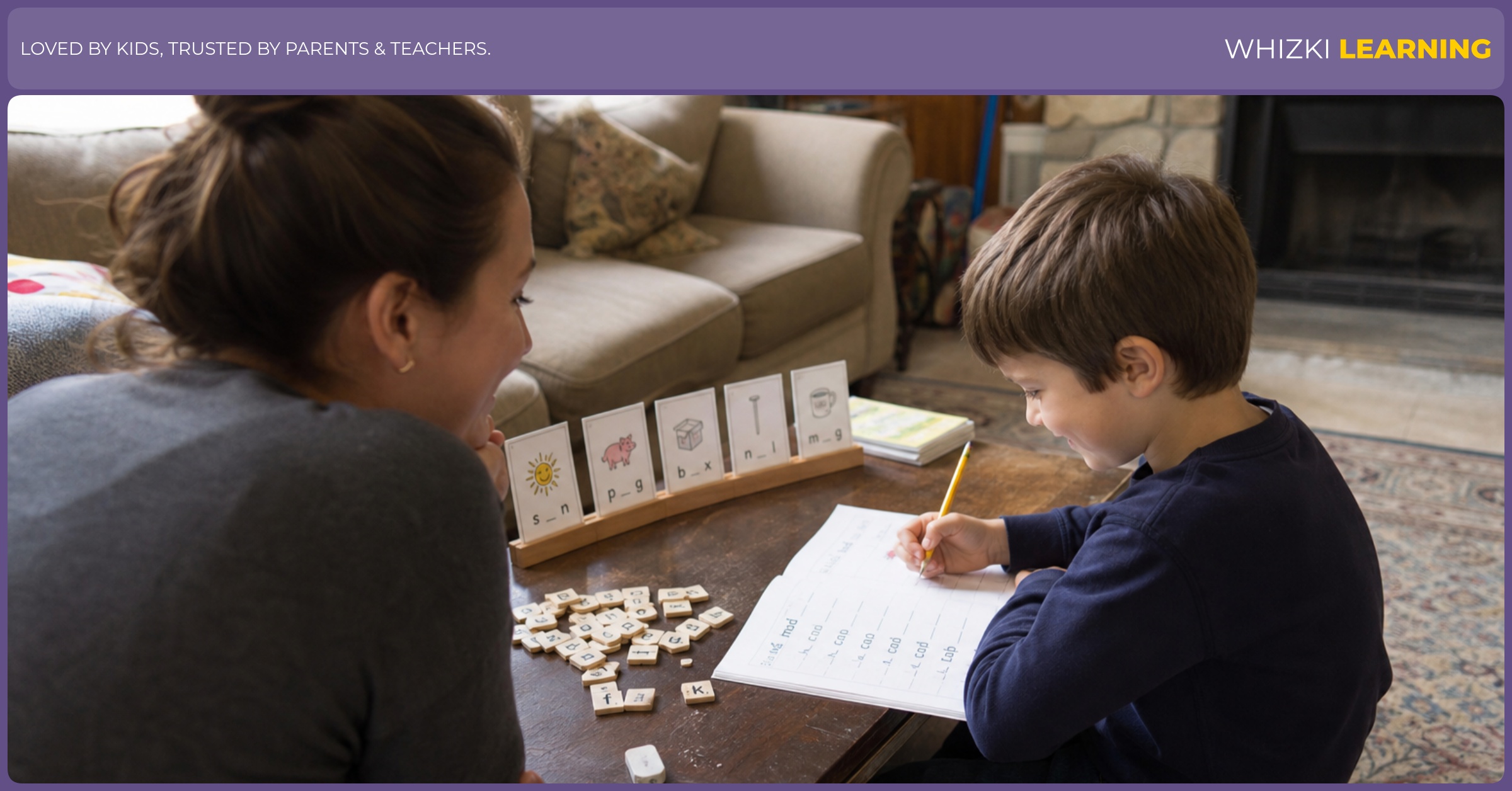
A word ladder turns short A reading into a small puzzle instead of a worksheet battle. Occupational-therapy basics support the hands-on part: moving a card, crossing out one letter, and writing a new letter gives the eyes and fingers a job while the mouth blends. Keep the ladder short, because young readers learn more from a clean six-word round than from a long tired round.
Use six cards in this order: bad, dad, lad, mad, pad, pal. Ask the child to read the first card, then change only one letter for the next card. The adult job is to say, "What sound changed?" and wait long enough for the child to look again.
Montessori and Reggio classrooms often use observation before correction, and the same idea helps at home. Watch whether the child notices the first letter, the vowel, or the ending first. That observation tells you whether tomorrow's practice should use fewer words, larger print, or more sound-by-sound finger tracking.
- Build the ladder with blank cards and write the six words in large lowercase letters.
- Read the first card together, then swap one letter for the next card.
- Celebrate slow sound-by-sound reading before asking for a faster read.
How to practice without pushing too hard
Short A practice should stay short, playful, and predictable for children ages 3 to 7. NAEYC guidance points adults toward developmentally appropriate practice, which means the lesson length should match the child's attention and mood. Five good minutes with three correct blends is better than twenty minutes of sighing and guessing.
Reggio-inspired observation gives adults permission to follow the child's interest during reading practice. A child who loves animals might choose the animal words first, while a child who loves building might read the words and place blocks on matching cards. The adult still guides the sound work, but the child's interest keeps the practice grounded in real play.
Speech-language pathology practice also reminds adults to separate a reading mistake from a speech sound issue. If a child cannot hear the difference between sounds after many playful tries, a speech-language pathologist or reading specialist may help sort out the next step. Parent concern is enough reason to ask a professional, even when the classroom teacher is still watching and waiting.
Short A word families work best when the routine feels simple enough to repeat tomorrow. Choose one ending, read five words, build two words, and stop while the child still feels successful. A calm finish protects the next reading session.
New readers need many small wins before word lists feel easy. Keep the cards visible, keep the voice warm, and let the child see that reading grows one sound at a time.