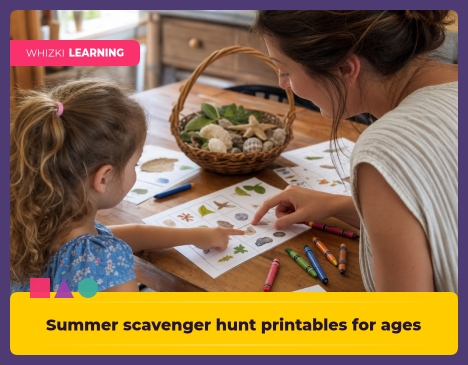
If summer noise, sibling squabbles, or the fifth request for a screen has you counting minutes until bedtime, print one scavenger hunt, hand over a crayon, and send the search to one small place first. A summer hunt works because children ages 3-7 can move, talk, notice, and mark the page without needing a long lesson. The search phrase summer scavenger hunt printable kids often comes from a parent who needs a real next step, and a one-page I-spy sheet is a good place to start.
Reviewed by Whizki Editorial Team, Early Childhood Education Editors.
Choose the right summer hunt for the day
The best summer scavenger hunt printable is the one that matches the day already happening. A backyard page can ask children to find a smooth rock, a yellow flower, a crawling bug, and a shady spot, while a porch I-spy page can work with raindrops, boots, puddles, and bird sounds. NAEYC guidance reminds early-childhood teachers to build from children's real settings, and a home hunt does exactly that.
A neighborhood walk hunt should stay simple enough for a child to carry without constant adult reading. I like picture boxes, big check marks, and one tiny drawing space because preschoolers and kindergartners can show what was found even before handwriting is easy. For ready-to-print pages, our printable library is the place I would send a busy family first.
A summer hunt also fits best when the family has a gentle plan for the week. If mornings are for outside time and afternoons are for quiet table work, the printable does not have to compete with every other activity. The idea pairs well with a weekly summer rhythm because children know when exploring, resting, and making all have a place.
Run the hunt without losing the plot
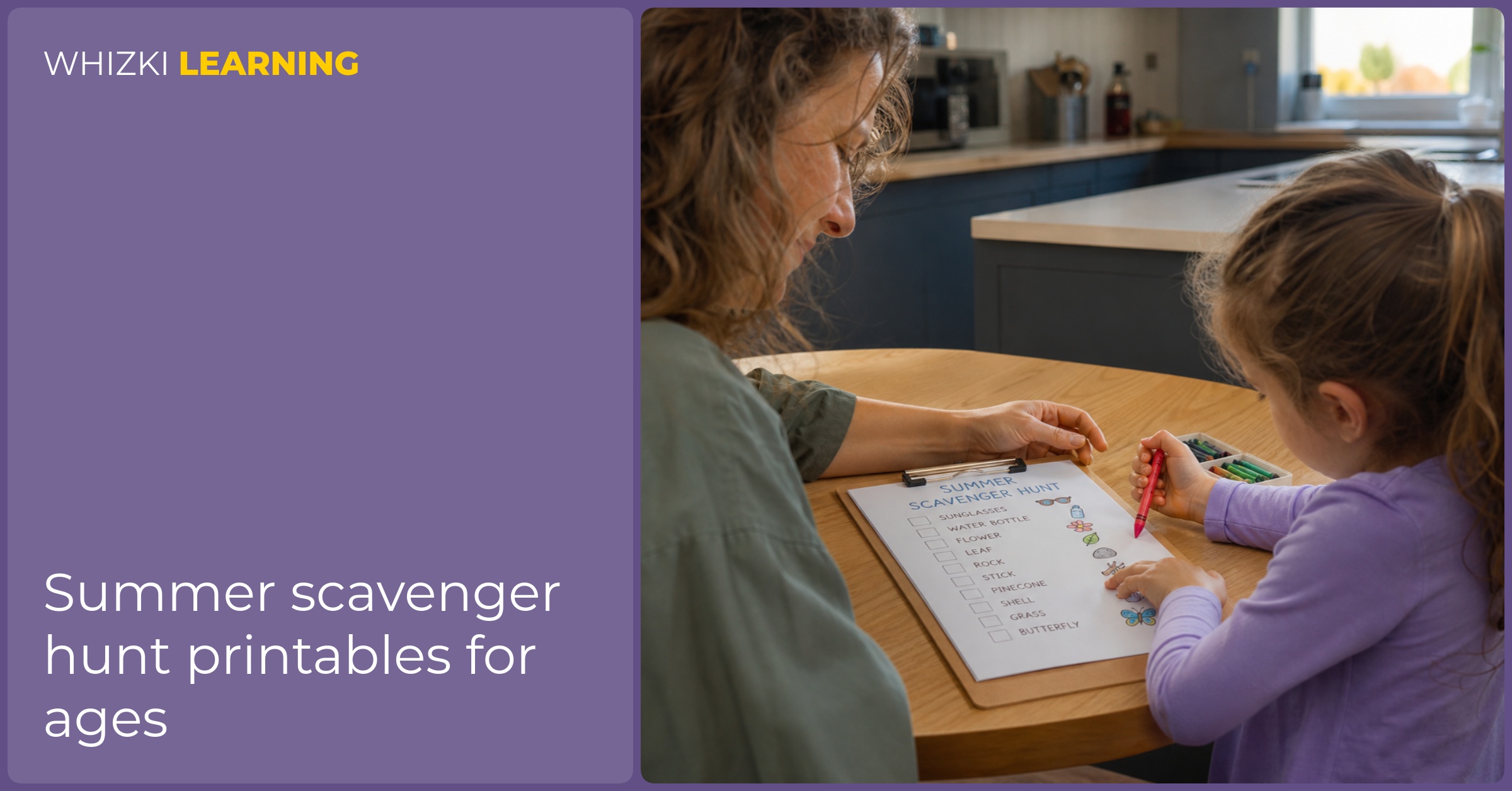
The hunt will go better when the adult gives a small boundary before the paper comes out. The boundary can be, “We are hunting on the porch,” or “We are walking to the corner and back,” because young children need the edge of the game before the choices begin. Occupational-therapy basics call this a good match between task demand and body control, and the right-size space keeps the activity calm.
The adult can read only two boxes at a time for a 3-year-old, while a 6- or 7-year-old can scan the whole page and plan an order. The printable can sit on a clipboard, the child can use a chunky crayon, and the adult can model one check mark rather than correcting every mark. A short hunt with a clear ending usually teaches more than a long hunt that turns into wandering.
The teacher move I use most comes from Reggio-inspired observation: watch what the child notices before adding adult questions. If the child stares at an ant trail for four minutes, the scavenger hunt can pause while the child draws the line of ants in the margin. The worksheet is the invitation, not the boss of the experience.
Four summer versions that work
A backyard hunt should use common items so success does not depend on a perfect yard. A child can search for something rough, something round, something that makes noise, and something that feels warm. Montessori practical-life thinking supports this kind of concrete sorting because the child's hands and senses do real work.
A neighborhood walk hunt should include safety language in plain words. The adult can say, “Feet stop at driveways,” and “Eyes look for cars before the next box,” while the child searches for a mailbox, a fence, a dog leash, or a stop sign. The printable becomes a reason to slow down and notice the block instead of racing to a destination.
A beach or lake hunt needs flexibility because water, wind, and sand change the plan fast. Children can look for a shell, a feather, a bucket, a smooth stone, or a footprint, then draw one favorite find before snack. For families using a premium pack, the Summer Skills Review set in our worksheet sets can sit beside the hunt for a short table follow-up after outside play.
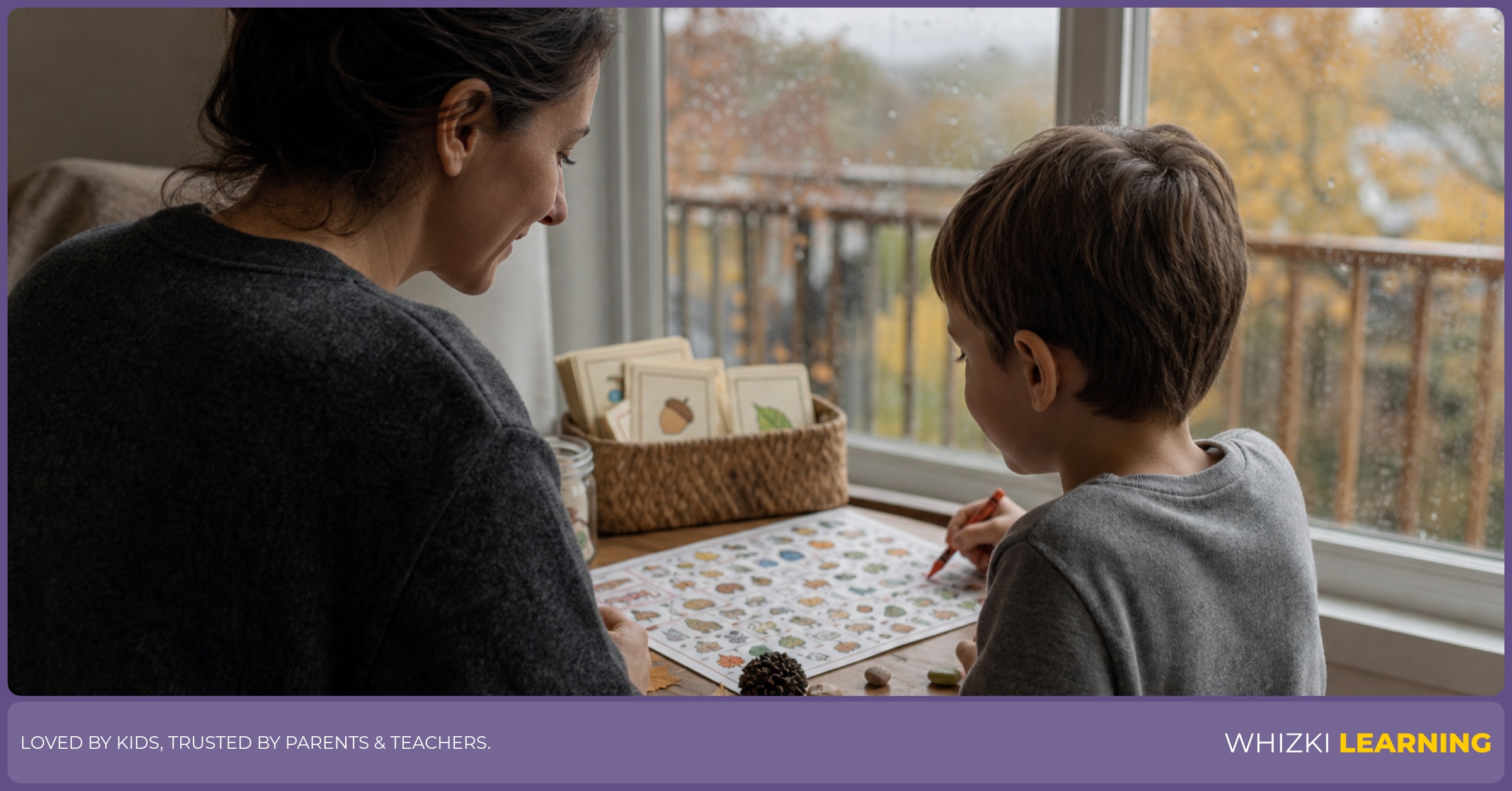
A rainy-porch I-spy page can save a day that feels stuck inside. Children can count window drops, find a dark cloud, listen for thunder, spot an umbrella, or compare wet and dry leaves. NAEYC's play-based guidance fits here too because the child is still investigating real materials, just from a smaller space.
Turn the hunt into letter and number practice
The easiest literacy layer is to pick one sound before the hunt begins. An Orton-Gillingham approach keeps sound, symbol, and touch together, so the child can say /s/, trace S in the air, and then search for sun, sandal, shell, or sidewalk. If the child is ready for a printed match, the letter S learning page can turn one favorite find into a short sound practice after the hunt.
The number layer should stay concrete for ages 3-7. A child can count five leaves, circle five shells, or put five pebbles beside the number on the paper, then touch each object while counting out loud. If the number needs a visual anchor, the number 5 learning page gives the child a simple bridge from real objects to a written numeral.
Speech-language practice can fit inside the same page without turning the hunt into a quiz. The adult can ask, “What did you find?” “Where was the feather?” and “What else looked shiny?” because describing, locating, and comparing build oral language. The adult should accept short answers and add one richer sentence back, such as, “The feather was under the chair, and the tip looked soft.”
Print, store, and repeat without making a mess
A printable summer pack works best when the pages live where the real day happens. Keep three copies on a fridge clip, one in the stroller pocket, and one in a beach bag with a short crayon. The occupational-therapy rule of thumb is to reduce setup friction, because a child can begin sooner when materials are visible and reachable.
Laminating is optional, but a plastic sleeve can make one page reusable with a dry-erase marker. A reusable page helps children repeat the same hunt and notice new details, which is very normal for preschool and kindergarten learning. Repetition is not boring to young children when the place, weather, and conversation keep changing.
A small finish routine matters as much as the start. The child can choose one box to tell about, draw one extra detail, or place one found object in a bowl for a few minutes of sorting. Montessori and Reggio classrooms both value the child's return to the work, and a two-minute share gives the hunt a clear ending.
For families who prefer paper that is already bound and ready for a bag, our printed workbooks make summer table time easy to keep nearby. The summer hunt pages pair well with crayons, a clipboard, and a small basket for found objects. The complete pack lives in Plus.
A summer scavenger hunt does not need to be fancy to be useful. The printable gives the child a reason to look closely, move with purpose, and talk about the world right in front of the family. Print one page, choose one small place, and let the first hunt be short enough that everybody wants another turn.