If your child can name igloo and insect but goes blank when asked for an I action word, pick one verb, act the verb with your whole body, and say the word out loud together. Action words stick faster when little hands, feet, and voices join the lesson. In my preschool and kindergarten work, I use short movement routines because young children learn language best when the word feels useful right away.
Reviewed by Whizki Editorial Team, Early Childhood Education Editors.
How to teach I verbs with movement
The Orton-Gillingham approach asks children to connect sound, sight, speech, and movement, and I verbs are perfect for that kind of practice. The letter I can make a short sound as in itch and a long sound as in ice, so the child needs to hear the word before tracing or reading the word. For a quick sound warm-up, keep our letter I learning page nearby and say the sound before the action.
The NAEYC guideline for young children is simple: play is serious learning, and vocabulary practice should feel like a real activity. The occupational-therapy rule I lean on is just as practical, big body movement before tiny pencil movement helps many children settle into print. A child can inch across the rug, then point to the printed word, then try one careful trace with less fuss.
Body actions that start with I
Body actions are the best first stop because the child can feel the verb right away. Occupational-therapy practice often starts with gross-motor movement before tabletop work, especially for children who wiggle, press hard, or avoid pencils. Speech-language practice also favors verbs children can act, because a moving word is easier to use in a sentence.
Inch: Inch under the table. Itch: Itch your elbow gently. Inhale: Inhale like smelling soup. Imitate: Imitate a sleepy cat. Inspect: Inspect your clean hands. Invite: Invite Nana to hop. Body verbs work best when the adult does the action first and the child copies the same short sentence.
Include: Include Teddy in line. Ignore: Ignore the silly noise. Interrupt: Interrupt with excuse me. Introduce: Introduce your favorite toy. Interlace: Interlace your fingers slowly. Intertwine: Intertwine two pipe cleaners. Social verbs need a gentle tone, so model the polite version before asking the child to perform the action.
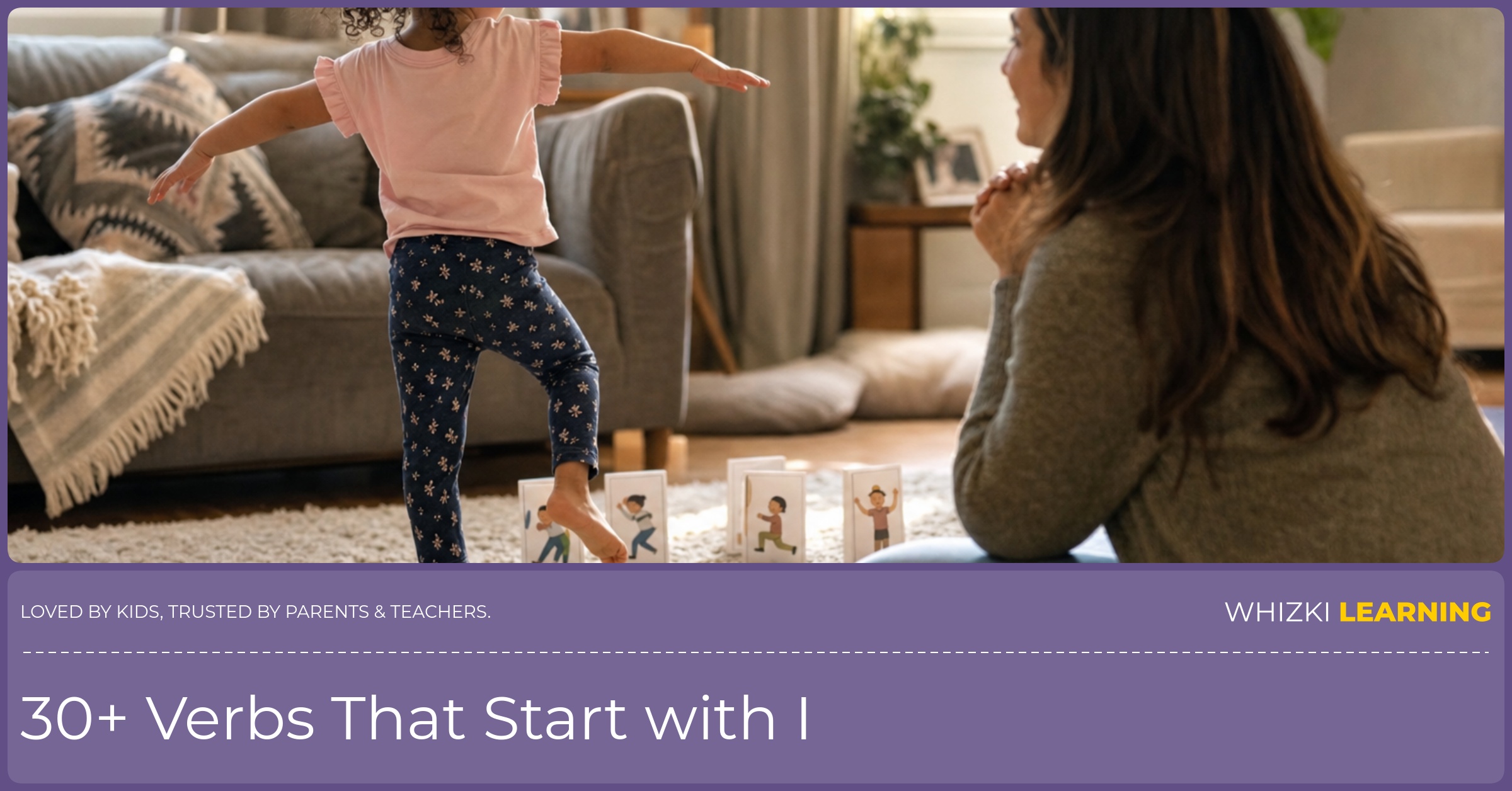
Print the matching action-word page from our sight-words printables and tape the page to the wall at child height. During breakfast or clean-up, ask the child to choose one I verb, act the word, and trace the first letter with one finger.
Household actions that start with I
Household verbs matter because children learn language during real routines, not just during lesson time. Montessori practical-life work and Reggio observation both treat pouring, wiping, sorting, and helping as meaningful language moments. A kitchen-table I word becomes easier to remember when the child has actually done the job.
Ice: Ice the pretend cupcake. Inflate: Inflate the beach ball. Insert: Insert socks in drawers. Ink: Ink the stamp pad. Imprint: Imprint stars in dough. Immerse: Immerse cups in water. Household verbs should stay safe, so swap real tools for pretend tools whenever heat, sharp edges, or tiny parts could distract from learning.
Illuminate: Illuminate the blanket fort. Interlock: Interlock the zipper teeth. Invert: Invert the empty cup. Iron: Iron doll clothes safely. The adult can say the verb once, then let the child do the job with hands. The household routine gives the word a purpose, which is exactly why practical-life vocabulary lasts.
Play actions that start with I
Play verbs carry a lot of language because pretend play gives children a reason to speak. In a Reggio-inspired classroom, I watch what children already care about, then add one useful word to the play scene. The NAEYC view of play fits here too, because the child is practicing vocabulary, turn-taking, and story language at the same time.
Imagine: Imagine a tiny dragon. Invent: Invent a silly dance. Illustrate: Illustrate a rain cloud. Improvise: Improvise a puppet song. Impersonate: Impersonate a friendly robot. Investigate: Investigate the leaf pile. Play verbs can sound big to adult ears, but the action sentence keeps each word child-sized.
Interact: Interact with the puppet. Intermix: Intermix red and blue. Ice-skate: Ice-skate across the rug. Instruct: Instruct your teddy bear. Impress: Impress circles in clay. The pretend scene does the teaching, so the adult does not need a long explanation. A child who presses circles into clay will understand impress much faster than a child who only hears a definition.
Act-it-out charades and tracing tip
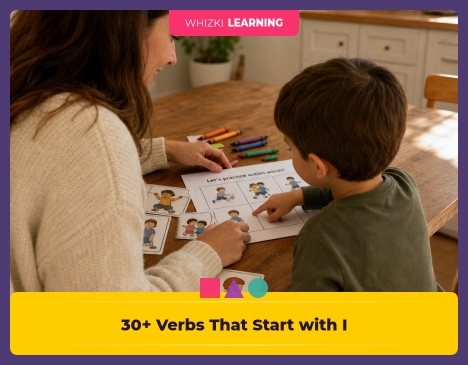
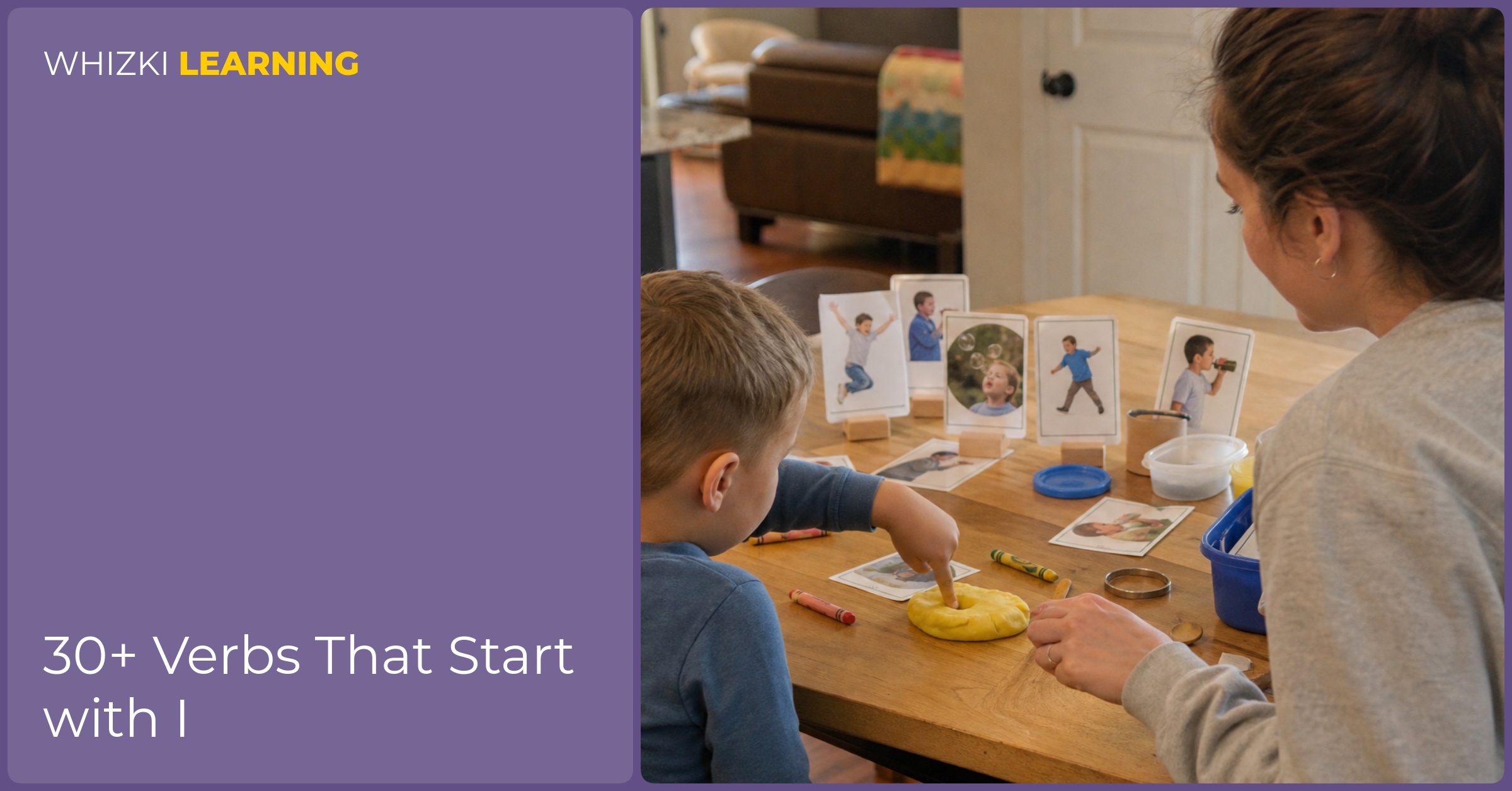
The I verb charades game needs only paper scraps, a crayon, and a few minutes. Write one action word on each card, place the cards face down, and let the child pick a card for the adult to read quietly. The child acts the word while everyone guesses, and the adult repeats the full sentence after the guess.
The tracing tip comes from the same Orton-Gillingham habit I use at my small-group table: say the sound, trace the letter, say the word, do the action. Ask the child to trace the uppercase I from top to bottom, then trace the lowercase i with a slow line and a dot. The occupational-therapy cue is gentle, use two fingers in the air before a pencil if the child grips too tightly.
The adult should keep the charades round short, because early literacy practice works best in small bites. Three cards before lunch is plenty for many 3- to 7-year-olds. A child who wants more can add a drawing on the back of the card and read the action sentence again.
Where I verbs fit with other I words
This post is only about verbs, which means action words a child can do, act, or pretend. For nouns such as igloo, insect, and island, use the separate guide to first words starting with I. For describing words such as itchy or icy, use the guide to describing words starting with I.
The Orton-Gillingham sorting habit is useful here: sort words by job, not by how fancy the word sounds. A verb tells what someone does, a noun names a person, place, thing, or animal, and an adjective describes. The adult can ask, Can I do the word, and the answer helps the child decide whether the I word is an action word.
Speech-language practice often builds sentences by starting with a strong verb, then adding who or what. A parent can say, I inflate, then add the ball, then say the full sentence, I inflate the ball. Short sentence building gives the child grammar practice without turning the kitchen table into a worksheet battle.
Keep I verbs playful, short, and connected to real movement. One acted word at the sink, on the rug, or beside the snack table is enough to grow a stronger reader over time.