
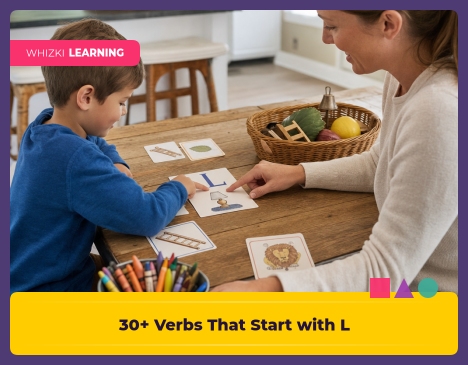
If your child can name a lion but freezes when asked for an L action word, stand up together and act out look, then say the word slowly. Kindergarten vocabulary grows faster when children can move, touch, and hear the word in the same small moment. A two-minute practice round at the kitchen table is enough for today.
Reviewed by Whizki Editorial Team, Early Childhood Education Editors.
How to teach L action words
L verbs are action words that begin with the /l/ sound, such as laugh, lift, and leap. The Orton-Gillingham approach starts with clear sounds, repeated practice, and multisensory work, so I say the word, stretch the first sound, and ask the child to move right away. A short action makes the word feel useful instead of like a quiz.
This verb list stays with action words only, because nouns and adjectives need a different kind of practice. If a child wants object words like leaf or lamp, use first words starting with L; if a child wants words like little or loud, use describing words starting with L. For letter-sound practice, pair the verbs with our letter L learning page, because NAEYC guidance favors playful language work connected to real child interests.
Body actions that start with L
Body action verbs are the easiest L words to teach first because children can feel the word in muscles, balance, and breath. Occupational-therapy basics often use big movement before pencil work, and the same idea helps vocabulary practice feel less tense. I keep the space clear, model one action, and let the child copy without correcting every tiny movement.
In my preschool room, body verbs worked best when the action stayed safe and silly. A child who is not ready to read the full word can still hear the /l/ sound, watch my mouth, and match the movement. Reggio-inspired observation helps here, because the adult watches what the child already enjoys and builds the word practice around that play.
Body L verbs to act out
- Laugh: Laugh with a puppet.
- Lean: Lean on the wall.
- Leap: Leap over the pillow.
- Lift: Lift the empty box.
- Limp: Limp to the chair.
- Listen: Listen for the bell.
- Look: Look under the table.
- Lounge: Lounge on the rug.
- Lunge: Lunge toward the cone.
- Lie: Lie beside your teddy.
- Lower: Lower your hands slowly.
- Land: Land on two feet.
- Lick: Lick the pretend cone.
Household actions that start with L
Household action verbs make vocabulary practice fit into the day you already have. Montessori practical-life work and Reggio classroom routines both treat chores as real learning, not filler. A child can label, load, and line up objects while hearing the L sound in a meaningful job.
Household verbs also help children understand that reading belongs in the coat area, the snack space, and the laundry basket. NAEYC guidance encourages language in familiar routines because children learn words best when the word answers a real need. Keep the job small, because a three-year-old can lay napkins for one table spot and a kindergartener can load a whole basket.
Household L verbs to act out
- Label: Label your cubby card.
- Latch: Latch the toy gate.
- Lay: Lay socks in pairs.
- Load: Load blocks into baskets.
- Lock: Lock the treasure box.
- Loosen: Loosen the jar lid.
- Lug: Lug the laundry bag.
- Line: Line cups on the shelf.
- Lather: Lather soap between fingers.
- Ladle: Ladle water into bowls.
- Layer: Layer napkins on plates.
For a mid-routine helper, print our sight-words printables and tape one L action page near the coat hooks or kitchen wall. A taped page lets a caregiver point to label, load, and line while a child is already moving through the routine.
Play actions that start with L
Play action verbs give children a reason to repeat words without feeling drilled. Reggio practice takes pretend play seriously, so a paper rocket, yarn loop, or doll bed can carry real vocabulary work. The adult can narrate the child action with one clear sentence, then pause for the child to try the word.
Speech-language pathology practice often pairs a short phrase with an object and an action, because the child hears the word in a complete meaning. A teacher might say, “Lace the shoe,” while the child touches the cardboard shoe and string. Keep the example sentence short, because a young child needs room to move and talk.
Play L verbs to act out
- Lace: Lace the cardboard shoe.
- Launch: Launch the paper rocket.
- Lead: Lead the toy parade.
- Lend: Lend Sam a crayon.
- Link: Link the chain pieces.
- Loop: Loop yarn around pegs.
- Lob: Lob the soft ball.
- Lasso: Lasso the stuffed horse.
- Lull: Lull the doll gently.
- Like: Like the funny puppet.
- Let: Let the car roll.
- Love: Love your soft bear.
Act-it-out L verb charades game
The L verb charades game turns the word list into movement, laughter, and listening. Speech-language pathology practice often uses imitation before independent speech, so the adult can act first and the child can guess. A quiet child may point to the printed word, whisper the word, or copy the action instead of speaking right away.
A kindergarten teacher can run the game with a small group, and a parent can run the same game with two sticky notes after dinner. NAEYC guidance supports playful turn-taking because children practice self-control while using language. Keep turns brief, and stop while the child still wants one more round.
- Write six favorite L verbs on small cards.
- Place the cards face down in a basket.
- Choose one card and act without talking.
- Let the guesser say the action word.
- Switch roles after every correct guess.
Trace-the-word tip for L verbs
The trace-the-word tip is simple: write one L verb in large lowercase letters, let the child trace the word with two fingers, then let the child act out the word. Orton-Gillingham lessons often connect sound, sight, touch, and movement, and a traced action word gives all four channels a small job. Say the /l/ sound first, say the whole word second, and do the action third.
Occupational-therapy basics remind adults to watch pencil grip, wrist comfort, and fatigue before asking for more writing. A preschool child can trace in sand, shaving cream, or crayon first, while a kindergartener can trace a dotted word and copy the word once. Stop after one good word if the child starts pressing too hard or rushing.
L verbs become easier when the word leaves the page and enters the room. Pick three action words for today, act each word once, and let the child choose the funniest word for tomorrow.