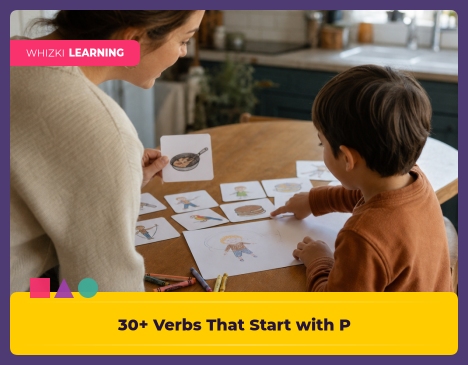
When a young reader is wiggly, hungry, or tired, a long vocabulary lesson can turn into a standoff; choose one P action word, say the word, act the word together, and stop while the child still feels successful. P verbs work well for ages 3 to 7 because children can connect the /p/ sound with a real movement, which is how many preschool and kindergarten brains hold onto new words.
Reviewed by Whizki Editorial Team, Early Childhood Education Editors.
Why P action words help early readers
Action words starting with P give children a body hook for the letter sound. In Orton-Gillingham lessons, teachers often pair a sound, a mouth movement, and a hand motion because multisensory practice makes a new spelling pattern easier to remember.
The letter P is a strong, quick sound, so children can feel the little puff of air when saying pat, push, or pop. For a slower letter routine, pair these verbs with our letter P learning page and ask the child to notice how the lips press together before the sound comes out.
This guide stays with verbs, which are action words a child can do. If your child wants object words, use first words starting with P, and if your child is ready to talk about color, size, or feeling words, use describing words starting with P instead.
Body actions that start with P
Body action verbs are often the easiest P words to teach because the child can move first and talk second. Occupational-therapy basics remind adults to watch body position, balance, and hand strength, so keep movements gentle and give plenty of floor space.
Speech-language pathologists often use imitation before expecting a child to produce a word alone. The adult can model one P verb, the child can copy the action, and the pair can say the word together in a playful voice.
Body P verbs to act out
- Pat. Pat the soft pillow.
- Push. Push the chair gently.
- Pull. Pull the wagon back.
- Point. Point at the door.
- Poke. Poke the play dough.
- Peek. Peek behind the curtain.
- Pout. Pout like a teddy.
- Puff. Puff your cheeks out.
- Pant. Pant like a puppy.
- Pedal. Pedal your toy bike.
- Perch. Perch on the step.
- Pose. Pose like a statue.
- Prance. Prance across the rug.
- Paddle. Paddle in the air.
Household actions that start with P
Household P verbs fit nicely into real routines because the child already has a reason to move. Montessori practice values purposeful work, and a child who packs, pours, or places something can hear the word while doing a meaningful job.
NAEYC guidance reminds teachers and parents to keep early literacy connected to play, conversation, and daily life. A grown-up can say one sentence from the list during cleanup or snack time, then let the child repeat the action without turning the routine into a quiz.
Household P verbs to act out
- Pack. Pack the lunch bag.
- Pick. Pick up socks.
- Place. Place cups on table.
- Pour. Pour water slowly.
- Peel. Peel a banana.
- Plant. Plant one seed.
- Polish. Polish the spoon.
- Press. Press the towel flat.
- Pinch. Pinch the clothespin open.
- Pump. Pump soap once.
- Put. Put blocks away.
- Pass. Pass the napkin.
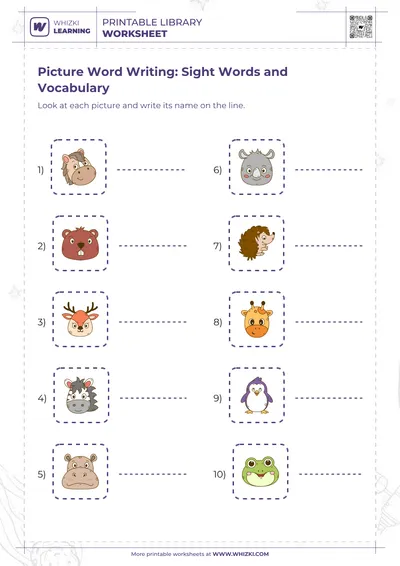
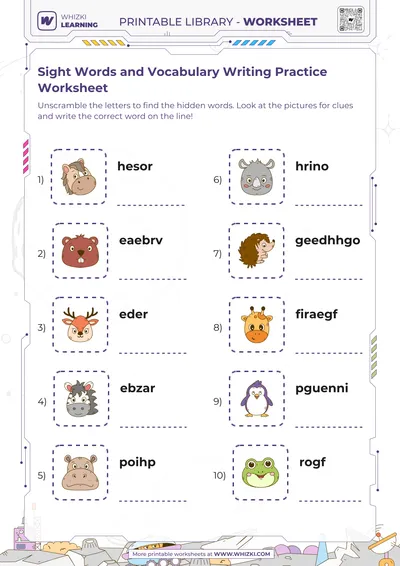
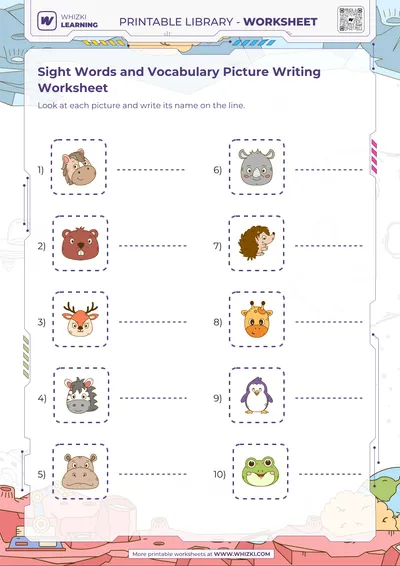
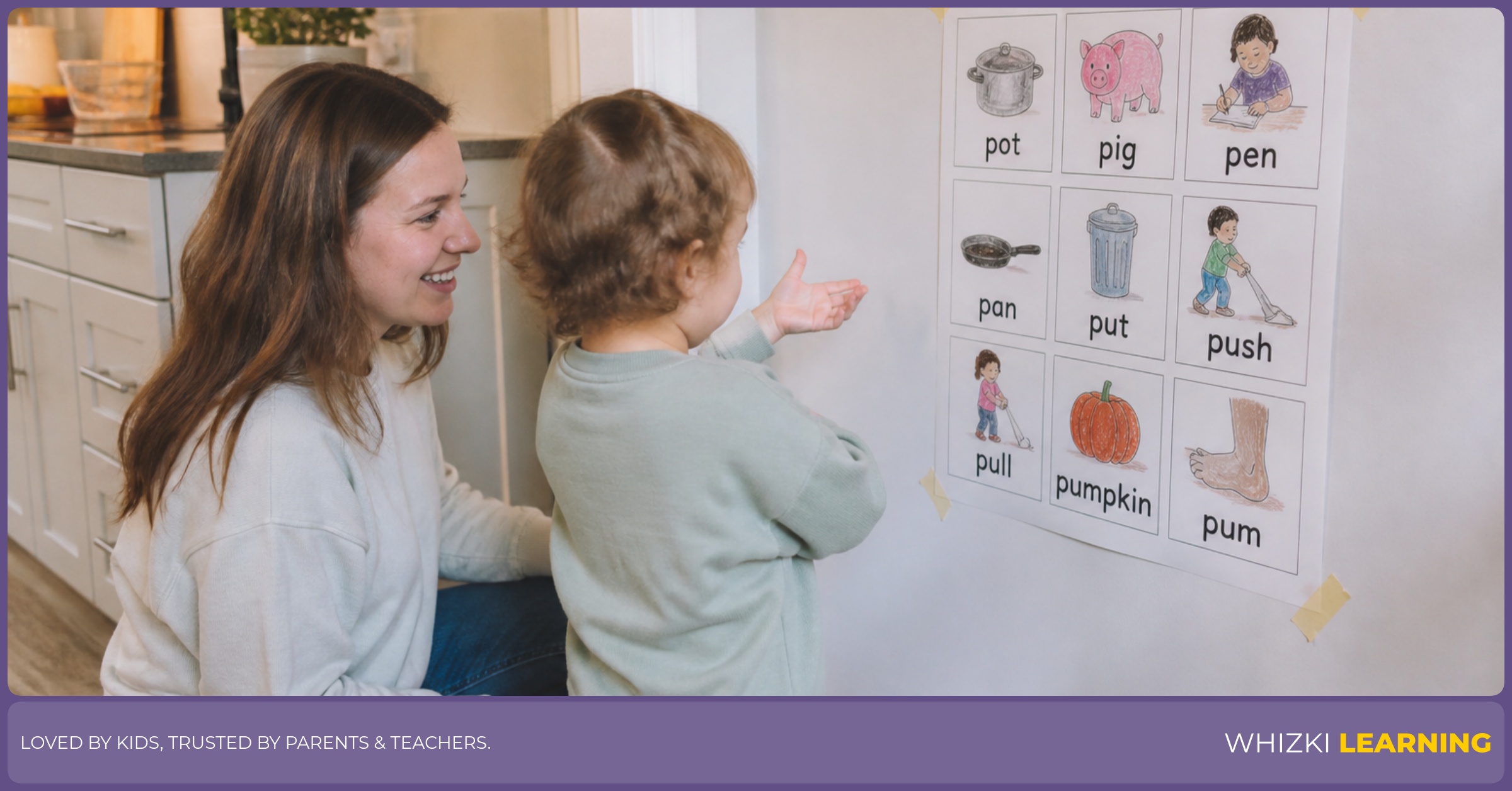
For a mid-routine helper, print the P verb page from our sight-words printables and tape the page near the coat hooks, breakfast spot, or play shelf. A posted page gives a child a quick point-and-act choice while an adult ties shoes, pours cereal, or resets the room.
Play actions that start with P
Play P verbs feel natural because the child can use toys, art supplies, pillows, or outdoor bubbles. Reggio-inspired teaching treats the child's play as useful information, so watch which actions bring a smile and repeat those words first.
Kindergarten teachers often get better word recall when a verb is tied to a prop. Keep the prop simple, such as a beanbag, paper plate, toy truck, puppet, or cushion, so the word stays more important than the stuff.
Play P verbs to act out
- Paint. Paint a paper plate.
- Paste. Paste one purple square.
- Pretend. Pretend to be pirates.
- Play. Play with puppet friends.
- Pop. Pop bubbles outside.
- Pound. Pound clay with fists.
- Pile. Pile pillows high.
- Parade. Parade around the couch.
- Pounce. Pounce on the cushion.
- Park. Park the toy truck.
- Print. Print paw stamps.
- Pitch. Pitch a beanbag softly.
Easy P verb routines: charades and tracing
A simple P verb charades game takes five minutes and needs only paper scraps. Write six P verbs from one group, let the child choose a card without showing the word, and have the child act while the adult guesses with warm, silly guesses.
The charades game works best when the adult models the first round. In speech-language practice, modeling lowers the pressure on expressive language, and the child gets to see the word, hear the word, and move the body before naming the action.
A trace-the-word tip is to write one P verb in large lowercase letters, then have the child trace the word with a finger before using a crayon or pencil. Occupational-therapy handwriting basics favor big movements before small pencil work, so a cookie sheet with sand, a chalkboard, or a wide marker can be a better first step than a tiny worksheet box.
The tracing routine should stay short and concrete. Say, "Trace pack, then pack one sock," because the written word and the real action belong together in a young child's mind.
P verbs are most useful when the action word lands inside real life, not in a long drill. Pick three favorite verbs for the week, tape the printable where the routine happens, and celebrate clear effort over perfect reading. A child who can act, say, and trace one word has already built a strong early-literacy connection.