
Telling Time Practice Pack printable worksheet set cover Pro

Telling Time Practice Pack

Reading a clock asks children to coordinate two hands and two number scales. This pack provides practice with analog and digital times, including hours and five-minute intervals. Look through the previews to choose between reading a clock, drawing its hands, and working out a later time.

Some pages show an analog clock and ask for the time in digits. Others supply a digital time and an empty clock face. The more demanding pages add a duration in hours and minutes to a starting time, then ask children to write the result or draw it on a 12-hour clock. Choose the response format that matches the clock skill you want to practice.

Begin with the hour hand and explain how its position changes as minutes pass. Count around the minute marks in fives before trying less familiar times. Save the elapsed-time pages for a child who can already read both hands and understands that 60 minutes make an hour. Begin with familiar times and introduce the longer calculations when those are comfortable.

A movable teaching clock can help you model one example before returning to paper. Find other activities in the free printable library, or use the Early Math Essentials set when counting and numeral recognition need more practice. Choose a few clocks at a time and check the reasoning together.

  • 15 printable worksheets
  • Opens with Whizki Pro

Preview every worksheet below.

A plan opens the downloads.
See plan
Telling Time Practice Pack

What is inside

15 worksheets
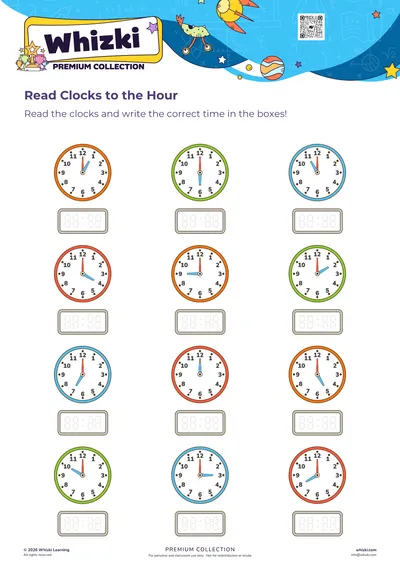
Read Clocks to the Hour
Practice whole hours: read each analog clock and write its time in digits. Use 12 clock examples with adult support for hour-hand and minute-hand reasoning.Read Clocks to the Hour
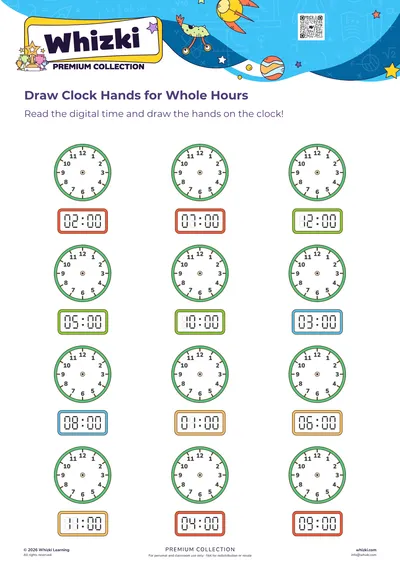
Draw Clock Hands for Whole Hours
Practice whole hours: read each digital time and draw the matching hands on an empty clock face. Use 12 clock examples with adult support for hour-hand and minute-hand reasoning.Draw Clock Hands for Whole Hours
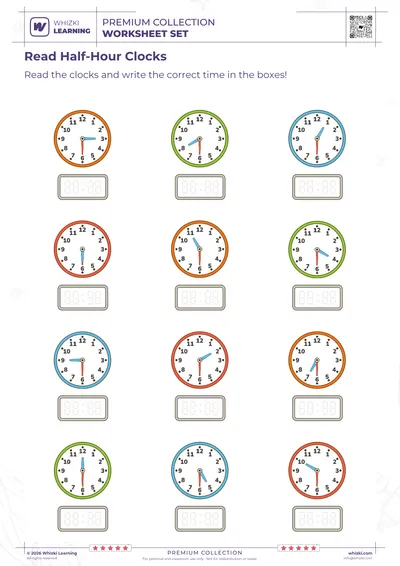
Read Half-Hour Clocks
Practice half-hour times: read each analog clock and write its time in digits. Use 12 clock examples with adult support for hour-hand and minute-hand reasoning.Read Half-Hour Clocks
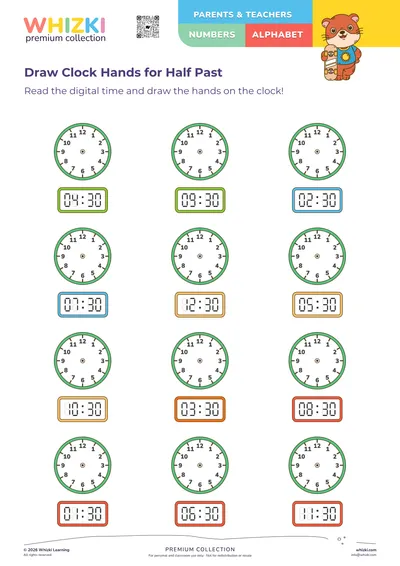
Draw Clock Hands for Half Past
Practice half-hour times: read each digital time and draw the matching hands on an empty clock face. Use 12 clock examples with adult support for hour-hand and minute-hand reasoning.Draw Clock Hands for Half Past
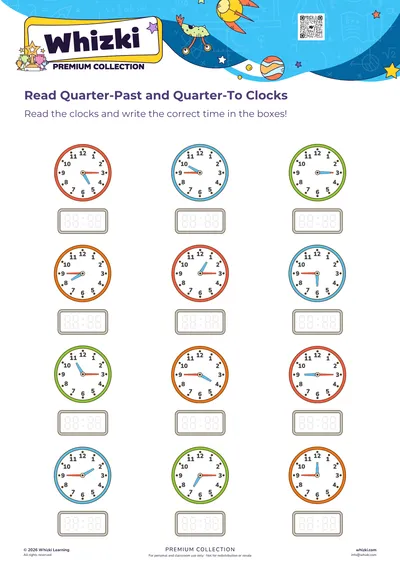
Read Quarter-Past and Quarter-To Clocks
Practice quarter-hour times: read each analog clock and write its time in digits. Use 12 clock examples with adult support for hour-hand and minute-hand reasoning.Read Quarter-Past and Quarter-To Clocks
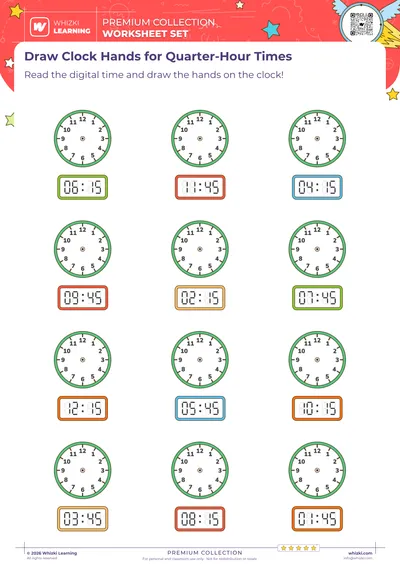
Draw Clock Hands for Quarter-Hour Times
Practice quarter-hour times: read each digital time and draw the matching hands on an empty clock face. Use 12 clock examples with adult support for hour-hand and minute-hand reasoning.Draw Clock Hands for Quarter-Hour Times
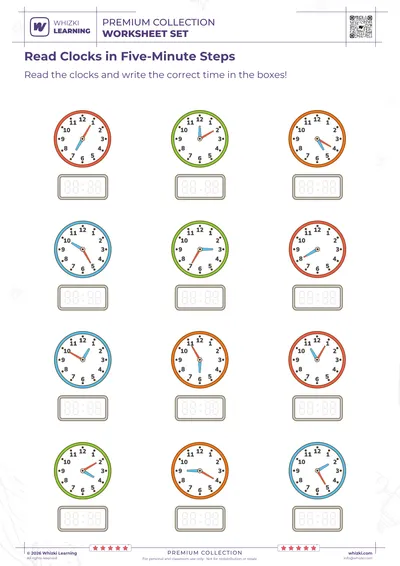
Read Clocks in Five-Minute Steps
Practice five-minute times: read each analog clock and write its time in digits. Use 12 clock examples with adult support for hour-hand and minute-hand reasoning.Read Clocks in Five-Minute Steps
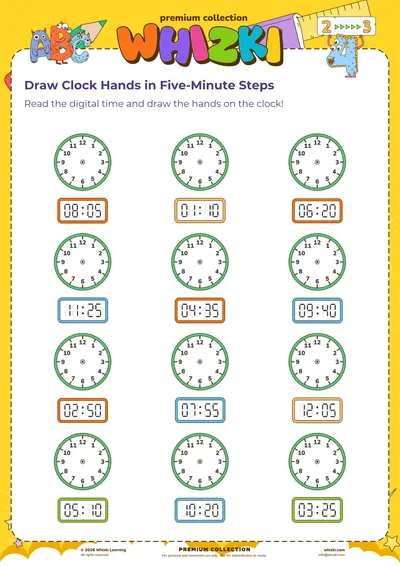
Draw Clock Hands in Five-Minute Steps
Practice five-minute times: read each digital time and draw the matching hands on an empty clock face. Use 12 clock examples with adult support for hour-hand and minute-hand reasoning.Draw Clock Hands in Five-Minute Steps
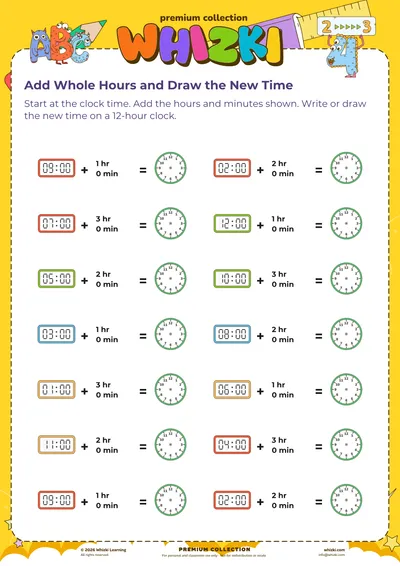
Add Whole Hours and Draw the New Time
Practice adding whole hours: add the stated duration to each starting clock time and draw the hands for the new time. Use 14 clock examples with adult support for hour-hand and minute-hand reasoning.Add Whole Hours and Draw the New Time
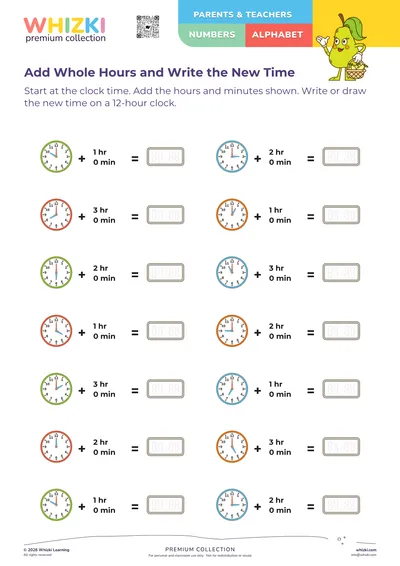
Add Whole Hours and Write the New Time
Practice adding whole hours: add the stated duration to each starting clock time and write in digits the new time. Use 14 clock examples with adult support for hour-hand and minute-hand reasoning.Add Whole Hours and Write the New Time
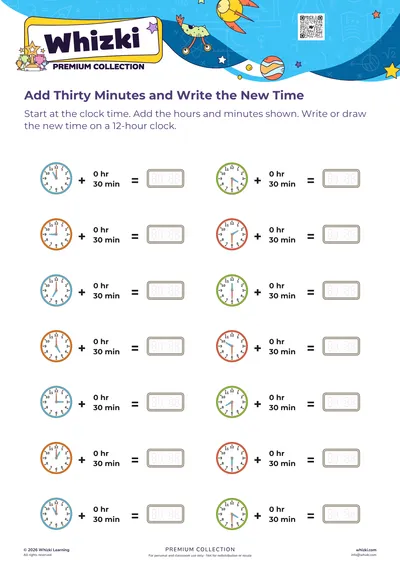
Add Thirty Minutes and Write the New Time
Practice adding thirty minutes: add the stated duration to each starting clock time and write in digits the new time. Use 14 clock examples with adult support for hour-hand and minute-hand reasoning.Add Thirty Minutes and Write the New Time
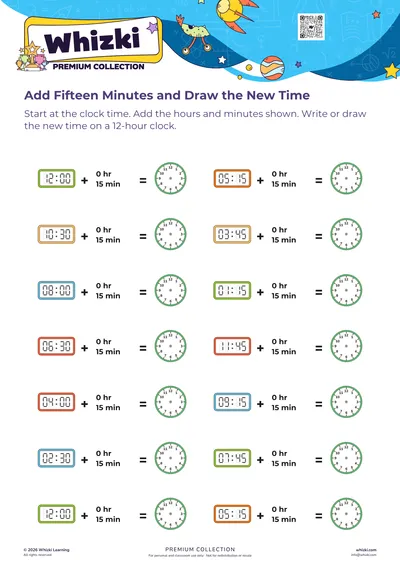
Add Fifteen Minutes and Draw the New Time
Practice adding fifteen minutes: add the stated duration to each starting clock time and draw the hands for the new time. Use 14 clock examples with adult support for hour-hand and minute-hand reasoning.Add Fifteen Minutes and Draw the New Time
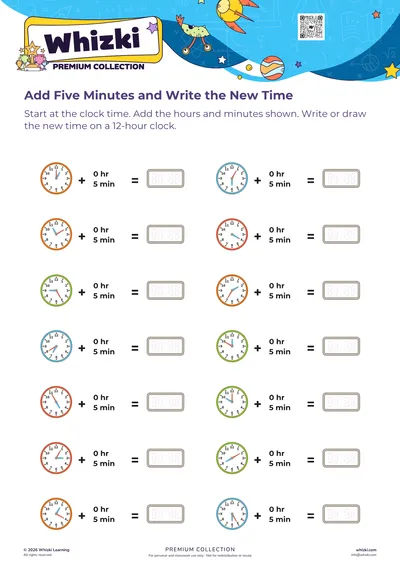
Add Five Minutes and Write the New Time
Practice adding five minutes: add the stated duration to each starting clock time and write in digits the new time. Use 14 clock examples with adult support for hour-hand and minute-hand reasoning.Add Five Minutes and Write the New Time
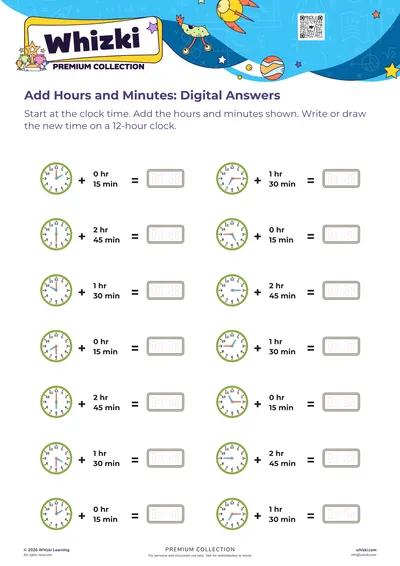
Add Hours and Minutes: Digital Answers
Practice adding hours and quarter-hour durations: add the stated duration to each starting clock time and write in digits the new time. Use 14 clock examples with adult support for hour-hand and minute-hand reasoning.Add Hours and Minutes: Digital Answers
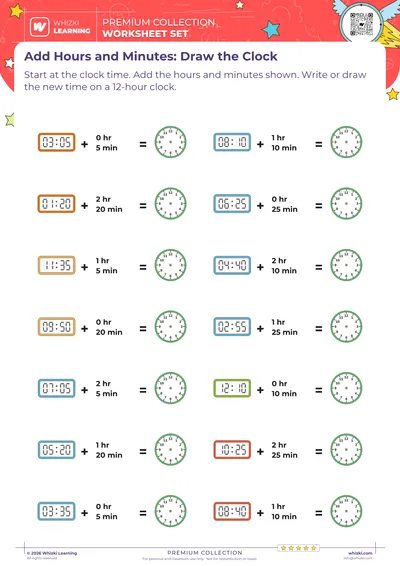
Add Hours and Minutes: Draw the Clock
Practice adding hours and five-minute durations: add the stated duration to each starting clock time and draw the hands for the new time. Use 14 clock examples with adult support for hour-hand and minute-hand reasoning.Add Hours and Minutes: Draw the Clock

Plan a little more practice

Pick a page from the time and money worksheets. Free PDFs need a free account to download. You can also explore number explanations.

For a ready-made set of related activities:

Addition and Subtraction Pack

Addition and subtraction become easier to discuss when children can connect symbols with quantities. This pack combines picture arithmetic, number equations, short story problems, and making-ten activities. It also includes counting and comparison pages that can support a child who needs more practice before working with equations. The previews show several distinct formats. Some pages ask for a sum or difference, some compare two quantities, and picture-value puzzles ask children to infer a hidden value from clues. Choose a page that practices the operation you are working on, and introduce the picture-value puzzles after familiar equations feel manageable. Choose a task based on its number range and reasoning demand. Let a child model an equation with counters, explain what a story says happened, or check a comparison by counting. Picture-value puzzles can involve larger totals and several reasoning steps, so they may be a later choice even when their illustrations look playful. Return to Early Math Essentials when quantities and numerals need more work. For arithmetic involving measurement units, explore the Measurement Workshop set . Work through one example together, then ask your child to explain a method on the next instead of relying only on a written answer.
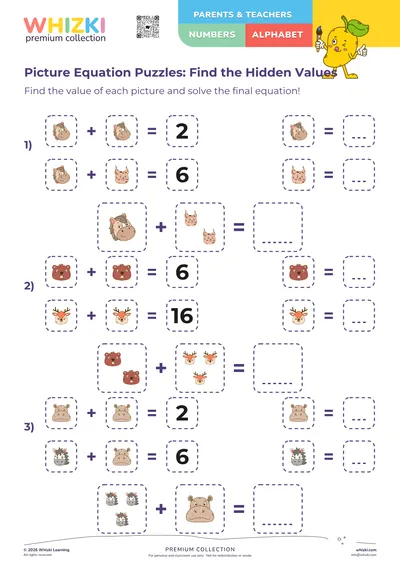
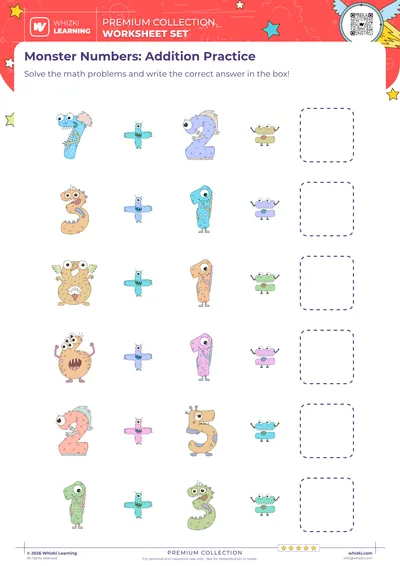
Picture Equation Puzzles: Find the Hidden ValuesMonster Numbers: Addition PracticeCount, Match, and Complete Numbers 1–10
Early Math Essentials

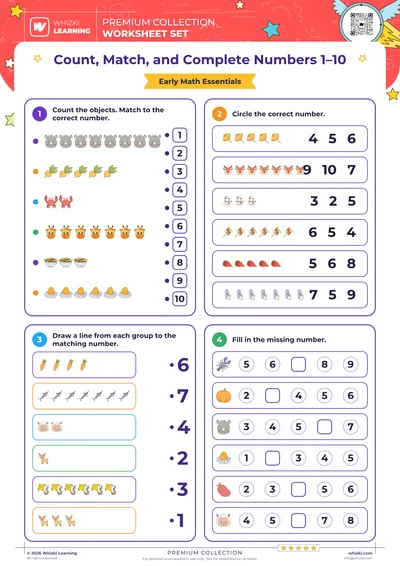
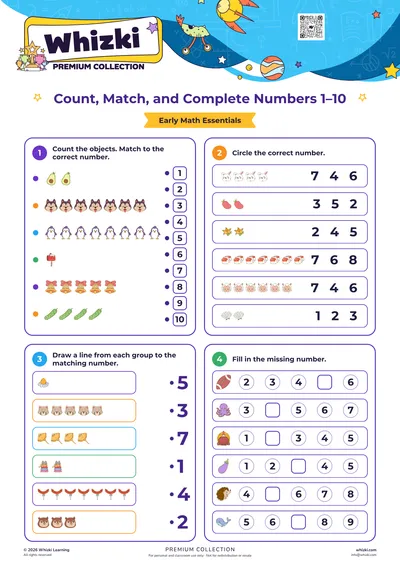
A child can count familiar objects before written numbers begin to make sense. This collection gives adults several ways to connect quantities with numerals: counting picture groups, choosing or writing a number, tracing numerals, and completing number sequences. Start with a page that matches what your child can already count comfortably. The published collection also includes comparing groups, addition within ten, number names, missing numbers, and introductory place value. These formats ask for different skills. The pages are choices for practice rather than a lesson sequence in which every worksheet is easier than the next. Model counting by touching each object once and saying that the last number tells how many there are. When a page introduces addition, use counters to show two groups joining. For comparison, check each quantity before choosing a symbol. Save tens-and-ones work for a child ready to connect grouped objects with a two-digit numeral. The number reference library can help explain a particular numeral. When your child is ready for more arithmetic, explore the Addition and Subtraction Pack . A few careful examples are enough for one sitting; use the rest when another short practice opportunity comes along.

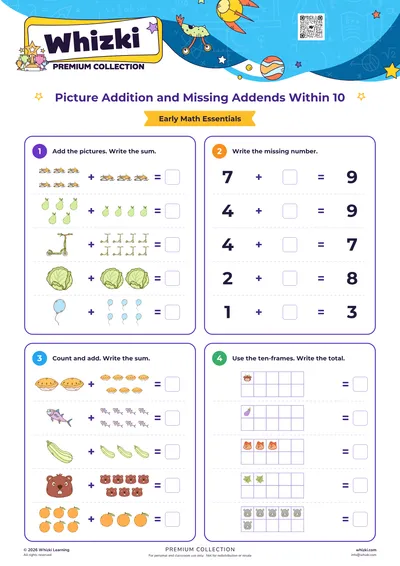
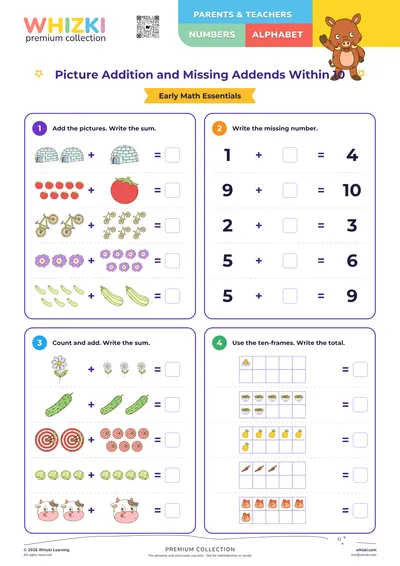
Count, Match, and Complete Numbers 1–10Picture Addition and Missing Addends Within 10Picture Addition and Missing Addends Within 10
Halloween Learning Activities Pack

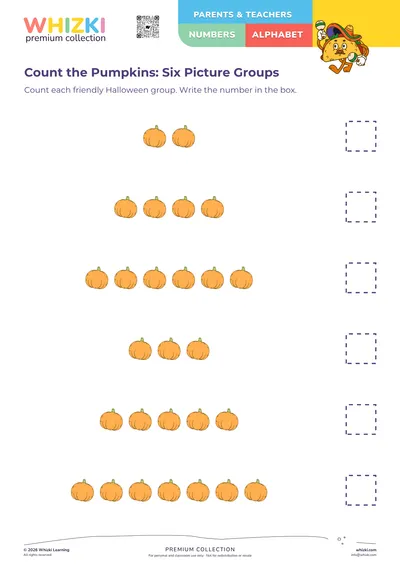
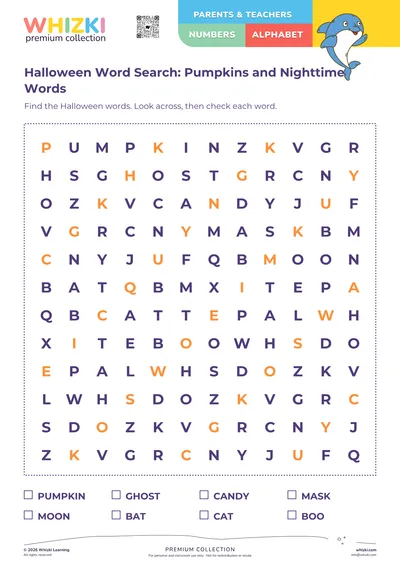
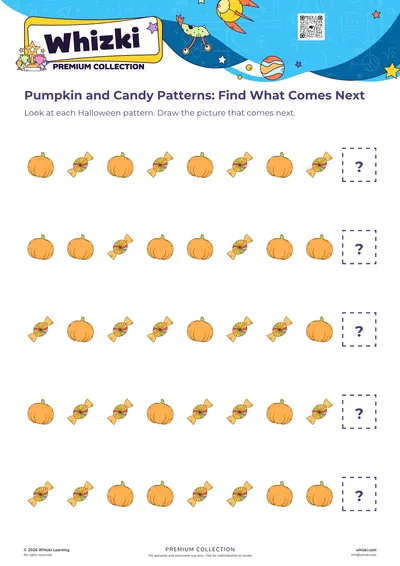
Halloween themes can give a familiar practice task a reason to come back to the table. This collection uses pumpkins, candy, and friendly seasonal pictures in counting, word-search, pattern, and handwriting activities. Choose the format your child is ready to use rather than expecting the theme to make every task equally easy. The counting pages ask children to attend to objects and quantities. Word searches use a printed bank of Halloween vocabulary, pattern pages ask what repeats or comes next, and handwriting pages provide words to trace and write. Check the actual preview for the words, number range, or pattern rule on that page. An adult can read the directions and name unfamiliar seasonal words. For a word search, model matching the first letter and checking the remaining letters in order. For a pattern, say the repeating unit aloud. A child who is ready to count objects may still need substantial help reading a longer word such as costume. Use Early Math Essentials for more counting practice beyond the theme. The Spelling and Word Building Pack provides other word activities. Print a single page for a short seasonal session, or choose several suitable activities from the published collection.

Count the Pumpkins: Six Picture GroupsHalloween Word Search: Pumpkins and Nighttime WordsPumpkin and Candy Patterns: Find What Comes Next

Save the worksheet on its page, or add an activity to your learning planner for another day. Compare Free, Plus, and Pro if you need more saved materials or planning tools.

Instant download

Your sets are ready the moment a plan starts. Open one, download the PDF, and you can be printing within the minute.

Made by teachers

Every worksheet is built and checked by early-childhood educators, so the practice is sound and the pages stay friendly for small hands.

Print again and again

Download a set once and print it as often as you like, for one child at the kitchen table or a whole classroom.

Screen-free practice

Every page is pencil and paper. The sets are made for calm, hands-on time well away from a screen.

Secure checkout

Billing runs through Creem with encrypted checkout, and you can cancel from your account whenever you want.

Frequently asked questions

FAQ

Everything you need to know.

GENERAL

How many worksheets are in Telling Time Practice Pack?

This published set currently contains 15 downloadable worksheets. Each individual worksheet is one printable page. The previews above show the available activities.

Which plan gives access to this set?

This set requires Pro. Pro includes published Plus and Pro sets, expanded planner tools, unlimited bookmarks,.

Can I try a worksheet without a paid subscription?

Yes. Individual worksheets marked FREE in the printable library are available with a free account. Download one to try, save a favorite, or add it to your planner. This set is a separate subscription resource.

Can I print a downloaded worksheet again?

Yes. You can print your downloaded PDF again for personal or classroom use. Do not re-upload or redistribute the PDF. An active eligible subscription is required to download subscription materials from Whizki.

When should I introduce reading a clock?

Connect time words with familiar routines first. In Common Core grade 1, children learn to tell and write time to the hour and half-hour. Choose a worksheet whose clock intervals match what your child is ready to practice.

Limited-time savings
on Whizki workbooks.

Boost your child’s skills with our discounted workbooks. Engaging activities for preschool, kindergarten, and grade 1 - now at special sale prices!

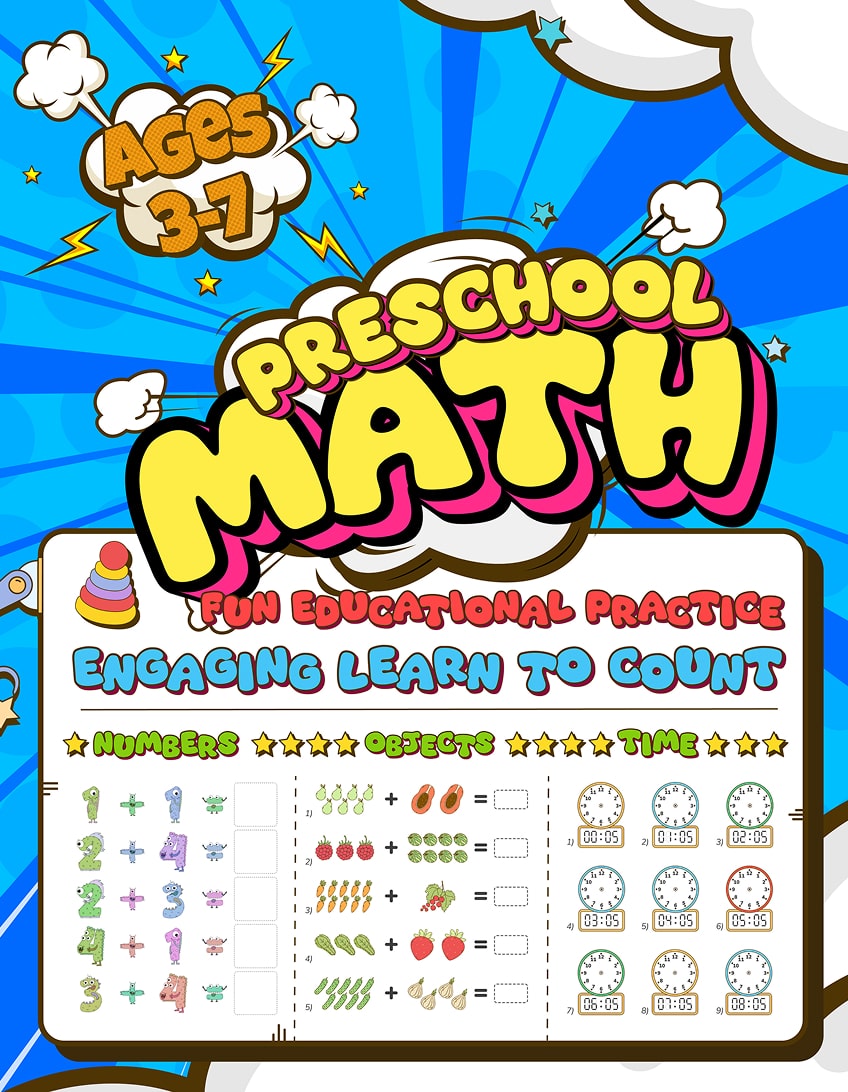
Preschool and Kindergarten Math Workbook Ages 3-7: Numbers... Workbook Cover BackgroundPreschool and Kindergarten Math Workbook Ages 3-7: Numbers, Counting, Shapes, Time, Simple AdditionA long-format early math workbook for ages 3 to 7. Numbers, counting, shapes, telling time, and gentle addition for kids who are still learn...

-40% $8.99

List Price: $14.99
Buy Now
June Summer Learning Workbook for Kindergarten to 1st Grad... Workbook Cover BackgroundJune Summer Learning Workbook for Kindergarten to 1st Grade: Math, Reading, Writing, Science, Brain QuestsA workbook for the slow weeks of June. Reading, math, writing, science, and brain quests for kids stepping from kindergarten into 1st grade.

-27% $10.99

List Price: $14.99
Buy Now
Sight Words and Word Search Workbook for Kids Ages 5-7: Pr... Workbook Cover BackgroundSight Words and Word Search Workbook for Kids Ages 5-7: Pre-K, Kindergarten, 1st Grade ReadingA sight words and word search workbook for ages 5 to 7. Themed puzzles, sentence-building, and trace-and-write practice for early independen...

-40% $8.99

List Price: $14.99
Buy Now
Summer Brain Activities Workbook for Preschool and Kinderg... Workbook Cover BackgroundSummer Brain Activities Workbook for Preschool and Kindergarten: Coloring, Logic Puzzles, Brain Quests, Social StudiesA summer thinking workbook for ages 4 to 6. Coloring, logic puzzles, brain quests, and short social studies activities for the slow afternoo...

-45% $10.99

List Price: $19.99
Buy Now

Join the Screen-Free Movement.

Get exclusive activities, expert tips, and inspiration for a more meaningful, offline family life.

Enter your email address to receive Whizki learning ideas.

Copyright © 2025 - 2026 Whizki Learning. All rights reserved.

Sign in to add to your planner

Sign in or create your FREE Whizki Learning account to plan activities with this worksheet set. After sign-in, choose a learner and a day in your learning planner.

Open with Whizki Pro

Subscribe to Whizki Pro to download the Telling Time Practice Pack pack and the rest of the library. Already have an account? Sign in.