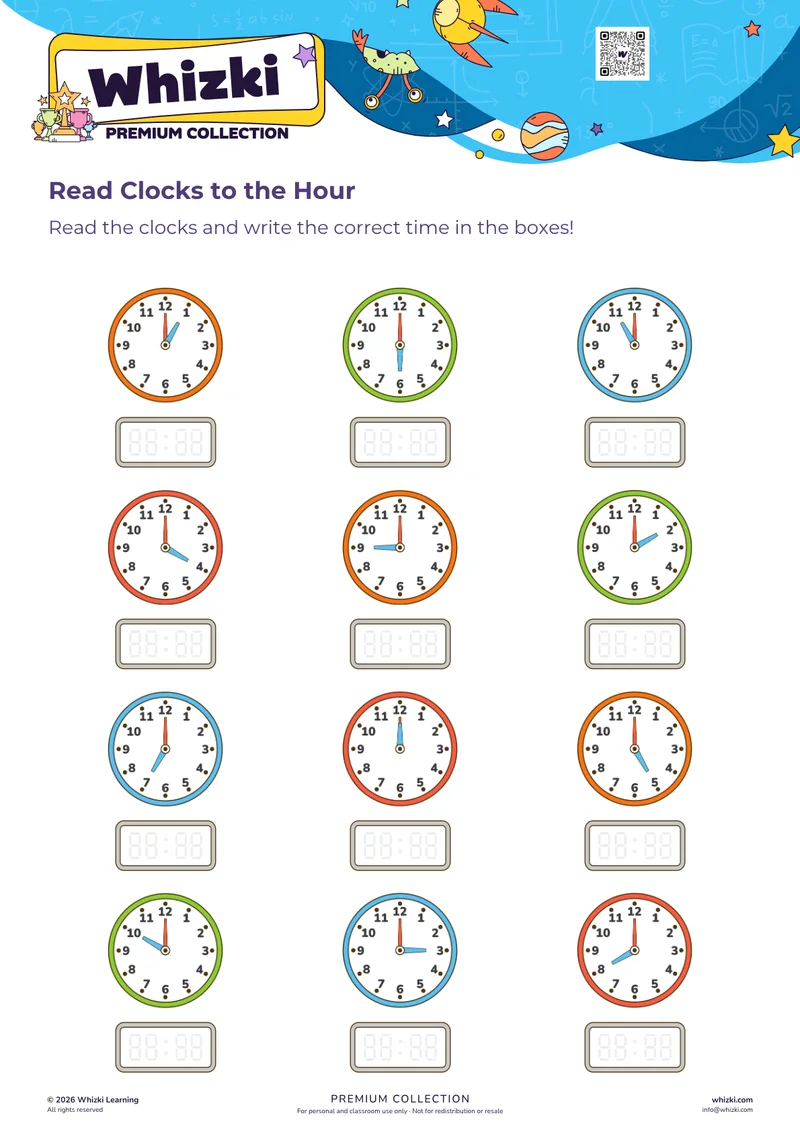
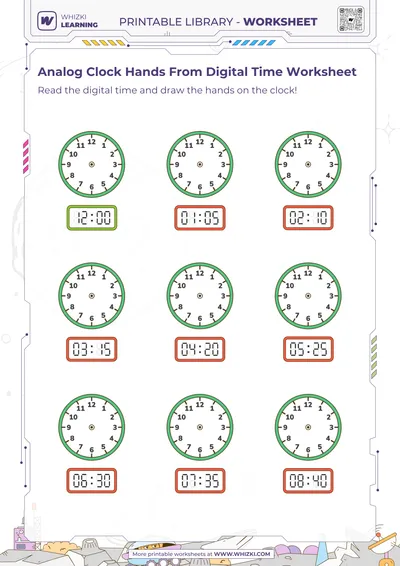
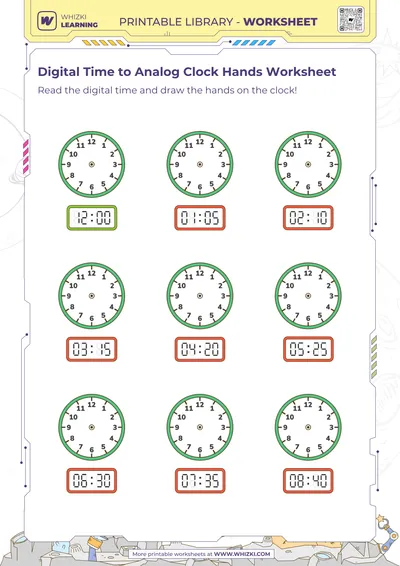
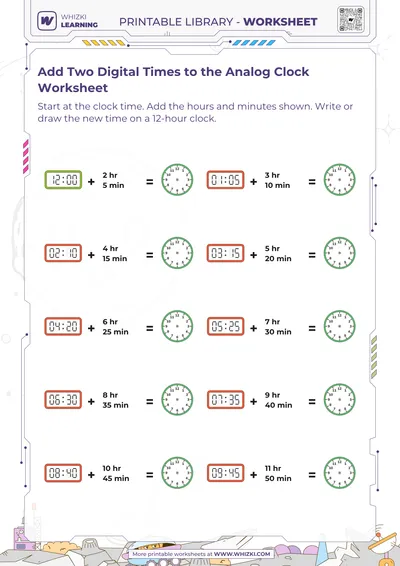
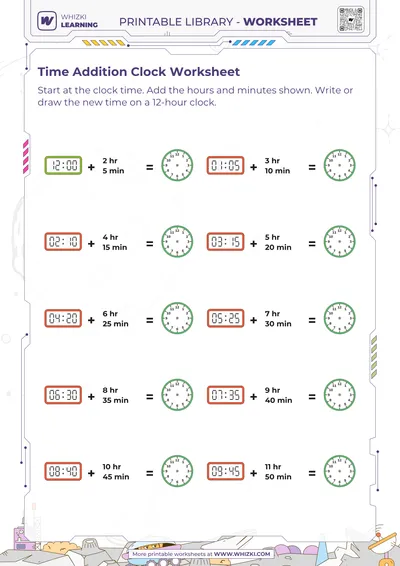
Interpret the hour and minute information in whole hours, using the two clock hands or the supplied digital notation.
Connect whole hours on a clock face with the corresponding written hours and minutes, checking both parts of the time.
Record a clock time using hours, a colon, and two minute digits, then check it against the example.

This whole hours worksheet asks children to read each analog clock and write its time in digits. The page contains 12 examples focused on this specific clock skill. Work through one example together before choosing a small group for your child to try, using the printed clock faces and response spaces as the starting point.
Read the hour hand first, then check that the minute hand points to 12. Use a movable teaching clock to model the movement if the relationship between the two hands is unfamiliar. The longer hand shows minutes and the shorter hand shows the hour. Read both together rather than choosing the nearest hour number without checking the minutes.
Choose this page when your child is ready to connect clock hands with written hours and minutes. Name the parts of the clock and model how to check the two hands together. When writing the answer, separate hours and minutes with a colon and use two digits for the minutes. Pause after a few examples to compare the method with the model.
The Telling Time Practice Pack offers other reading, drawing, and elapsed-time activities. If counting steps need more practice, explore Early Math Essentials before returning to clocks. A short check of a real household clock can be a separate follow-up. Match the difficulty to your child's current understanding and leave unused examples for another session.

Boost your child’s skills with our discounted workbooks. Engaging activities for preschool, kindergarten, and grade 1 - now at special sale prices!


Fast shipping
Secure Payment
Licensed Teachers
For the planet
Printed in the USA
Helpful guides for parents and teachers, and tips for making learning at home super fun.

Turn a short walk or window view into a leaf color map that helps children ages 3-7 notice fall changes, compare places, and revisit observations over time.

A warm decision guide for asking how a preschool or kindergarten screening handles testing language, interpretation, observations, and home-language evidence.

Use one familiar snack to build science talk and vocabulary without pressure to taste. This kitchen-table investigation honors allergies, texture needs, and child choice.

Help young children measure with paper clips before a ruler, using equal units, clear endpoints, and quick fixes for gaps, overlaps, and different answers.
Get exclusive activities, expert tips, and inspiration for a more meaningful, offline family life.