Learning Outcomes
Elapsed time on analog clocks → Adding minutes in 5-minute steps → Students correctly calculate end times and record digital times, steadily increasing accuracy and confidence.
Analog start times → Understanding hour and minute roles → Learners read clock faces and write digital times, strengthening connections between analog and digital displays.
Elapsed time on clocks → Visualizing time passing → Children use 'start time + added minutes' problems to picture routines, strengthening planning and scheduling skills.

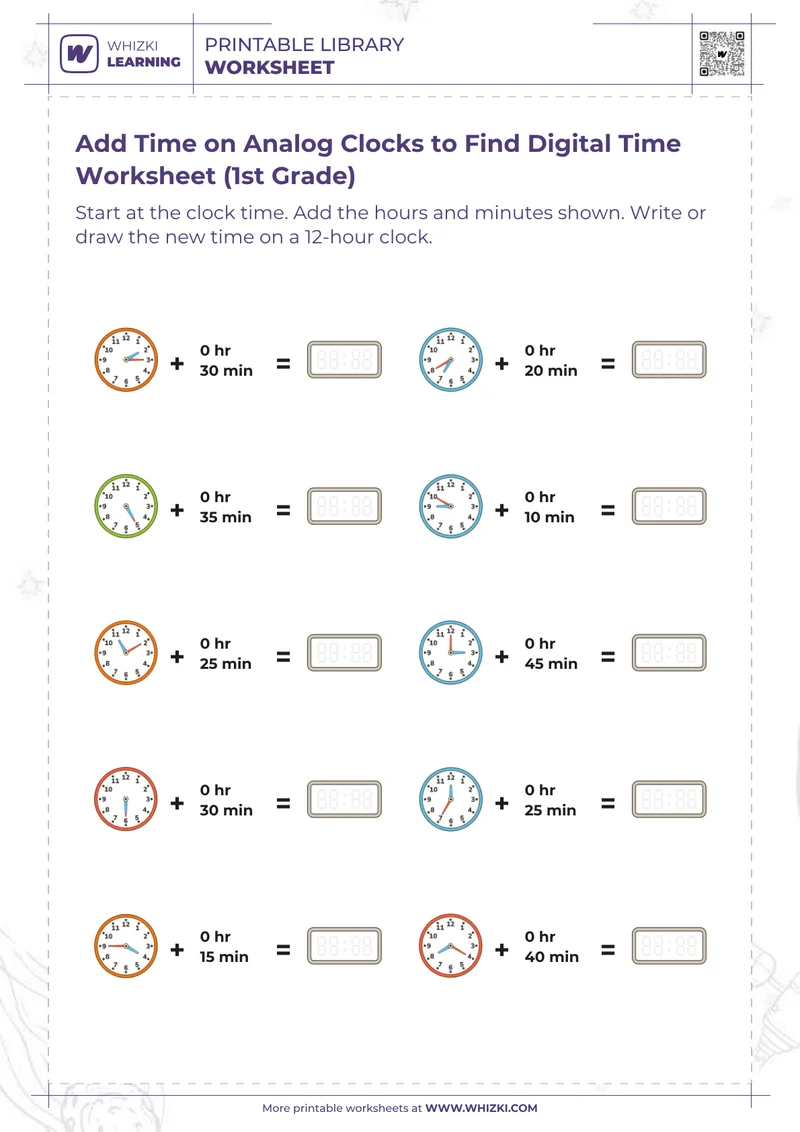
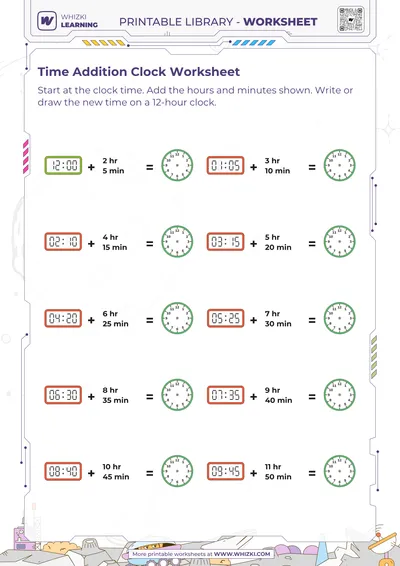
Add Time on Analog Clocks to Find Digital Time Worksheet (1st Grade)
The Add Time on Analog Clocks to Find Digital Time Worksheet (1st Grade) gives children analog start times, asks children to add a set number of minutes, and then record the new time in digital form to practice elapsed time on clocks.
The elapsed time on analog clocks skill matters because children use elapsed time every day for routines like knowing when a show ends or when a lesson finishes, and early practice with adding minutes on clocks builds the foundation for future time word problems and scheduling.
Parents and teachers can use the Add Time on Analog Clocks to Find Digital Time Worksheet by first modeling one problem, talking through “start time plus added minutes equals new time,” then letting children solve independently while covering the digital answer space until children have counted the minutes on the clock or with a number line.
The Whizki Learning elapsed time clock addition worksheet is especially useful because each task uses clear, bold analog clocks, child-friendly minute jumps of 10–45 minutes, and carefully chosen across-the-hour examples, so children must really think about changing both the hour and minutes while still feeling successful.
Limited Time Sale
Kids’ Workbooks!
Boost your child’s skills with our discounted workbooks. Engaging activities for preschool, kindergarten, and grade 1 - now at special sale prices!


Fast shipping
Secure Payment
Licensed Teachers
For the planet
Printed in the USA
Find fresh ideas
To help your little learners grow!
Helpful guides for parents and teachers, and tips for making learning at home super fun.

Parents often struggle to find engaging, screen-free activities for kids while traveling or waiting in line. This tactical playbook provides 15 highly effective letter-sound games that require zero preparation and zero digital devices. Learn how to transform everyday car rides and grocery trips into powerful phonemic awareness lessons using occupational therapist-approved auditory games.
Sunny Hedge
Many early childhood reading programs rely on memorizing 'sight words' using flashcards, but this visual memorization strategy often creates fragile readers. This comprehensive guide compares phonics instruction against rote memorization, explaining the neurological mechanisms behind decoding. Learn why teaching letter sounds builds genuine reading confidence and how to foster a growth mindset in young readers.
Sunny Hedge
Teaching a child to read often creates immense anxiety for parents, leading to frustrating flashcard memorization. This comprehensive guide details a proven, Montessori-inspired phonics method that prioritizes letter sounds over letter names. Learn how screen-free, hands-on learning activities build essential phonemic awareness and prepare preschoolers for fluent reading without academic pressure.
Sunny Hedge
When a child cries at the sight of a pencil, parents must completely stop handwriting practice to prevent long-term academic anxiety. This tactical 7-day guide provides a clinical 'Writing Confidence Reset' designed by early childhood experts. Learn how to rebuild a child's fine motor confidence through screen-free sensory play, vertical drawing, and high-quality printed workbooks without any pressure or shame.
Sunny HedgeJoin the Screen-Free Movement.
Get exclusive activities, expert tips, and inspiration for a more meaningful, offline family life.