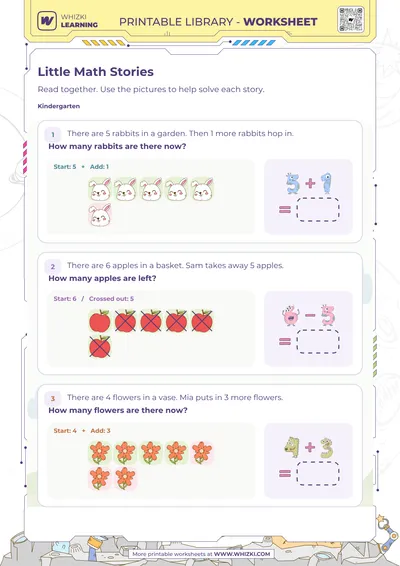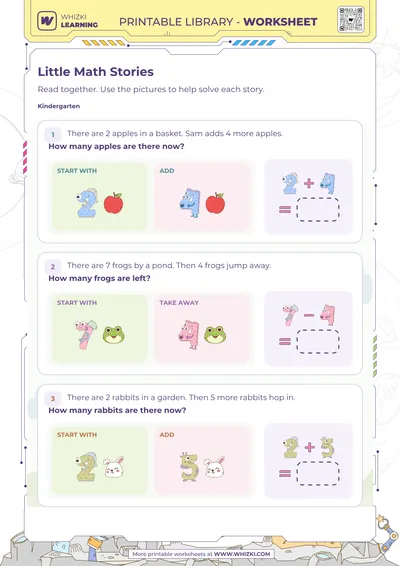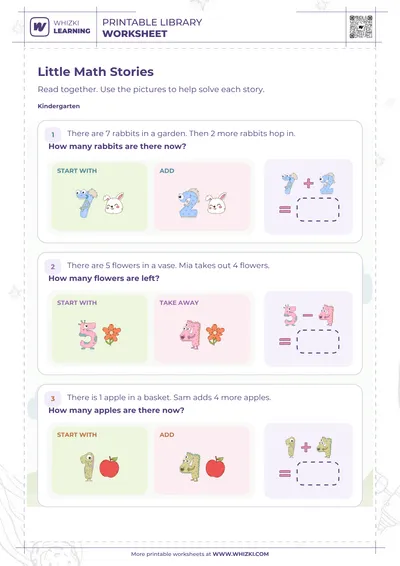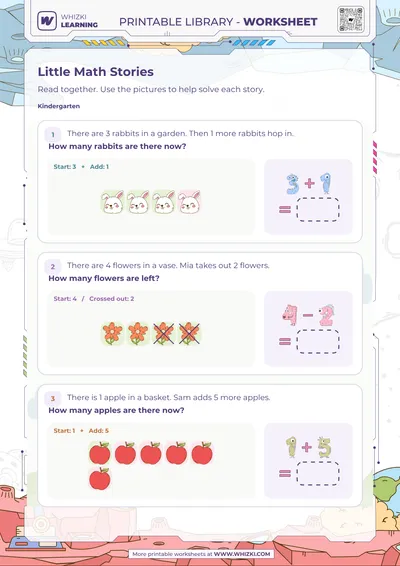


Identify a story’s starting quantity, the amount added or taken away, and what the question asks to count.
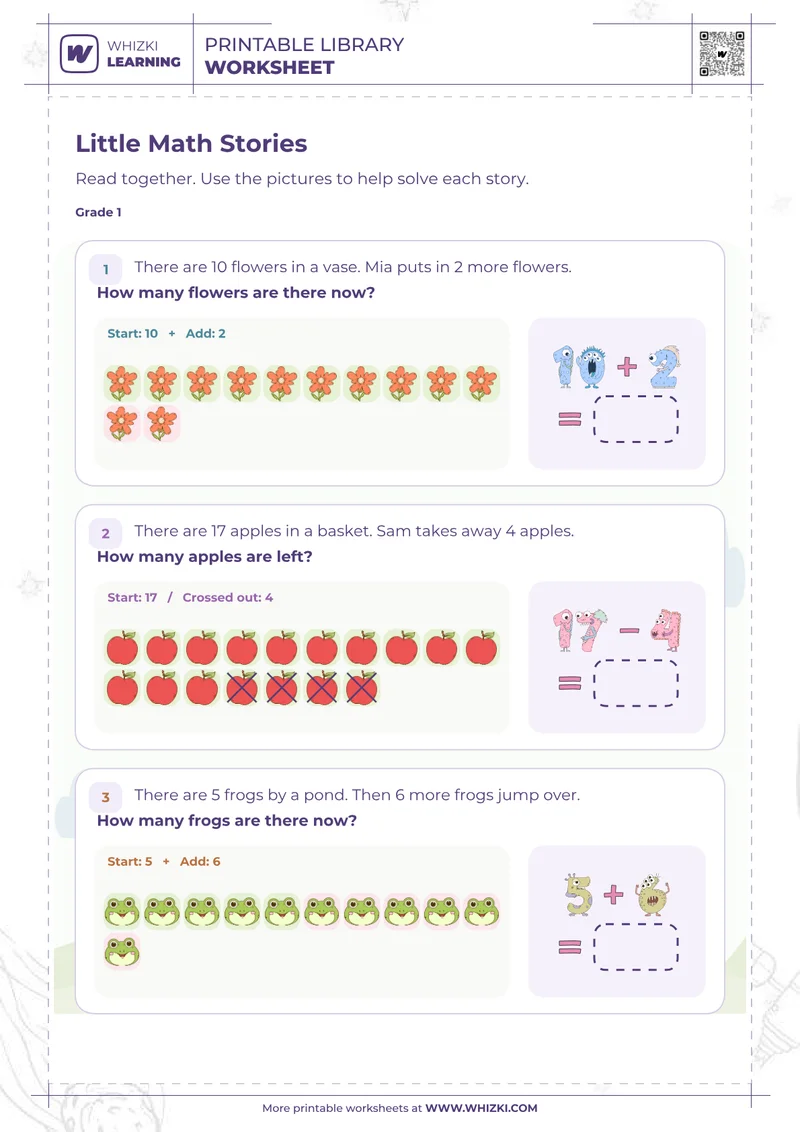
Connect the first story with 10 + 2 = 12 and interpret the result as 12 flowers.
Use the printed model or separate counters to check each answer and retell the quantity change in everyday words.

This addition and subtraction story worksheet presents three short situations about flowers, apples, frogs. Read each story together, decide what changes, and use the printed equation to record the answer. The picture models show objects being added or crossed out. Each story has its own answer space, so finish and check one situation before starting the next.
The first story says: “There are 10 flowers in a vase. Mia puts in 2 more flowers.” It asks, “How many flowers are there now?” The calculation is 10 + 2 = 12, giving 12 flowers. Point out the starting quantity and what happens to it before writing the answer. The new group joins the starting group, so the total increases. Return to the story to say what the answer counts.
For an addition model, count both pictured groups. For subtraction, begin with the full group and leave crossed-out objects out of the final count. An adult can read unfamiliar words and help the child represent the quantities with counters on separate paper. Ask what happened in the story instead of teaching a single keyword as an automatic signal to add or subtract.
The addition and subtraction collection offers related practice. The Addition and Subtraction set includes other supported number activities. After checking a story, invite your child to retell it using the same amounts and a different familiar object. Keep the starting quantity and change clear, then explain what the final number represents.
Boost your child’s skills with our discounted workbooks. Engaging activities for preschool, kindergarten, and grade 1 - now at special sale prices!


Fast shipping
Secure Payment
Licensed Teachers
For the planet
Printed in the USA
Helpful guides for parents and teachers, and tips for making learning at home super fun.

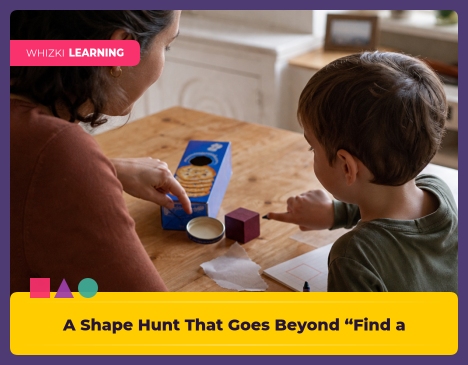
Turn a quick room search into early geometry talk by asking about sides, corners, curves, and shapes inside everyday objects.

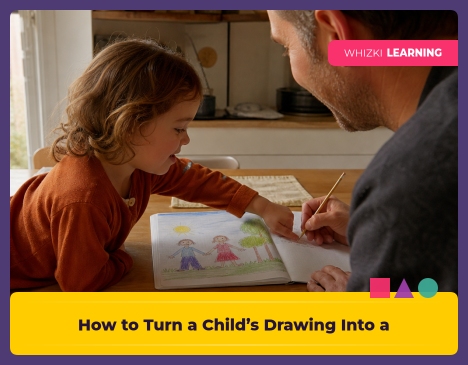
Use a child’s own drawing and spoken words to build a first sentence through adult dictation, shared writing, or optional child writing.

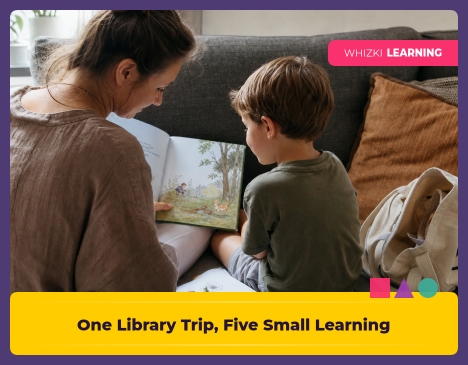
Turn one borrowed book into five short learning moments for ages 3 to 7, with choosing, rereading, drawing, counting, memory, and returning.

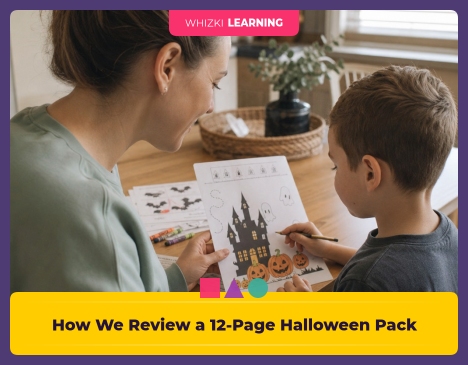
A practical field note on reviewing a 12-page Halloween activity pack for counting, patterns, tracing, vocabulary, handwriting, print choices, and age fit.
Get exclusive activities, expert tips, and inspiration for a more meaningful, offline family life.