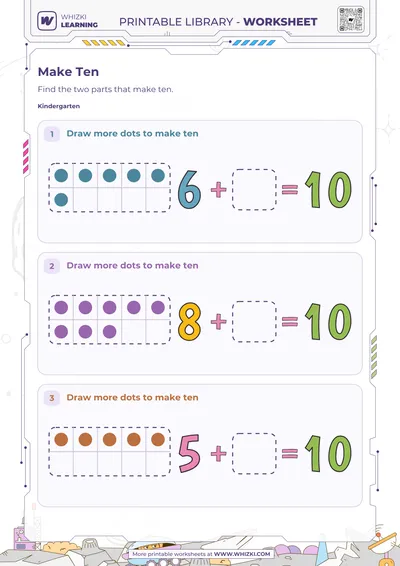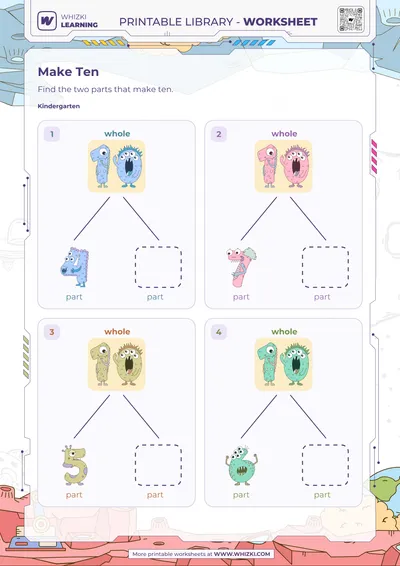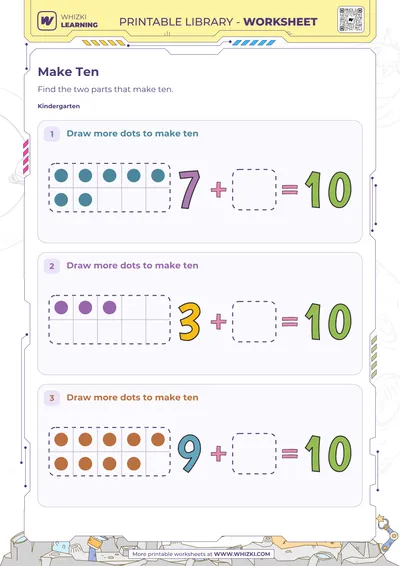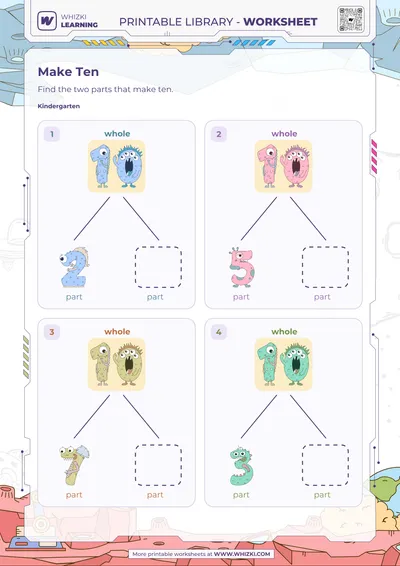


Find a missing part when the whole is ten, beginning with 3 and 7.
Interpret the whole and two parts in a number-bond diagram without confusing the total with a part.
Explain a pair that totals ten and compare it with another pair using counters or the printed model.

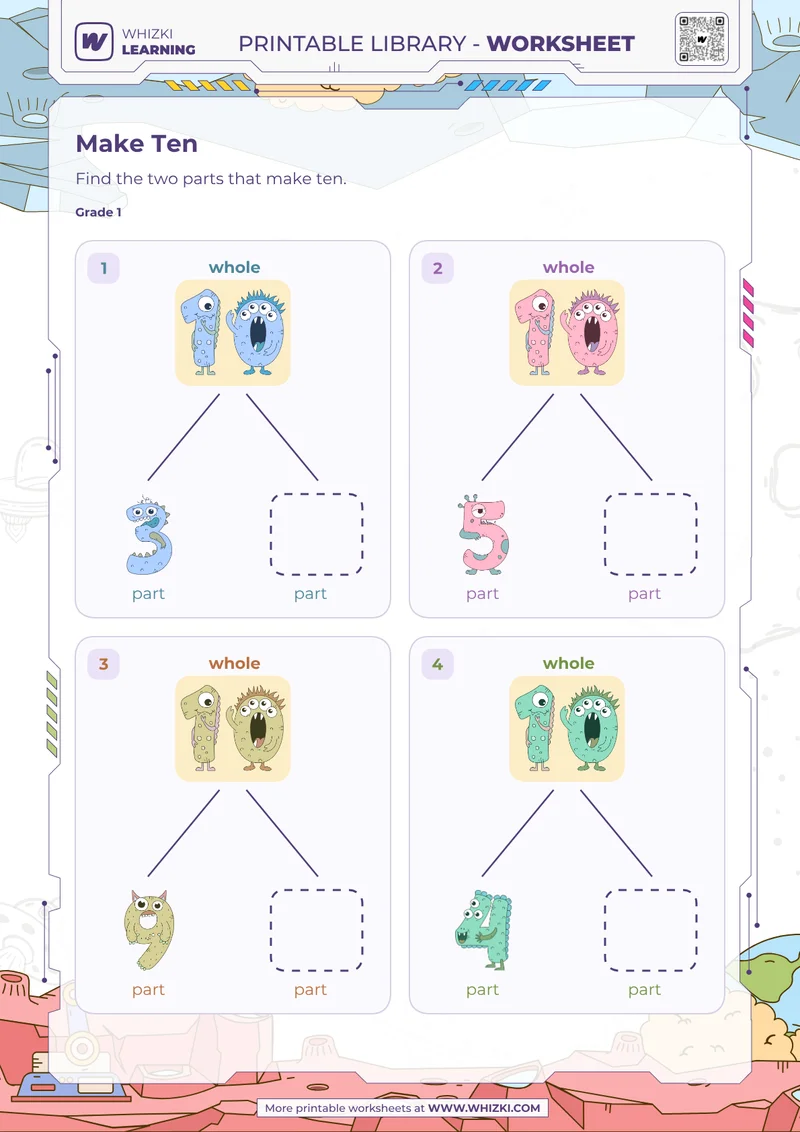
How many more are needed to make ten? This make-ten worksheet presents 4 number-bond diagrams, each with one part already shown. Find the missing part of each pair when the whole is ten. The first example begins with 3, leaving 7 more to reach ten. Use counters alongside the page if a physical model helps.
Begin with the first model and name the part that is already there: 3. Build a group of ten counters, separate the given part, and count the counters left in the other group. The missing part is 7, so 3 plus 7 makes ten. Point to each part while saying the complete relationship before writing the answer.
The pairs on this page are 3 and 7; 5 and 5; 9 and 1; 4 and 6. Compare two examples and notice that the whole stays ten even when its parts change. The whole belongs above its two parts in each diagram. Follow the connecting lines to keep the given part and missing part separate from the total. Invite your child to explain one answer with a model as well as a number.
Explore the number 10 guide for another look at ten. The Addition and Subtraction set provides related practice with parts and totals. Complete a few examples and revisit the rest later. For a hands-on follow-up, split ten counters into two groups, cover one group, and work out how many are hidden. Reveal the counters to check the prediction together.
Boost your child’s skills with our discounted workbooks. Engaging activities for preschool, kindergarten, and grade 1 - now at special sale prices!


Fast shipping
Secure Payment
Licensed Teachers
For the planet
Printed in the USA
Helpful guides for parents and teachers, and tips for making learning at home super fun.

Turn a quick room search into early geometry talk by asking about sides, corners, curves, and shapes inside everyday objects.

Use a child’s own drawing and spoken words to build a first sentence through adult dictation, shared writing, or optional child writing.

Turn one borrowed book into five short learning moments for ages 3 to 7, with choosing, rereading, drawing, counting, memory, and returning.

A practical field note on reviewing a 12-page Halloween activity pack for counting, patterns, tracing, vocabulary, handwriting, print choices, and age fit.
Get exclusive activities, expert tips, and inspiration for a more meaningful, offline family life.