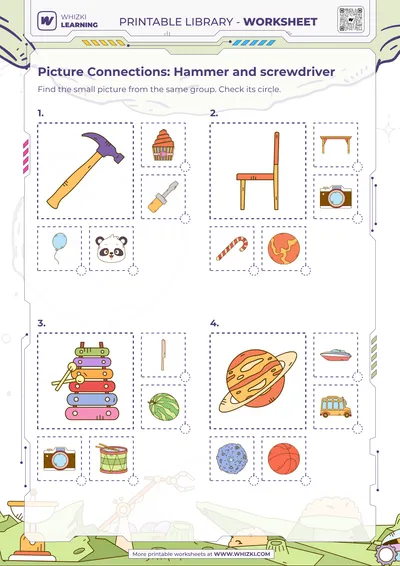
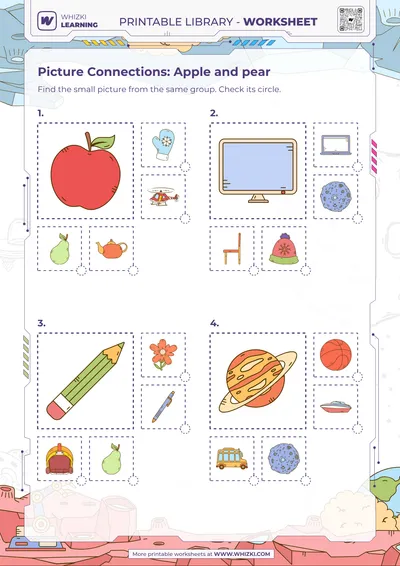
Picture category matching worksheet → Visual sorting → Child identifies shared groups and uses before needing reading or written answers.
Four logical connection puzzles → Reason giving → Child points to a matching picture and explains a simple choice aloud.
One large picture with four choices → Careful comparison → Child notices differences, rules out extra choices, and chooses the closest match.

The picture category matching worksheet gives 5-year-olds four logical connection puzzles. Each puzzle asks a child to match one large picture with one of four smaller pictures from the same group or with a shared use, practicing category matching without reading.
At preschool age, children are learning to notice what objects have in common before explaining a choice with words. Five-year-olds can get bored fast when logic work feels like a quiz, so picture choices keep the thinking visible, simple, and active.
Sit beside the child with a crayon and look at one puzzle together. Name the large picture, then ask which small picture belongs with the large picture. After the child circles or points to an answer, invite one short reason, such as same group, same job, or used together.
The page is useful because every puzzle starts with one large picture and four smaller choices, so the child has a clear job on every row. The picture-only design also lets a parent hear the child’s reasoning instead of checking a memorized word answer.
Boost your child’s skills with our discounted workbooks. Engaging activities for preschool, kindergarten, and grade 1 - now at special sale prices!


Fast shipping
Secure Payment
Licensed Teachers
For the planet
Printed in the USA
Helpful guides for parents and teachers, and tips for making learning at home super fun.

A practical guide for inviting family stories about names, language, music, routines, celebrations, and places without putting children on display.

Turn a quick room search into early geometry talk by asking about sides, corners, curves, and shapes inside everyday objects.

Use a child’s own drawing and spoken words to build a first sentence through adult dictation, shared writing, or optional child writing.

Turn one borrowed book into five short learning moments for ages 3 to 7, with choosing, rereading, drawing, counting, memory, and returning.
Get exclusive activities, expert tips, and inspiration for a more meaningful, offline family life.