Learning Outcomes
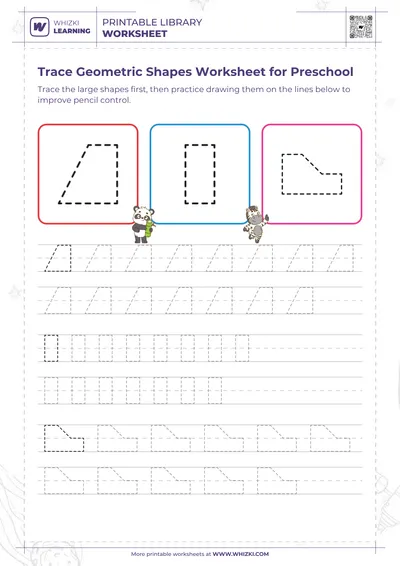
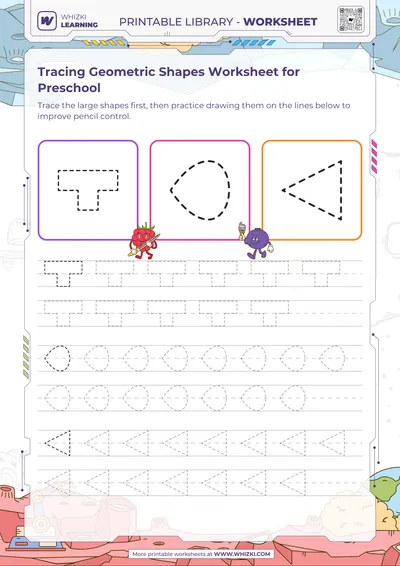
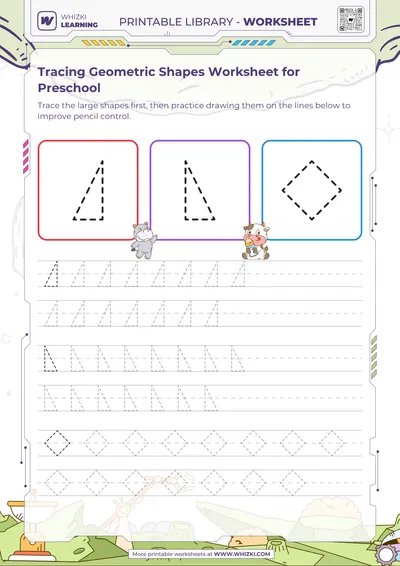
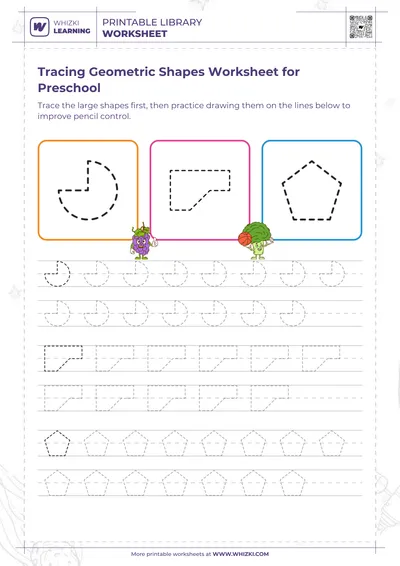
The Whizki Learning worksheet strengthens shape recognition accuracy for circles, squares, and triangles by guiding the child to trace bold, high-contrast outlines repeatedly.
The Whizki Learning worksheet improves fine motor control in the small hand muscles by encouraging slow, careful pencil movements along curved and straight geometric paths.
The Whizki Learning worksheet builds early math vocabulary by prompting the child to name each traced shape and describe size differences using everyday objects.

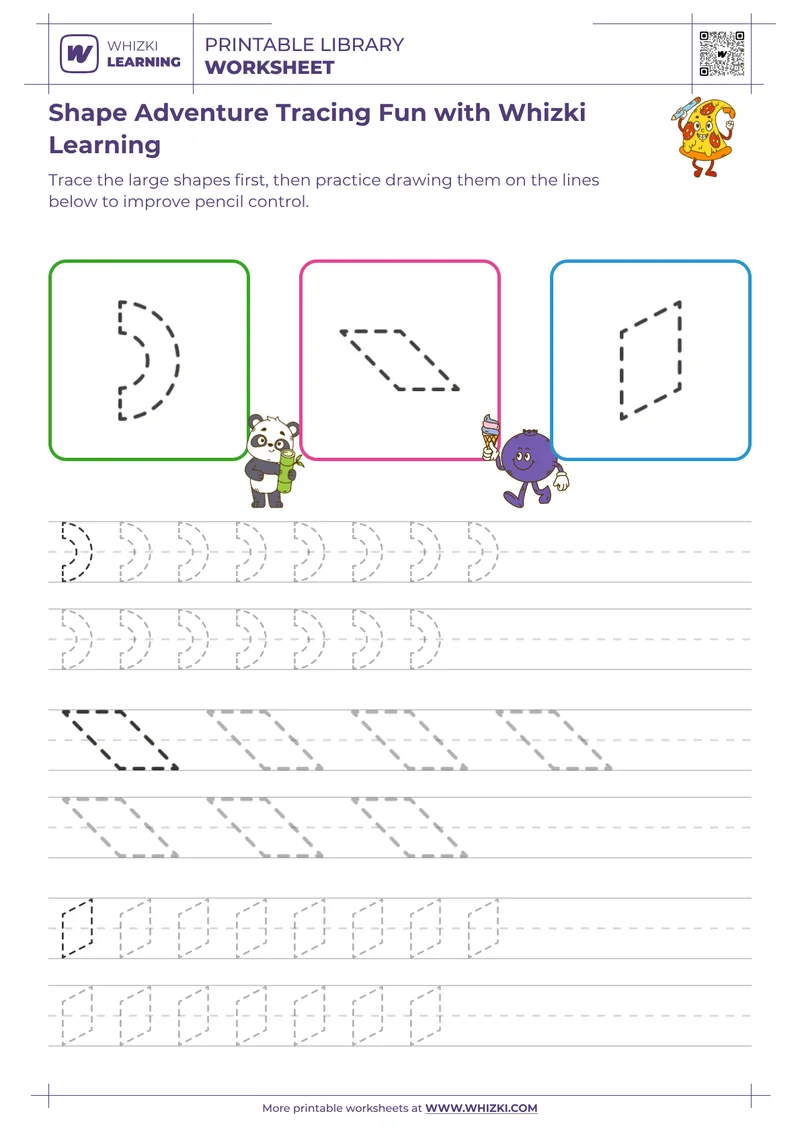
Shape Adventure Tracing Fun with Whizki Learning
Whizki Learning’s Shape Adventure Tracing Fun worksheet gives 3-year-olds a joyful first step into early math through circles, squares, and triangles. The Whizki Learning worksheet invites the child to trace large, friendly geometric shapes while exploring bold outlines that are easy for little eyes to follow. Early childhood educators and curriculum designers created the worksheet so that the child builds confidence with shapes long before formal math lessons begin. Parents and teachers can rely on the Whizki Learning worksheet as a research-informed tool for gentle, age-appropriate math exploration.
The Whizki Learning Shape Adventure Tracing Fun worksheet focuses on building strong pencil control and fine motor coordination in young children. Carefully spaced tracing paths encourage the child to move slowly and deliberately, strengthening the small hand muscles required for coloring, writing, and drawing. The Whizki Learning worksheet balances curved and straight lines so that the child practices a variety of strokes used later in letter and number formation. Educator-backed design decisions in the Whizki Learning worksheet, such as line thickness and shape size, support successful tracing even for very young beginners.
The Whizki Learning shape-tracing worksheet also reinforces early geometry and math language in a playful, concrete way for 3-year-olds. Parents and teachers can use the worksheet to help the child name each geometric shape, compare big and small versions, and connect shapes to real-world objects like balls, windows, and slices of pizza. By pairing tracing with conversation, the Whizki Learning worksheet turns simple lines into rich math talk, strengthening vocabulary such as “circle,” “square,” “triangle,” “sides,” and “corners.” Repeated use of the Whizki Learning worksheet supports strong conceptual foundations for later topics like patterning, measurement, and number sense.
The Whizki Learning Shape Adventure Tracing Fun worksheet is an easy-to-print, classroom-ready and home-friendly resource created by experienced early childhood educators. Families can print the Whizki Learning worksheet multiple times, slide the worksheet into a reusable sleeve, or laminate the worksheet to use with dry-erase markers for extended practice. Teachers can add the Whizki Learning worksheet to math centers, morning work, or small-group fine motor stations to provide consistent, low-prep practice. Because the Whizki Learning worksheet is carefully aligned with developmental milestones for 3-year-olds, adults can feel confident that every tracing activity meaningfully advances early math readiness and pre-writing skills.
Limited Time Sale
Kids’ Workbooks!
Boost your child’s skills with our discounted workbooks. Engaging activities for preschool, kindergarten, and grade 1 - now at special sale prices!


Fast shipping
Secure Payment
Licensed Teachers
For the planet
Printed in the USA
Find fresh ideas
To help your little learners grow!
Helpful guides for parents and teachers, and tips for making learning at home super fun.

A parent-friendly CVC words list sorted by short a, e, i, o, and u, with word-family groups and simple blending tips for ages 3 to 7.
Sunny Hedge
A calm guide to typical counting at age 4, why reciting numbers is different from understanding quantity, and two easy kitchen games to try today.
Sunny Hedge
A parent-friendly kindergarten sight words list, merged from Dolch and Fry, grouped by teaching order with a simple printable PDF plan.
Sunny Hedge
Most children write a recognizable first name between ages 4 and 5. Learn what comes first, what is normal, and how to begin gently.
Sunny HedgeJoin the Screen-Free Movement.
Get exclusive activities, expert tips, and inspiration for a more meaningful, offline family life.