Learning Outcomes
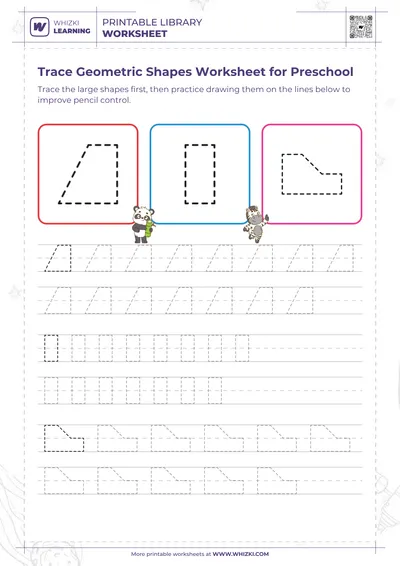
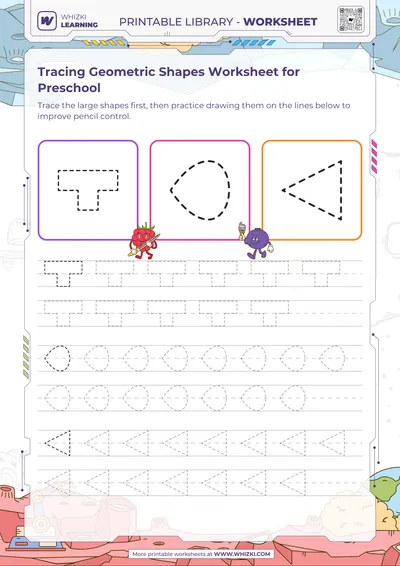
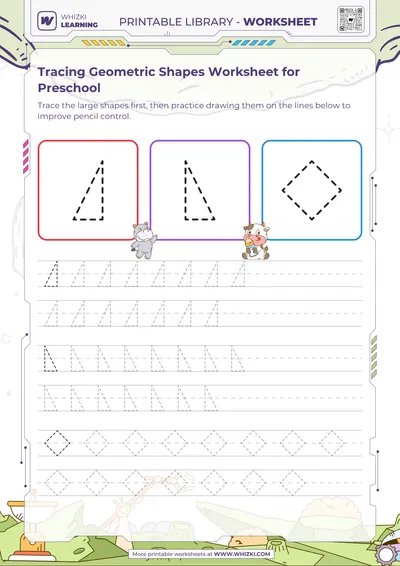
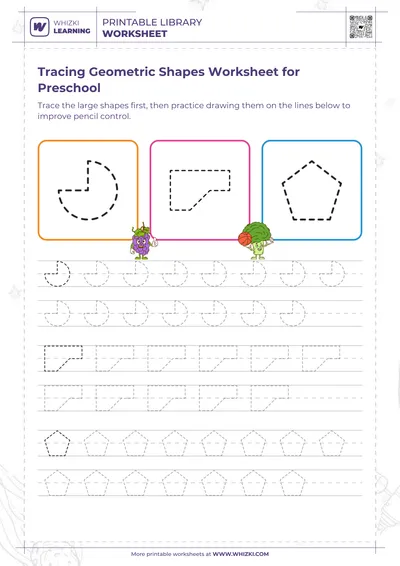
The Whizki Learning worksheet strengthens shape recognition accuracy by guiding children to trace circles, triangles, and rectangles repeatedly, reinforcing visual memory for early math success.
The Whizki Learning tracing activity improves pencil control and hand-eye coordination by encouraging slow, deliberate line following along clearly defined geometric shape paths.
The Whizki Learning worksheet introduces foundational geometry concepts by linking traced shapes to real-world objects, supporting understanding of size, corners, and straight versus curved sides.

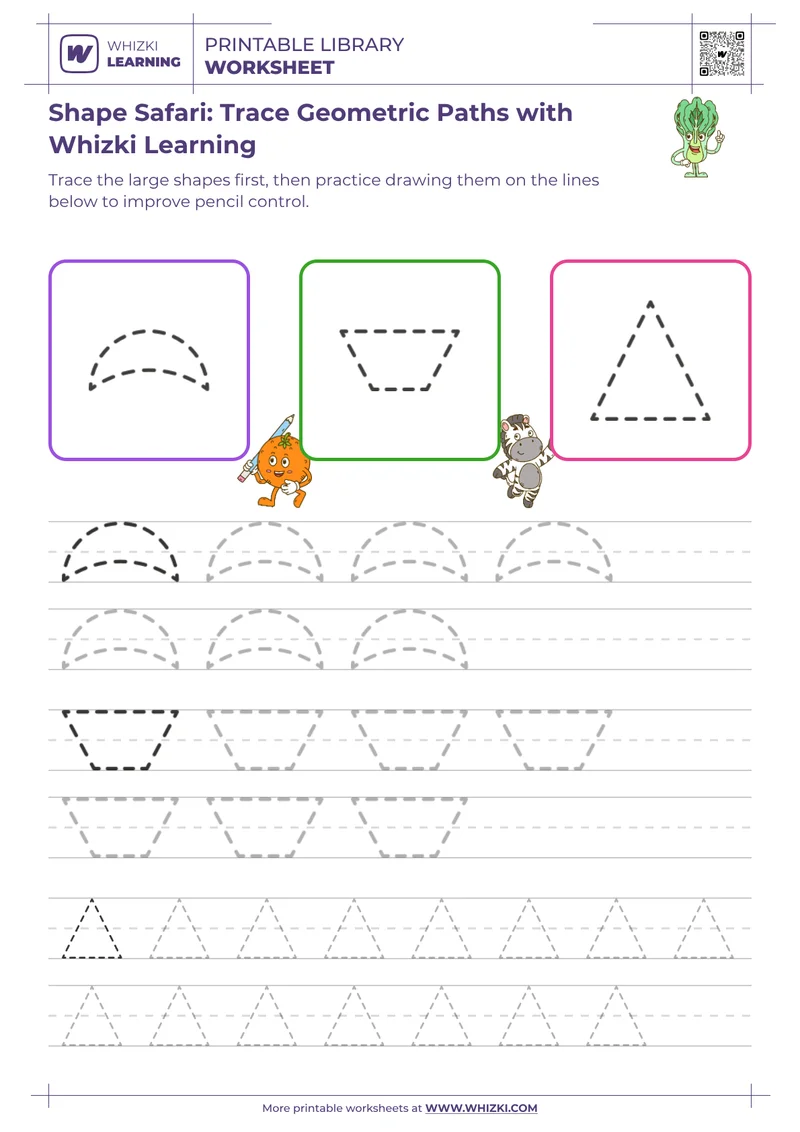
Shape Safari: Trace Geometric Paths with Whizki Learning
Whizki Learning's Shape Safari worksheet turns tracing geometric shapes into a playful early math journey for young learners ages 7 and up. The worksheet invites children to trace circles, triangles, and rectangles with clear, bold outlines that support strong shape recognition and early geometry foundations. Every guided line helps the child connect geometric shapes to early math skills such as sorting, comparing, and simple pattern recognition. Families and educators can use the Shape Safari worksheet as a low-pressure, high-engagement way to revisit core preschool and kindergarten math concepts with older children who benefit from extra practice.
This Whizki Learning worksheet is carefully crafted to develop pencil control, hand strength, and precise line following needed for confident writing. Each geometric path gradually challenges the child to stay on the line, turn sharp corners, and manage curves without frustration. Repeated tracing builds fine motor endurance and grip stability, which experts recognize as essential prerequisites for legible handwriting and math notation. The worksheet layout reflects input from early childhood educators and pediatric occupational therapy consultants who specialize in motor readiness for school success.
The Whizki Learning Shape Safari worksheet also builds vocabulary and conceptual understanding around geometry and spatial reasoning. Guided prompts encourage the child to name each geometric shape, count corners, compare side lengths, and describe curved versus straight lines. Through repeated tracing and labeling, the child strengthens visual memory for shapes that appear later in graphs, charts, and early problem-solving tasks. Parents and teachers can extend learning by inviting the child to find matching shapes in the classroom, at home, or in outdoor environments, reinforcing authentic math connections.
Every Whizki Learning worksheet is designed by experienced early childhood educators and reviewed for clarity, developmental appropriateness, and ease of classroom or home use. The Shape Safari tracing resource prints cleanly in black and white, making the worksheet easy to reuse in learning centers, tutoring sessions, or homework packets. Educators can differentiate instruction by asking more advanced learners to color-code shapes, create simple patterns, or write the shape names under each outline. Whizki Learning supports families and teachers with research-informed, engaging materials that nurture confident, curious mathematicians from the earliest grades.
Limited Time Sale
Kids’ Workbooks!
Boost your child’s skills with our discounted workbooks. Engaging activities for preschool, kindergarten, and grade 1 - now at special sale prices!


Fast shipping
Secure Payment
Licensed Teachers
For the planet
Printed in the USA
Find fresh ideas
To help your little learners grow!
Helpful guides for parents and teachers, and tips for making learning at home super fun.

Many early childhood reading programs rely on memorizing 'sight words' using flashcards, but this visual memorization strategy often creates fragile readers. This comprehensive guide compares phonics instruction against rote memorization, explaining the neurological mechanisms behind decoding. Learn why teaching letter sounds builds genuine reading confidence and how to foster a growth mindset in young readers.
Sunny Hedge
Teaching a child to read often creates immense anxiety for parents, leading to frustrating flashcard memorization. This comprehensive guide details a proven, Montessori-inspired phonics method that prioritizes letter sounds over letter names. Learn how screen-free, hands-on learning activities build essential phonemic awareness and prepare preschoolers for fluent reading without academic pressure.
Sunny Hedge
When a child cries at the sight of a pencil, parents must completely stop handwriting practice to prevent long-term academic anxiety. This tactical 7-day guide provides a clinical 'Writing Confidence Reset' designed by early childhood experts. Learn how to rebuild a child's fine motor confidence through screen-free sensory play, vertical drawing, and high-quality printed workbooks without any pressure or shame.
Sunny Hedge
Children frequently develop incorrect handwriting habits, such as starting letters from the bottom or applying extreme pencil pressure. This tactical guide outlines the five most common letter formation mistakes and provides occupational therapist-approved, kind fixes for each. Learn how high-quality printed workbooks and specific tactile exercises build permanent, correct muscle memory without frustrating the child.
Sunny HedgeJoin the Screen-Free Movement.
Get exclusive activities, expert tips, and inspiration for a more meaningful, offline family life.