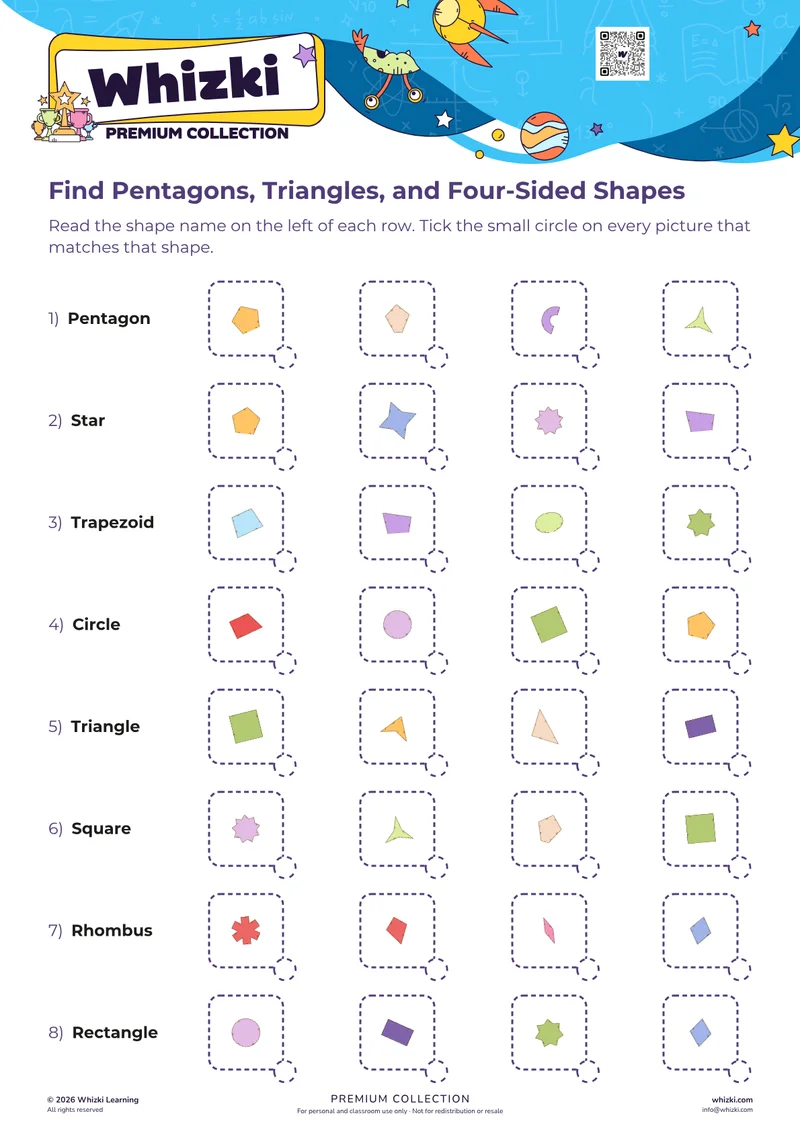
Connect spoken or printed shape names with the pictures in eight groups: pentagon, star, trapezoid, circle, triangle, square, rhombus, and rectangle, with adult help reading unfamiliar labels.
Recognize matching outlines in different orientations by comparing straight sides, curves, and corners instead of relying on which way a picture points.
Check every picture in a row and explain a selection using one visible feature, allowing for more than one correct match.

This shape recognition worksheet presents eight labeled rows, each with four pictures to compare. The target groups are pentagon, star, trapezoid, circle, triangle, square, rhombus, and rectangle. An adult can read each label aloud while the child studies the outlines and marks every matching picture. Several rows have more than one answer, so take time to inspect all four choices.
Pictures are turned in different directions to encourage attention to their features. Compare the round circle with the stretched oval, then look at the straight-sided figures. For a triangle, follow its three sides and three corners even when one corner points sideways instead of upward. Ask your child to point out the edge or corner that helped with a choice before moving to the next row.
Begin with a familiar name and model one comparison together. Trace a boundary with a finger, count straight sides where helpful, and use words such as curved, straight, corner, and point. Keep unfamiliar names as shared vocabulary: an adult can provide the word while the child does the visual comparison. A few carefully discussed rows are a useful first session.
For another comparison task, explore the Shapes and Geometry Pack. The Pre-Writing Warm-Ups offer contour tracing when your child wants to draw similar outlines. After using this page, turn a paper shape in your hand and ask whether its name changes. Return to one printed example to explain the answer using its visible features.

Boost your child’s skills with our discounted workbooks. Engaging activities for preschool, kindergarten, and grade 1 - now at special sale prices!


Fast shipping
Secure Payment
Licensed Teachers
For the planet
Printed in the USA
Helpful guides for parents and teachers, and tips for making learning at home super fun.

Use one familiar snack to build science talk and vocabulary without pressure to taste. This kitchen-table investigation honors allergies, texture needs, and child choice.

Help young children measure with paper clips before a ruler, using equal units, clear endpoints, and quick fixes for gaps, overlaps, and different answers.

Picture labels can build meaning, first-sound attention, or guessing habits. Use this parent-friendly decision tree to know when to cover or reveal the picture.

A vague school screening notice can leave families guessing, so start with seven plain questions about the test, timing, language, evidence, and next steps.
Get exclusive activities, expert tips, and inspiration for a more meaningful, offline family life.