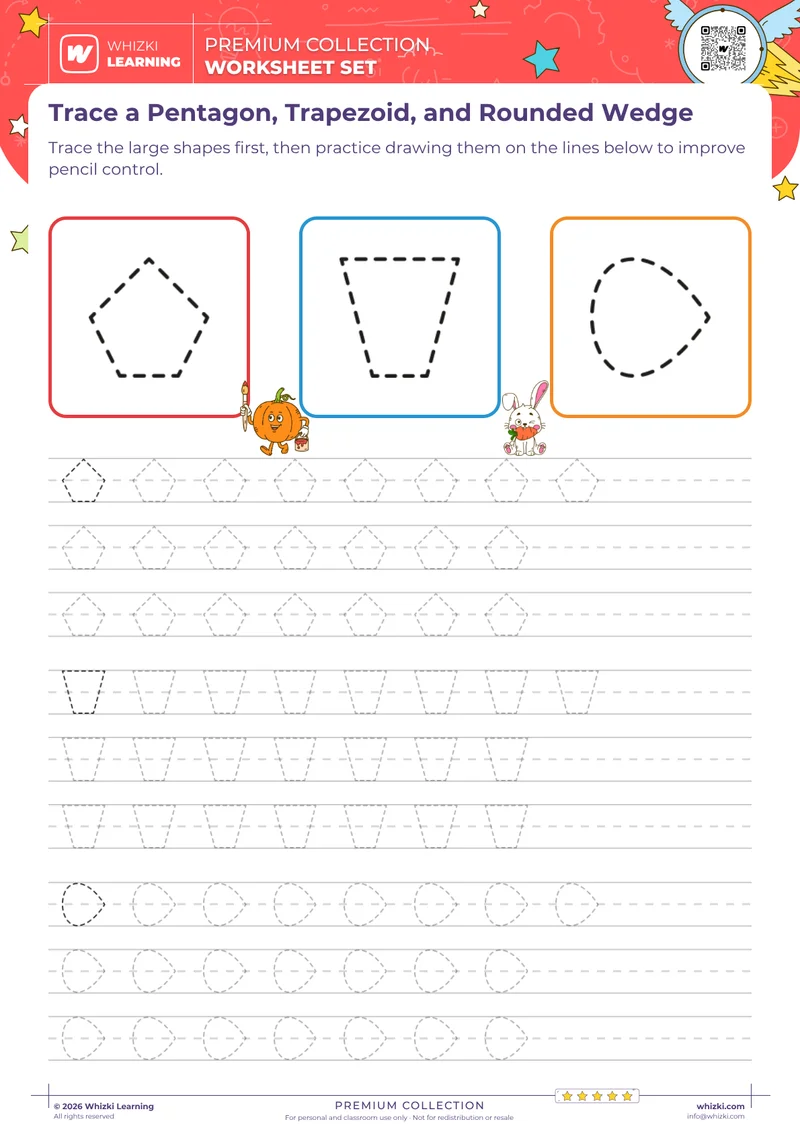
Follow the printed contours with a finger or pencil, noticing closed outlines with straight sides or a broad curved edge before attempting the smaller practice copies.
Practice placing repeated outlines within the writing rows while returning to the large model for guidance on shape and direction.
Compare a traced or drawn attempt with its model and identify one corner, curve, or straight edge to practice again.

This shape tracing worksheet gives children three large outlines to study and smaller practice versions on writing lines below. The models show a pentagon, a narrow trapezoid, and a rounded wedge. The movement practice centers on closed outlines with straight sides or a broad curved edge. Choose one model to look at together before beginning with a finger or pencil.
Trace the large outline first, then compare it with the smaller copies in its practice rows. Notice where the path changes direction and whether an edge is straight or curved. The row guides help a child attend to placement, while the lighter dotted outlines offer repeated tracing opportunities. There is room to try drawing the shape again when your child is ready for less support.
An adult can model a short section and pause at a difficult turn instead of tracing the entire page for the child. Use ordinary words such as corner, curve, point, or straight line; remembering every formal shape name is not required for this pencil task. Work on a few copies, compare them with the model, and stop before repeated attempts become uncomfortable or rushed.
Choose another page from Pre-Writing Warm-Ups for a different set of contours. The Shapes and Geometry Pack offers related recognition and property activities. As a separate follow-up, draw a larger version of one outline on plain paper and try just its most difficult turn together before returning to the printed scale.

Boost your child’s skills with our discounted workbooks. Engaging activities for preschool, kindergarten, and grade 1 - now at special sale prices!


Fast shipping
Secure Payment
Licensed Teachers
For the planet
Printed in the USA
Helpful guides for parents and teachers, and tips for making learning at home super fun.

A warm decision guide for asking how a preschool or kindergarten screening handles testing language, interpretation, observations, and home-language evidence.

Use one familiar snack to build science talk and vocabulary without pressure to taste. This kitchen-table investigation honors allergies, texture needs, and child choice.

Help young children measure with paper clips before a ruler, using equal units, clear endpoints, and quick fixes for gaps, overlaps, and different answers.

Picture labels can build meaning, first-sound attention, or guessing habits. Use this parent-friendly decision tree to know when to cover or reveal the picture.
Get exclusive activities, expert tips, and inspiration for a more meaningful, offline family life.