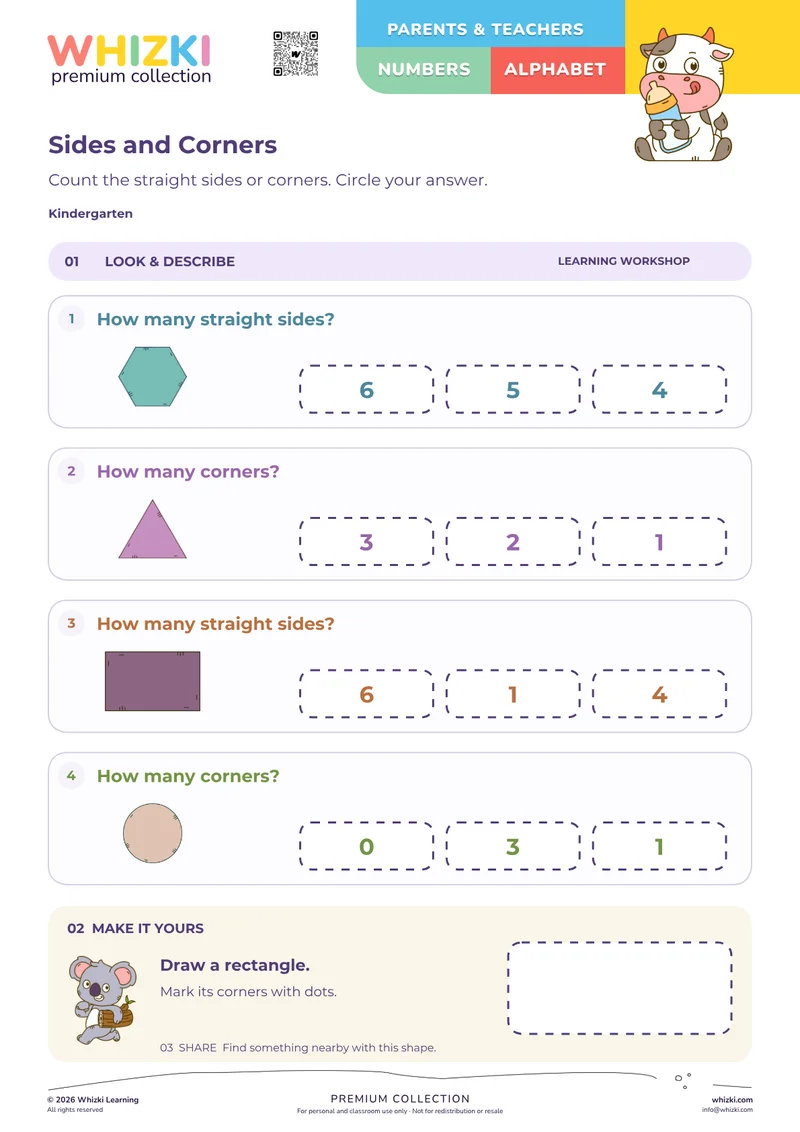
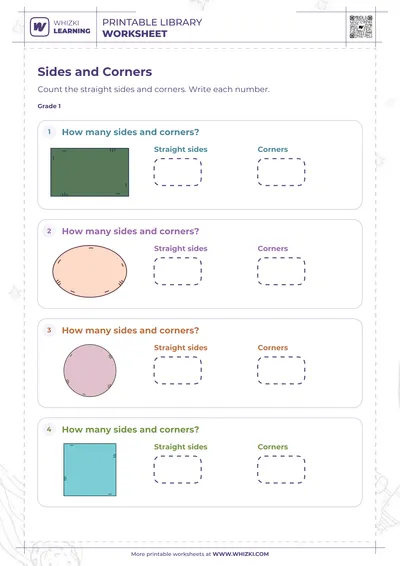
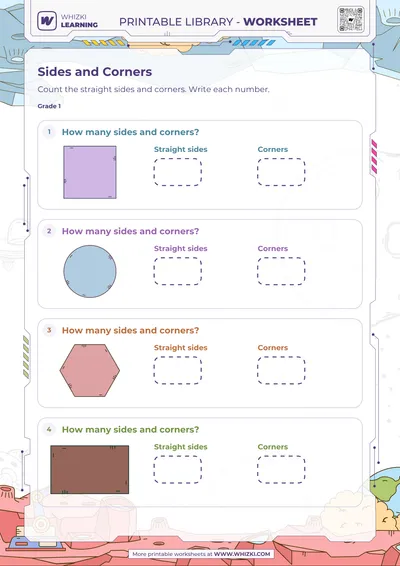
This shape sides and corners worksheet asks four focused questions about a hexagon, triangle, rectangle, and circle. Children count the requested feature and circle a number from three choices. The rows ask for the hexagon’s straight sides, the triangle’s corners, the rectangle’s straight sides, and the circle’s corners, so read each question before counting.
A side is a straight part of the polygon boundary; a corner is where two sides meet. Trace each requested side or touch each corner once, returning to the starting point without counting it again. The hexagon has six straight sides, the triangle has three corners, and the rectangle has four straight sides. The circle has a curved boundary and no corners.
Work through one example aloud, then let your child show how the next answer was found. An adult can read the question and number choices while the child counts. In the drawing activity, make a rectangle and place a dot at each corner. Compare the drawing with the printed rectangle and check that each of its four corners has exactly one dot.
The Shapes and Geometry Pack includes related naming, sorting, and position practice. For more counting activities, explore Early Math Essentials. After completing a few rows, draw a larger triangle or rectangle on plain paper and count around its outline together. Keep attention on the feature being counted, using separate passes for sides and corners.