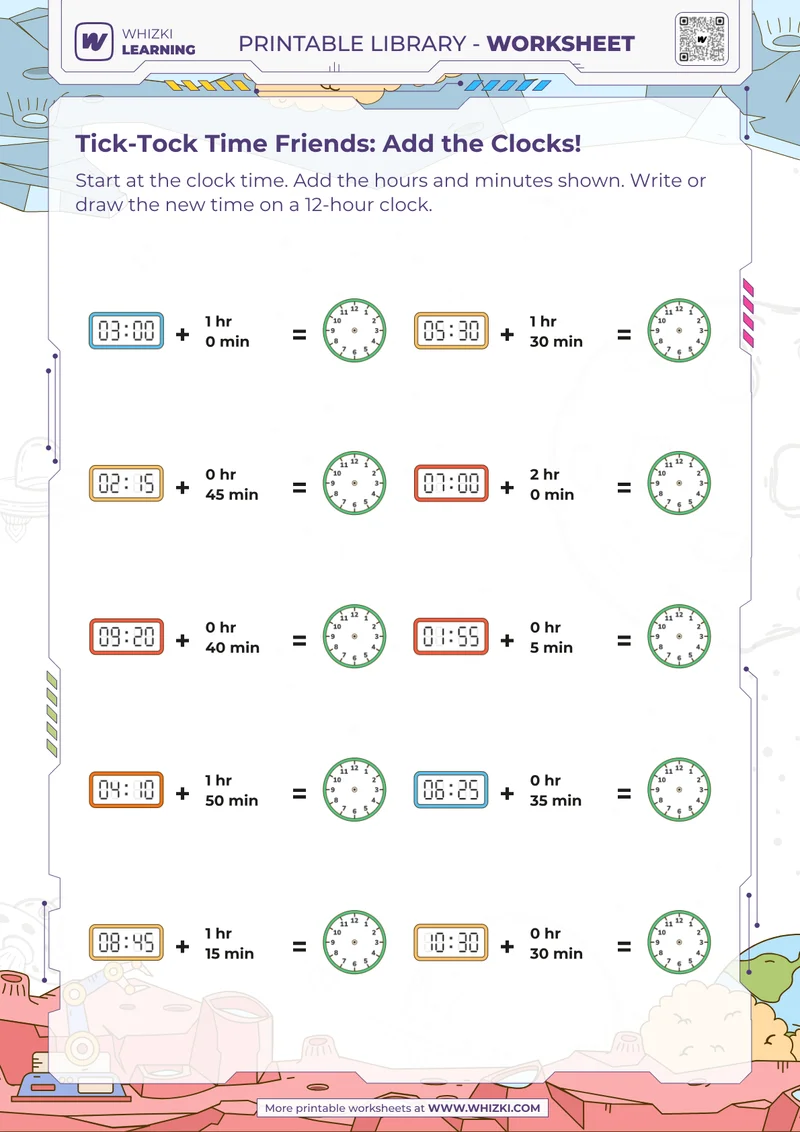
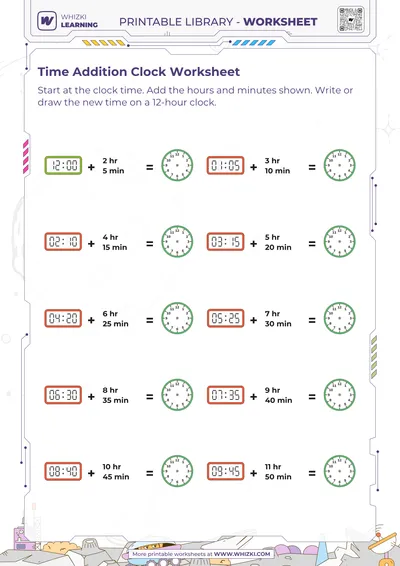
A clock time tells us when something starts; a duration tells us how long it lasts. This elapsed-time worksheet gives ten starting times and amounts to add, then asks children to draw the new time on an analog clock. The first problem starts at 3:00 and adds 1 hour and 0 minutes. Use it with adult support after your child is comfortable reading clock hands and counting minutes.
Model the first problem aloud: begin at 3:00, move forward by 1 hour and 0 minutes, and arrive at 4:00. Add the hours and minutes in stages, remembering that 60 minutes make another hour. Place the minute hand for the result first, then position the hour hand to show how far the hour has progressed. Keep the starting time visible while checking the amount moved forward.
The next starting time is 5:30. Read its duration before calculating; the amount to add is a length of time, rather than a second time of day. A movable teaching clock or a short timeline can make crossing the next hour easier to follow. Continue through 12 on the twelve-hour clock when needed. These prompts do not specify morning or evening, so an a.m. or p.m. label is not part of the answer.
Use the Time and Money set for related clock activities. You can also add a short practice session to the Learning Planner. Complete a small selection and review one uncertain answer together. For an everyday follow-up, choose a start time for a short activity and work out when it will finish. Return to the remaining prompts when reading the hands and recording the time feel manageable.