Learning Outcomes
The Whizki Learning time worksheet improves number recognition accuracy from 1 to 12 by guiding the child to match clear numerals with bold analog clock faces.
The Whizki Learning time worksheet strengthens visual-motor coordination as the child traces numbers and draws clock hands to specific hours and minutes with guided prompts.
The Whizki Learning time worksheet introduces early counting-by-fives awareness by prompting the child to count tick marks around the clock while saying each number aloud.
The Whizki Learning time worksheet supports language development by encouraging the child to use time words such as morning, night, o’clock, early, and late during guided discussion.
The Whizki Learning time worksheet nurtures understanding of daily routines by helping the child connect familiar activities, such as meals and bedtime, to simple clock representations.

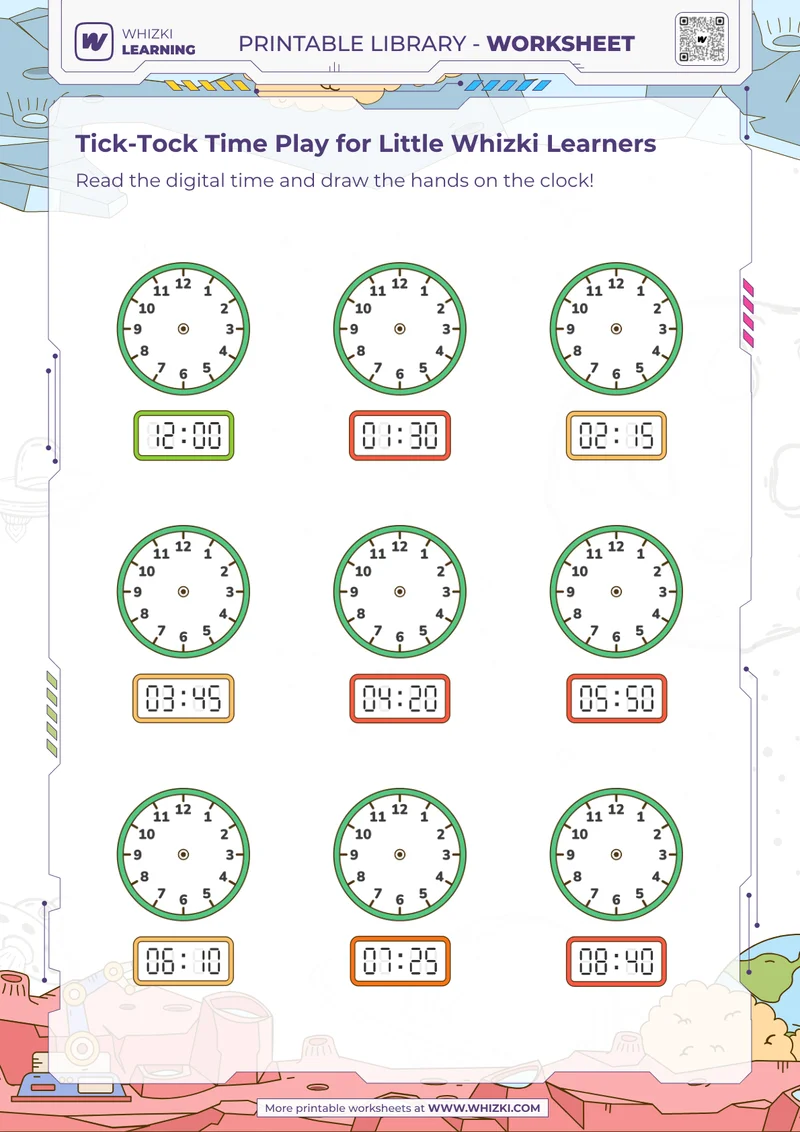
Tick-Tock Time Play for Little Whizki Learners
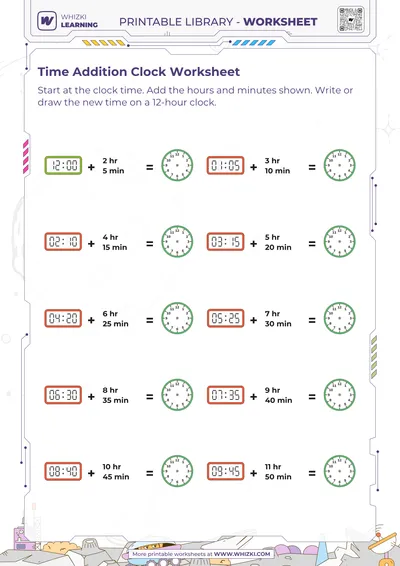
The Whizki Learning Tick-Tock Time Play worksheet introduces very young learners to clocks and simple time concepts through gentle, age-appropriate math exploration. The Whizki Learning worksheet invites a 3-year-old child to look at friendly clock faces, match numbers, and notice everyday moments such as breakfast time or playtime. Early childhood educators and math curriculum specialists designed the Whizki Learning resource to support relaxed, playful exposure to early time vocabulary rather than formal time-telling pressure.
The Whizki Learning time worksheet uses large, clear analog clock faces and bold digital numbers to help a young child visually connect numbers with clock hands. Each activity on the Whizki Learning worksheet encourages the child to trace numbers, draw simple clock hands, and color specific hours or minutes. Experts in early numeracy development created the Whizki Learning layout to reduce visual clutter, which supports focus, visual tracking, and number recognition for preschool and early 1st grade learners.
The Whizki Learning Tick-Tock Time Play worksheet gently builds foundational skills for later time-telling, including counting by fives, sequencing events, and comparing lengths of time. Guided prompts on the Whizki Learning worksheet encourage the child to count tick marks around the clock, notice patterns between numbers, and talk about what usually happens at different times of day. Early childhood math specialists at Whizki Learning designed each task to grow language skills, reasoning skills, and math vocabulary such as “o’clock,” “morning,” and “night.”
The printable Whizki Learning time worksheet gives parents and teachers a flexible tool for quick, low-prep math moments at home or in the classroom. Adults can use the Whizki Learning worksheet during circle time, quiet table work, or one-on-one learning to start conversations about routines, schedules, and numbers. The high-quality Whizki Learning design supports repeated use with laminating or sheet protectors, allowing the child to revisit the same clocks many times for confident, stress-free practice.
Limited Time Sale
Kids’ Workbooks!
Boost your child’s skills with our discounted workbooks. Engaging activities for preschool, kindergarten, and grade 1 - now at special sale prices!


Fast shipping
Secure Payment
Licensed Teachers
For the planet
Printed in the USA
Find fresh ideas
To help your little learners grow!
Helpful guides for parents and teachers, and tips for making learning at home super fun.

Teaching a child to read often creates immense anxiety for parents, leading to frustrating flashcard memorization. This comprehensive guide details a proven, Montessori-inspired phonics method that prioritizes letter sounds over letter names. Learn how screen-free, hands-on learning activities build essential phonemic awareness and prepare preschoolers for fluent reading without academic pressure.
Sunny Hedge
When a child cries at the sight of a pencil, parents must completely stop handwriting practice to prevent long-term academic anxiety. This tactical 7-day guide provides a clinical 'Writing Confidence Reset' designed by early childhood experts. Learn how to rebuild a child's fine motor confidence through screen-free sensory play, vertical drawing, and high-quality printed workbooks without any pressure or shame.
Sunny Hedge
Children frequently develop incorrect handwriting habits, such as starting letters from the bottom or applying extreme pencil pressure. This tactical guide outlines the five most common letter formation mistakes and provides occupational therapist-approved, kind fixes for each. Learn how high-quality printed workbooks and specific tactile exercises build permanent, correct muscle memory without frustrating the child.
Sunny Hedge
Parents often purchase expensive educational toys to build their child's hand strength, but household items provide superior fine motor training. This tactical guide provides 20 occupational therapist-approved, screen-free fine motor games using everyday kitchen and laundry supplies. Learn how activities like threading pasta and squeezing sponges build the essential pincer grasp needed for handwriting.
Sunny HedgeJoin the Screen-Free Movement.
Get exclusive activities, expert tips, and inspiration for a more meaningful, offline family life.