Learning Outcomes
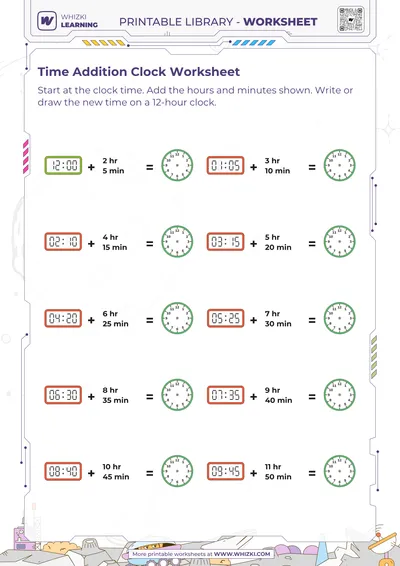
The Whizki Learning time-addition worksheet strengthens understanding of hours and minutes by guiding children through structured practice that connects clock math to familiar daily routines.
The Whizki Learning printable builds number sense by modeling how regrouping works when minutes reach sixty, encouraging children to decompose numbers and recombine amounts accurately.
The Whizki Learning time worksheet introduces elapsed-time thinking as children compare starting and finishing times, supporting success with schedules, timelines, and multi-step word problems.
Numbers & Counting
123
Learn numbers, counting, and early number sense through simple examples
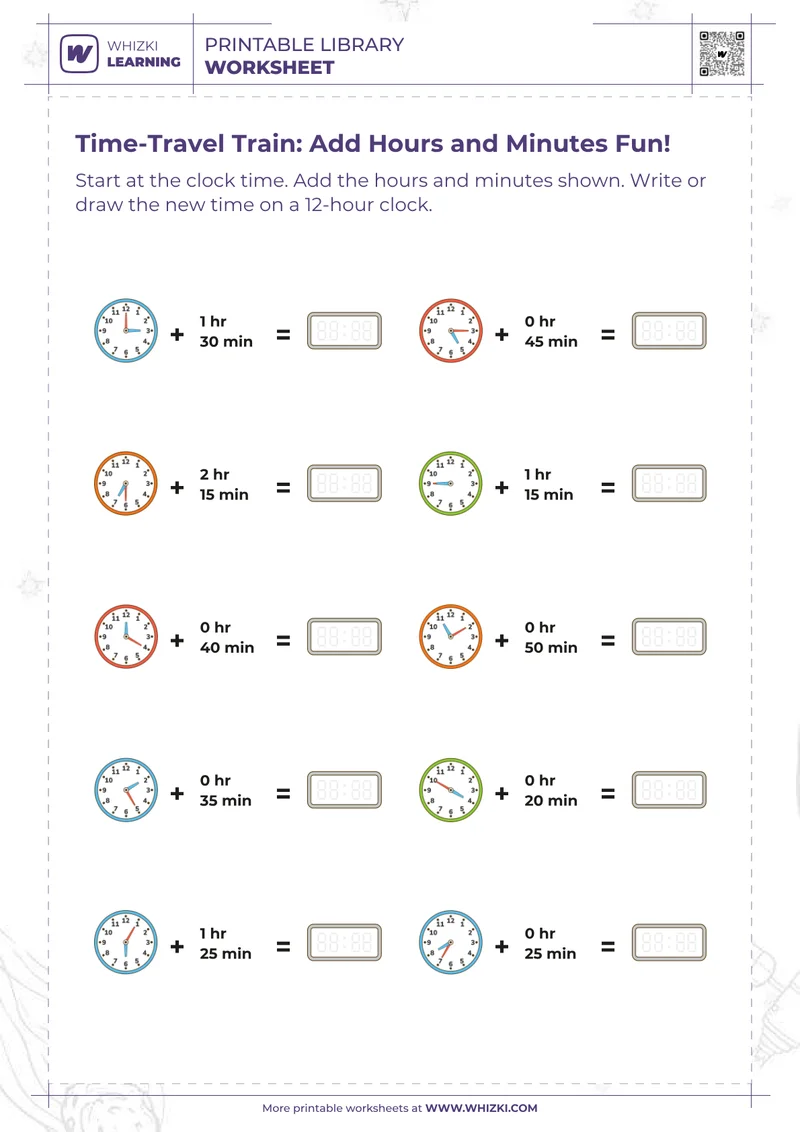
Time-Travel Train: Add Hours and Minutes Fun!
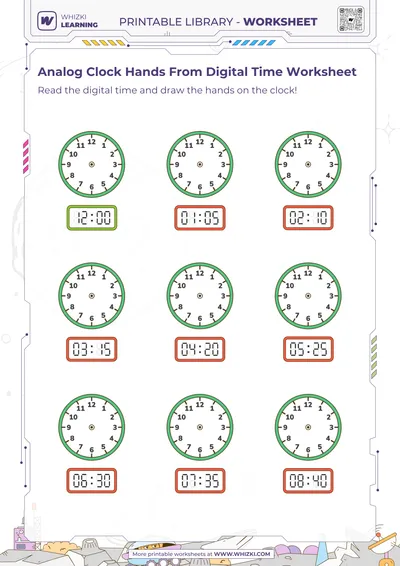
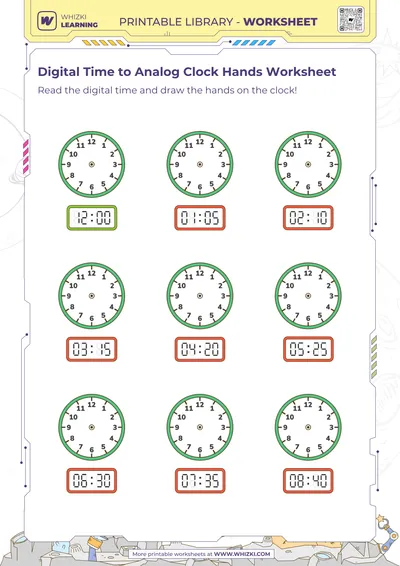
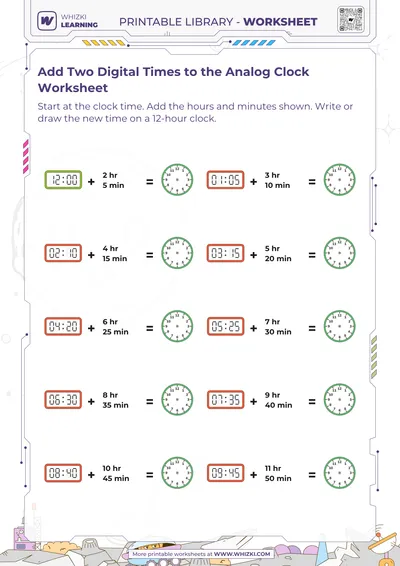
Whizki Learning Time-Travel Train: Add Hours and Minutes invites 6-year-old learners to practice adding hours and minutes on friendly digital clocks through colorful, story-based math questions. Each problem connects time math to everyday events such as leaving for school, visiting a friend, or getting ready for bed, helping children see how number operations describe real life. First grade students meet gentle time challenges without overwhelming difficulty, building early confidence with reading and combining hours and minutes.
Educator-designed structure guides every Whizki Learning time-addition worksheet, with clear models that show how to add hours and minutes step by step before independent practice begins. Example rows demonstrate how to stack numbers, regroup minutes when the sum reaches 60, and record final answers in digital time format, giving children a reliable routine for solving each problem. Experienced primary teachers and curriculum experts align every activity with first grade math standards, supporting strong foundations for later elapsed time problem solving.
Kid-approved design keeps the Whizki Learning time worksheet engaging through playful time-travel themes, simple icons, and ample white space that reduces frustration for young learners. Children trace start times, add new travel times for an imaginary journey, and write finishing times in bright answer boxes, reinforcing understanding through repeated, hands-on interaction. Parents and teachers can print multiple copies for quick warm-ups, math centers, homework packets, or extra support for children who need gentle, focused time practice.
Flexible teaching and learning options make the Whizki Learning time-addition worksheet useful for one-on-one tutoring, small-group rotations, or whole-class mini-lessons in first grade classrooms. Caregivers can pair worksheet pages with analog clocks, timer apps, or real household schedules so children connect paper exercises with real-world experiences. Step-by-step layout and consistent structure help young mathematicians develop perseverance, accuracy, and number sense while exploring how minutes and hours work together on a clock.
Limited Time Sale
Kids’ Workbooks!
Boost your child’s skills with our discounted workbooks. Engaging activities for preschool, kindergarten, and grade 1 - now at special sale prices!


Fast shipping
Secure Payment
Licensed Teachers
For the planet
Printed in the USA
Find fresh ideas
To help your little learners grow!
Helpful guides for parents and teachers, and tips for making learning at home super fun.

Getting an energetic preschooler to sit still for handwriting practice often results in frustrating power struggles. This educator-approved playbook provides 10 screen-free, proprioceptive calm-down activities designed to regulate a dysregulated nervous system. Learn how heavy work, fine motor warm-ups, and breath control prepare a child's body and mind for successful, tear-free tracing and writing.
Sunny Hedge
When a preschooler complains of boredom, parents often feel immediate guilt and offer digital entertainment. This educator-approved guide explains the psychological mechanism of unstructured time and why boredom is the ultimate catalyst for independent play. Learn how to survive the initial complaining phase and utilize high-quality printed workbooks to bridge the gap between digital stimulation and deep, analog focus.
Sunny Hedge
Many parents panic when their preschooler cannot sit still for more than two minutes, fearing the child is not ready for formal schooling. This educator-tested guide explains why early attention spans are naturally short and provides a step-by-step plan to gently stretch cognitive stamina. Learn how to build a reliable 15-minute focus habit using screen-free, analog activities before the first day of kindergarten.
Sunny Hedge
The kitchen provides a natural, highly engaging mathematics classroom for preschoolers. This educator-approved playbook details 10 easy, screen-free number games using everyday pantry items and snacks. Learn how sorting pasta, measuring water, and counting blueberries builds foundational counting skills, one-to-one correspondence, and deep number recognition without any formal preparation.
Sunny HedgeJoin the Screen-Free Movement.
Get exclusive activities, expert tips, and inspiration for a more meaningful, offline family life.