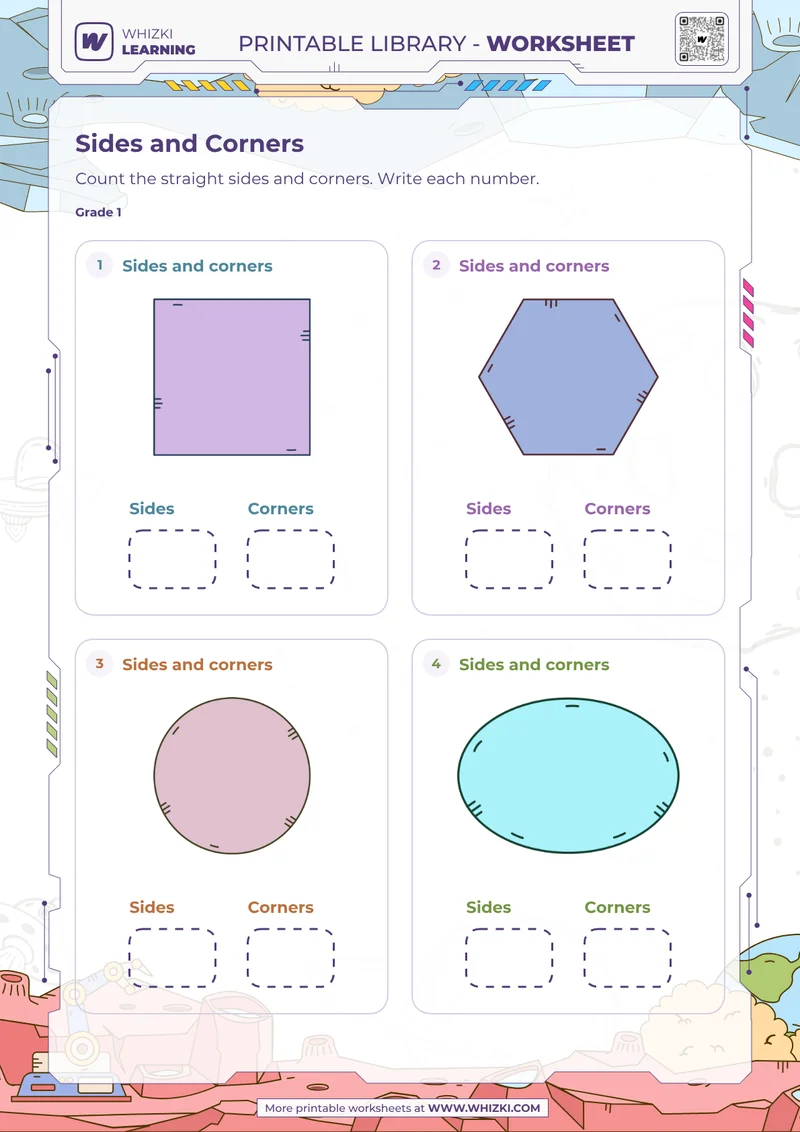
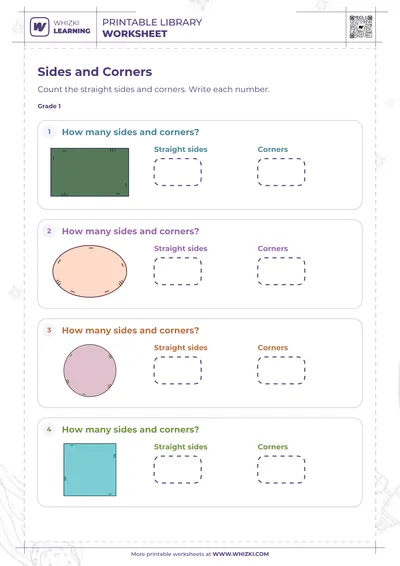
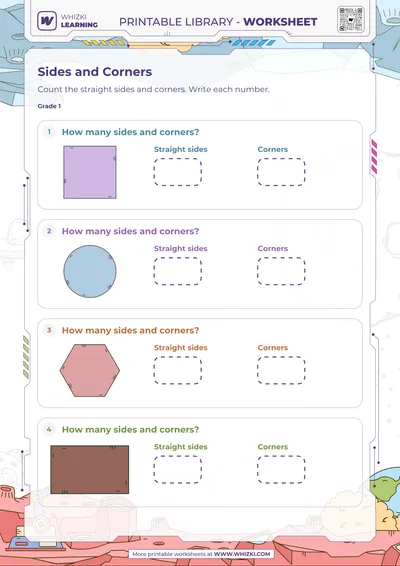
Children can learn more about a shape by looking closely at its outline. This straight sides and corners worksheet includes 4 pictured shapes: square, hexagon, circle, oval. The task is to write both the number of straight sides and the number of corners. Each shape has its own activity card. Read unfamiliar words aloud so your child can focus on the shape rather than struggle with the directions.
The first picture is a square, with 4 straight sides and 4 corners. Record the two counts in their separate spaces. Trace the outline with a finger before recording an answer. Count each straight edge once, then count the corners where edges meet. A circle and an oval have curved outlines, zero straight sides, and zero corners. Use the words “straight sides” consistently so a curved outline is not counted as a straight edge. Let the child explain the choice in a few words or by pointing.
Sides and corners answer different questions, even though the counts are equal for the polygons shown here. Point along an edge for a side and pause at a meeting point for a corner. Ask which feature is being counted before the child chooses or writes a number. Let your child say the answer first, then help with writing if needed. The written response should reflect the observation, not become a handwriting test.
The guide to naming shapes gives context for recognizing shapes in different orientations. The Shapes and Geometry set offers related activities. Finish a few examples and revisit any uncertain answer together. For a short follow-up, draw one of the shapes on scrap paper and ask your child to name it or point out its sides and corners. Keep the conversation tied to the features you can actually see.