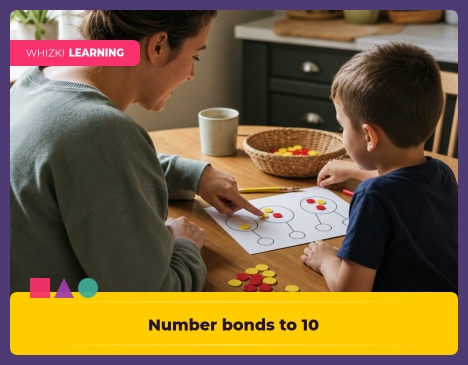
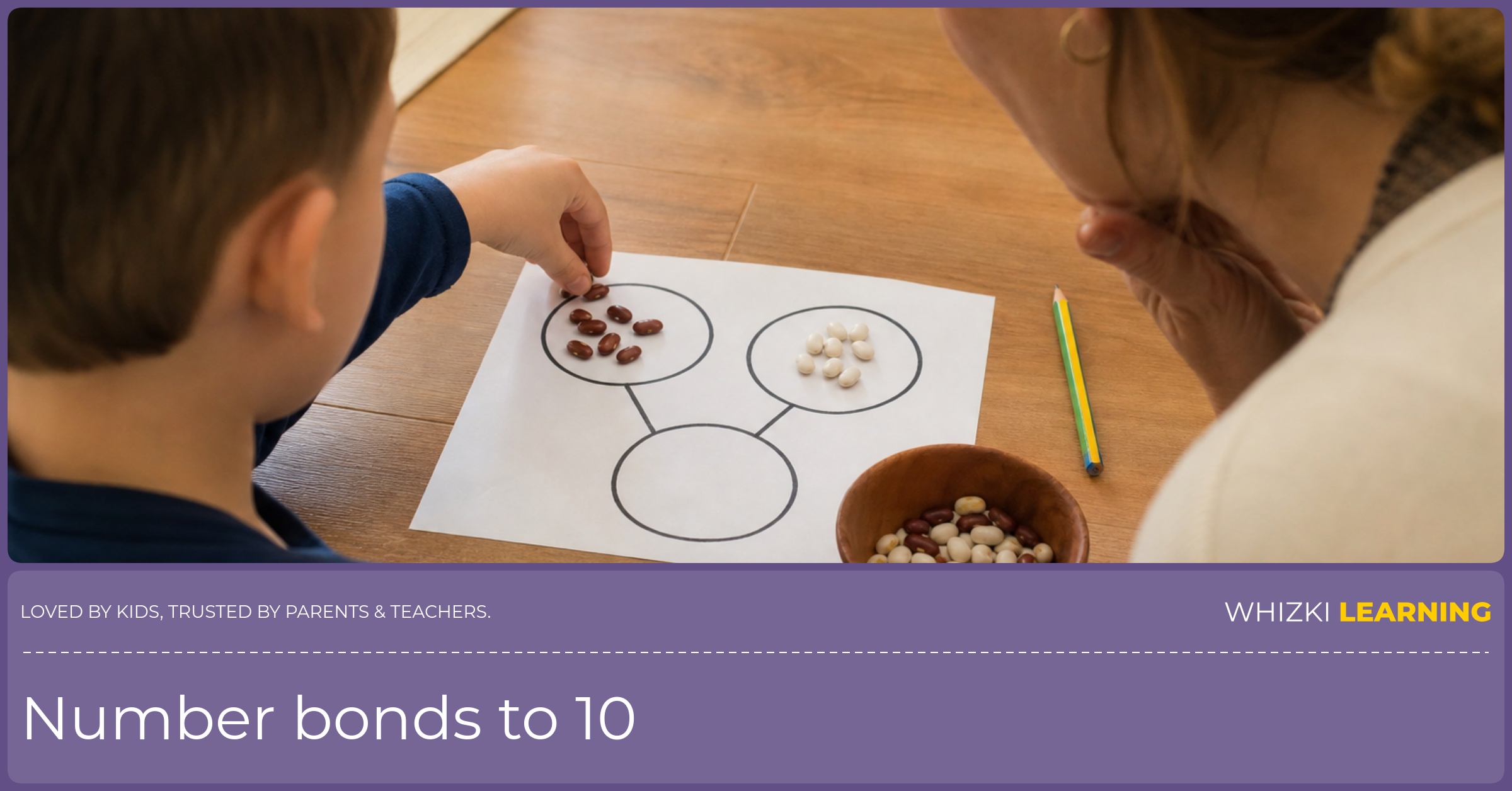
If your child keeps guessing 7 + 3 or stalls when fingers run out, draw one large circle for 10 and two smaller circles underneath, then move beans to show 7 and 3. Number bonds to 10 give young children a picture for how a whole number breaks into parts. A calm two-minute practice round at the table often works better than another long worksheet when a child is tired.
Reviewed by Whizki Editorial Team, Early Childhood Education Editors.
What number bonds to 10 mean
A number bond is a small math diagram that shows one whole and two parts. For bonds to 10, the whole is always 10, and the parts might be 6 and 4, 8 and 2, or 5 and 5. The diagram helps a child see that addition is about joining parts, not memorizing a string of symbols.
The Montessori and Reggio traditions both remind adults to start with objects a child can touch before moving to paper. Ten buttons, cereal pieces, connecting cubes, or pebbles make the whole number feel real. The written number bond comes after the child has moved the parts with hands and eyes.
In parent language, Common Core K.OA.A.3 asks kindergarten children to break numbers up to 10 into pairs and record the pair with a drawing or equation. The standard sounds formal, but the classroom action is simple: children show that 10 can be 9 and 1, 7 and 3, or another matching pair. For more number sense support, the numbers learning hub keeps counting, tracing, and early operations in one place.
Why bonds to 10 help addition feel easier
Number bonds to 10 give children a mental landmark. When a child knows 8 needs 2 to make 10, the child has a friendly place to start for 8 + 2, 2 + 8, and later 8 + 3. The bond picture also prepares children for ten-frames and place value without rushing past early understanding.
The Orton-Gillingham approach is best known for reading, but the teaching habits carry beautifully into early math: say the fact, build the fact, write the fact, and review the fact across days. A child might say “six and four make ten,” push six red cubes and four blue cubes together, then write 6 + 4 = 10. The multisensory loop keeps the math grounded instead of floating as a chant.
When a child is ready for more pair practice, all the ways to make 10 can extend the lesson with games and quick routines. The best practice is short, varied, and repeated, because young children often need many gentle meetings with the same idea. The goal is fast recognition over time, not speed pressure in the first lesson.
Bonds-to-10 chart for quick reference
A bonds-to-10 chart is a reference tool, not a test. Keep the chart near the practice area and let a child peek while the pairs are still new. NAEYC guidance asks adults to match learning to a child’s development, and open access to the chart supports confidence before recall.
Bonds-to-10 chart: 0 + 10 = 10; 1 + 9 = 10; 2 + 8 = 10; 3 + 7 = 10; 4 + 6 = 10; 5 + 5 = 10; 6 + 4 = 10; 7 + 3 = 10; 8 + 2 = 10; 9 + 1 = 10; 10 + 0 = 10. Read the chart from left to right on one day, then cover one addend on another day. The covered-number routine turns the chart into a thinking game.
The chart becomes more useful when the child connects each pair to a tiny story. Four crackers on the plate and six crackers in the bowl make ten crackers. Seven toy cars in the garage and three toy cars on the road make ten toy cars.
How to teach number bonds with hands-on practice
Hands-on number bond practice starts with one mat and ten small objects. Draw one circle at the top for the whole and two circles below for the parts, then let the child move objects between the bottom circles. Occupational-therapy basics favor a clear work space, stable posture, and small graspable items because the body work can either support the math or get in the way.
Start with the whole group of 10 in the top circle, then move some objects into the left part and the rest into the right part. Ask, “How many are here, and how many are there?” rather than asking for the equation first. The question keeps attention on quantity before symbols.
After the child names both parts, write the matching equation below the mat. A teacher might say, “I see 6 and 4. Six plus four equals ten.” The speech-language habit of modeling a full sentence helps children hear the math relationship clearly before being asked to repeat the full sentence alone.
If the child reverses the parts, celebrate the discovery. Four and six still make ten, and that switch is the beginning of understanding the commutative property in child-friendly language. Keep the wording simple: “The parts traded places, and the whole stayed ten.”
Printable practice and worksheets
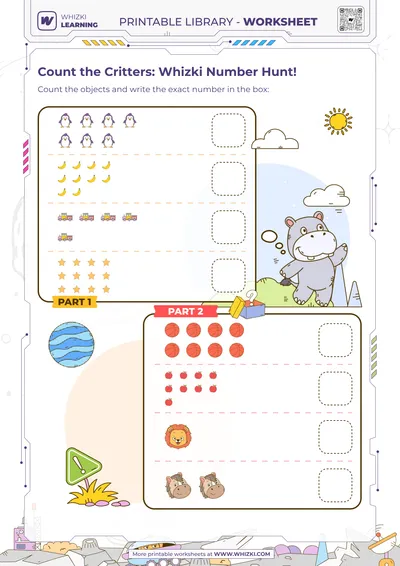
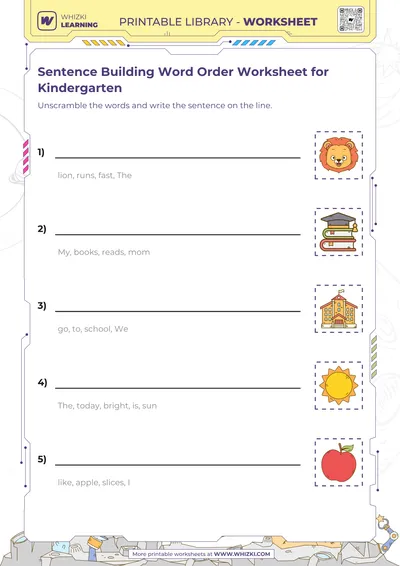
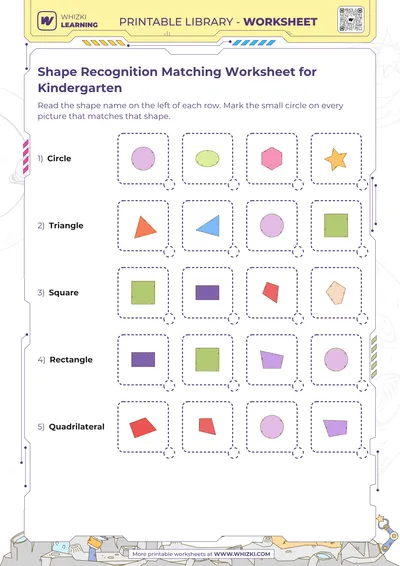
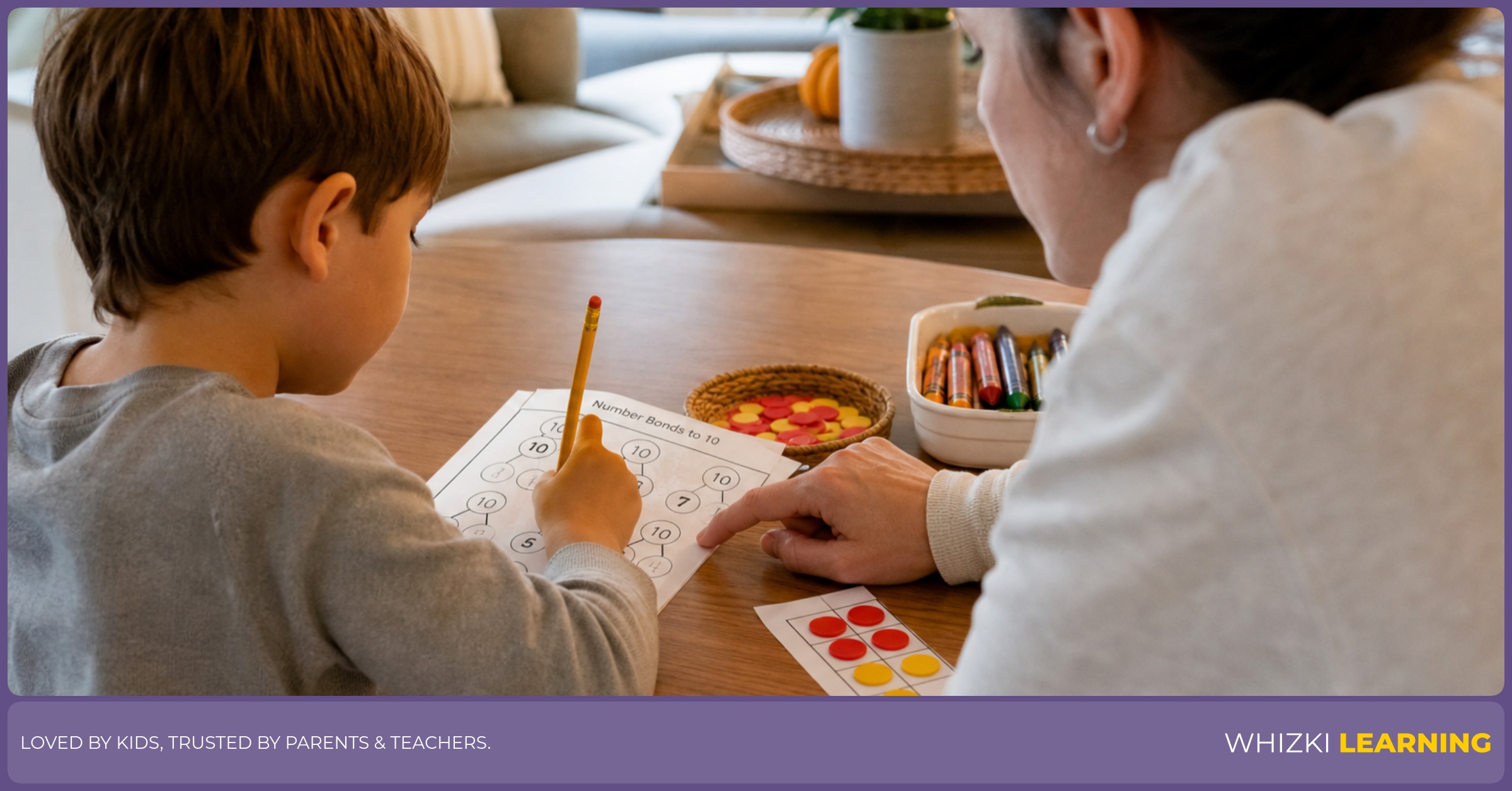
Printable number bonds to 10 worksheets work best after a child has built the pairs with real objects. The ten-frame warm-ups, cut-and-paste bond pages, and trace-and-solve sheets in our printable library give children paper practice without asking adults to create a new page every morning. I like to place only one page on the table so the work feels doable.
For repeated practice, our worksheet sets include early math pages that can be printed across several short sessions. A preschooler might trace the pair, a kindergartener might fill the missing part, and a first grader who still needs review might write the matching equation. The same bond idea can meet different children without making the task feel babyish.
For a ready-to-print option, the Number Bonds to 10 Practice Set pairs blank bond mats, missing-part pages, and make-10 review sheets for ages 4 to 7. The complete pack lives in Whizki Plus. I would print a few pages at a time, because young children learn more from steady practice than from a thick stack.
A good worksheet page leaves enough white space for small hands and growing pencil control. Occupational-therapy basics remind teachers to watch grip, wrist position, and fatigue during pencil tasks. If a child understands the pair with cubes but struggles to write the numerals, the writing load can be reduced while the math practice continues.
Common mistakes and simple fixes
A common number bond mistake is asking for memorized facts before the child has a picture of the parts. The Orton-Gillingham teaching pattern would move back to build, say, and write rather than repeat a missed fact louder. The fix is simple: return to ten objects and let the child rebuild the pair.
Another common mistake is doing too many pairs in one sitting. NAEYC-aligned practice respects attention span, especially for children ages 3 to 7. Three strong examples with calm talk are better than a full page finished with frustration.
A third common mistake is treating zeros as unimportant. Zero and ten is a real bond, and ten and zero is a real bond in the other order. Children who understand zero as “none in that part” often handle missing-addend work with less confusion later.
Number bonds to 10 are small, but the skill gives children a sturdy way to see addition. Start with ten objects, name the two parts, write one matching equation, and stop while the practice still feels successful.