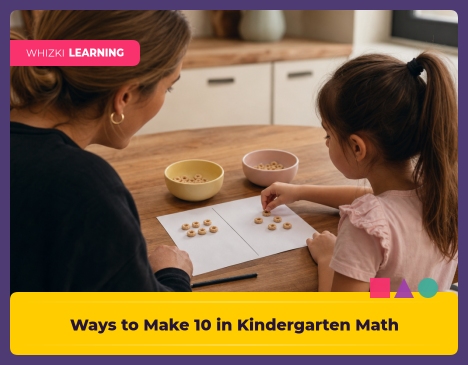
If 10 facts are turning snack time into a standoff, put ten raisins on the table tonight and ask your child to move some into each of two bowls. Ten is a friendly number because children already carry ten fingers, count ten toes, and see ten spaces on the ten-frame that shows up on kindergarten pages. Common Core K.OA.A.3 means your kindergartener will be asked to break 10 apart in different ways, and kitchen-table practice gets your child there.
Reviewed by Whizki Editorial Team, Early Childhood Education Editors.
Number bonds that make 10
Number bonds are just two smaller amounts that join to make one larger amount. In Reggio and Montessori-inspired rooms, teachers often start with real objects because children learn the relationship before children memorize the symbol. A parent can do the same thing with raisins, buttons, cereal pieces, pennies, or small blocks.
Kid-readable pairs for 10 can sound like this: 1 raisin with 9 raisins, 2 buttons with 8 buttons, 3 cereal pieces with 7 cereal pieces, 4 pennies with 6 pennies, 5 blocks with 5 blocks, 6 grapes with 4 grapes, 7 crackers with 3 crackers, 8 beads with 2 beads, and 9 cubes with 1 cube. The pair order changes, but the whole stays 10, which is the big idea behind number bonds.
The 5 and 5 pair deserves extra attention because 5 + 5 is the central kindergarten doubles fact. The 5 and 5 split also builds the ten-frame idea, with five spaces on the top row and five spaces on the bottom row. For children still working on numeral recognition, our number 10 learning page gives simple practice with the numeral, the count, and the quantity.
Hands-on kitchen-table games
Hands-on math works best when the game is short, calm, and concrete. NAEYC guidance for early childhood math points parents toward playful counting with real materials, and occupational therapy basics remind adults that small fingers need touch, movement, and time. Five minutes is enough for a preschooler or kindergartener who is learning to hold ten in mind.
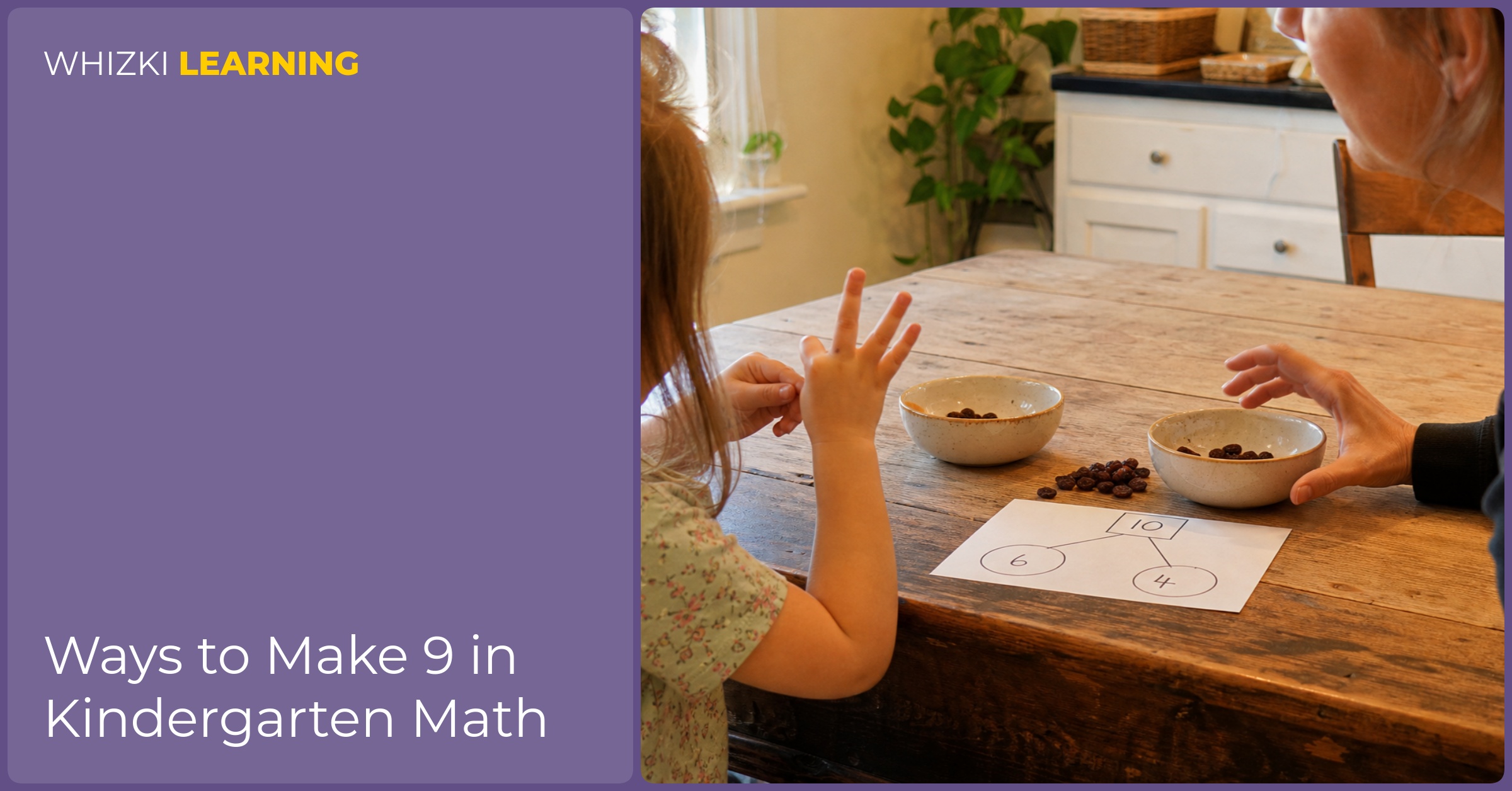
The two-bowl raisin game is the easiest start: put 10 raisins in one pile, move some raisins into a left bowl, and place the rest in a right bowl. A parent can ask, “How many here, and how many there?” The child can try every split across several days, with no need to finish all pairs in one sitting.
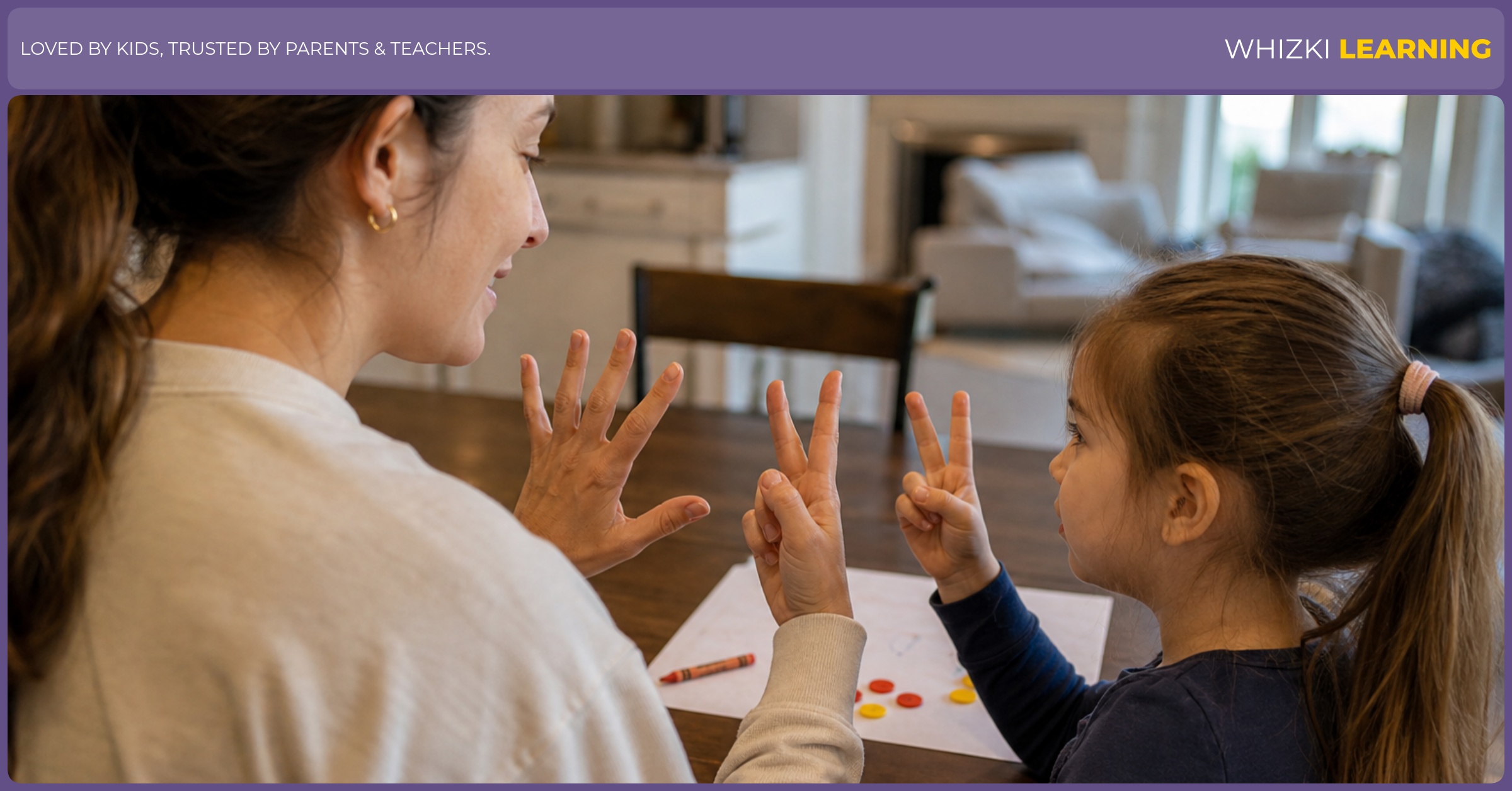
The finger-bond game uses the math tool children always have nearby: two hands. A child can show 10 fingers, then hide some fingers on the left hand while the right hand stays open, or show 4 on one hand and 6 on the other. Finger patterns help children see 10 as a whole made of parts, which is why many kindergarten teachers still use fingers even after worksheets appear.
The snack-time share 10 game works well with a sibling, cousin, or stuffed animal. A parent can place 10 crackers on a plate and say, “Share 10 so each friend gets some.” The social piece keeps the math natural, and the sharing talk gives children language for more, fewer, same, left, and right.
Simple equations on paper
Paper equations should come after the child has touched the objects and said the pairs out loud. The Orton-Gillingham approach reminds educators to connect sight, sound, movement, and language, and the same multisensory pattern helps early math. A parent can write the marks slowly and say, “The plus sign means join, and the equal sign means the same amount as.”
Write the full set in a low-pressure way: 1 + 9 = 10, 2 + 8 = 10, 3 + 7 = 10, 4 + 6 = 10, 5 + 5 = 10, 6 + 4 = 10, 7 + 3 = 10, 8 + 2 = 10, and 9 + 1 = 10. The first paper practice is exposure, not drill, so a child can trace one equation, circle the 10, or match the equation to the bowls.
Everyday counts make the equations feel useful: ten fingers, ten toes, ten cents in a dime, and ten boxes on a ten-frame. The numbers learning hub can help a parent connect number names, numerals, and quantities without turning breakfast into a lesson plan. A short, friendly count matters more than a perfect written page.
When a parent wants a ready-to-use page, our counting printables offer hands-on counting and number sense practice for ages 3 to 7. Print one page, add a handful of raisins or blocks, and keep the work light.
If you want to keep the same practice going on paper, take a look at our preschool and kindergarten math workbook.
Ways to make 10 become easier when a child sees the same ten objects split, joined, moved, and named across ordinary moments. What your kid will hear at school: Common Core K.OA.A.3 asks kindergarten children to decompose 10 into pairs in more than one way.