
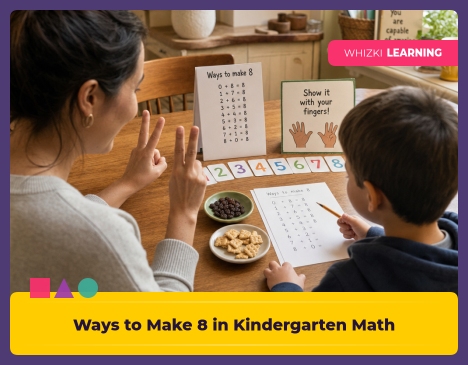
Some days, “Can we do math?” turns into a tug-of-war at the kitchen table, and you just want something that feels doable. This guide gives you quick, hands-on ways to make 8 that match what kindergarteners practice, without worksheets taking over your evening. For our number 8 learning page, start here: our number 8 learning page.
Reviewed by Whizki Editorial Team, Early Childhood Education Editors.
Number bonds for 8, every pair
Number bonds are a friendly way to see that 8 can be made from two smaller amounts, and this is exactly the kind of thinking your child will use at school. Common Core K.OA.A.3 practice looks like this, your kindergartener will be asked to break 8 apart in different ways, and this is the practice that gets them there. For extra context on the numbers your child is building, visit the numbers learning hub.
Use real objects for the pairs, and keep the focus on “How many on this side, and how many on that side?” Show the pairs as kid-readable sets, like 1 raisin and 7 raisins, 2 crackers and 6 crackers, 3 grapes and 5 grapes, and 4 pretzels and 4 pretzels. Then keep going with 5 and 3, 6 and 2, and 7 and 1 so the whole set of pairs feels familiar.
Here is the full set of pairs to say out loud while you build with objects: 1 + 7 = 8, 2 + 6 = 8, 3 + 5 = 8, 4 + 4 = 8, 5 + 3 = 8, 6 + 2 = 8, 7 + 1 = 8. The doubles fact, 4 + 4, is worth extra attention, because it becomes a quick “I know it” moment.
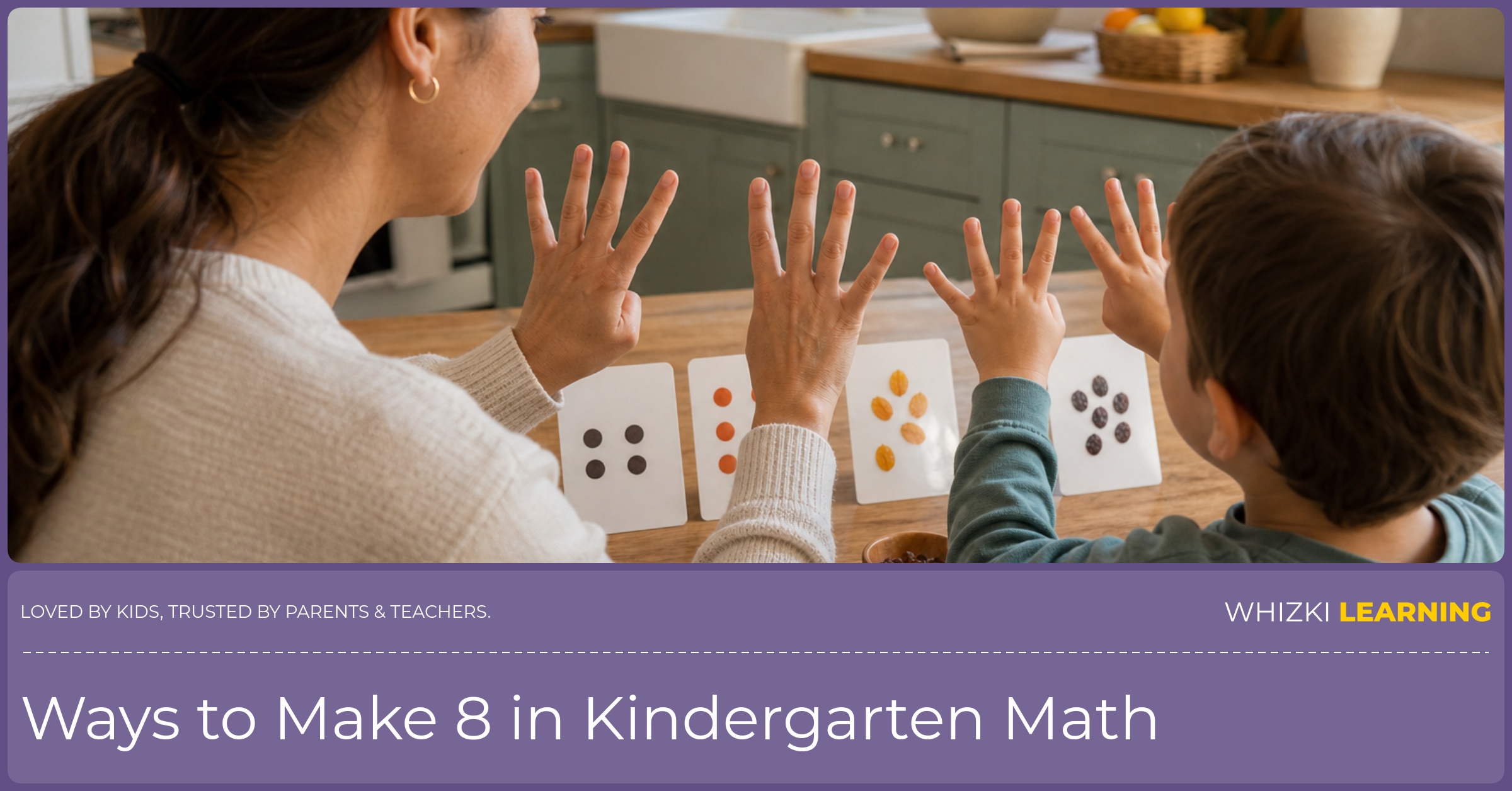
To make 4 + 4 stick, use your hands like a visual number bond. Put four fingers up on the left hand, then four fingers up on the right hand, and count together: “1, 2, 3, 4 on this side, and 1, 2, 3, 4 on that side. That makes 8.”
Hands-on object games for 5 minutes
Occupational-therapy basics for early math say, kids learn through movement and touch, so object play is not “extra,” it is the work. Keep each game short, and let your child choose the objects, like raisins, cereal, or small crackers. When the child is actively moving pieces, number bonds feel like a discovery instead of a test.
Game 1, Split 8 raisins into two bowls in every way. Put 8 raisins on a plate and two small bowls in front of your child. Say, “Let’s make 8 two ways,” then help them try one split, like 1 and 7, and cheer when they find the next split, like 2 and 6. Keep going until you have tried all pairs, and stop while your child still wants more.
Game 2, Finger-bond with two hands. Hold up both hands and ask, “How many on the left, how many on the right, so we make 8?” Your child can show 3 and 5 by lifting three fingers on one hand and five on the other, then you can switch to 6 and 2. This game builds the mental picture of “part-part-whole” without needing paper.
Game 3, Snack-time share 8 with a sibling. During snack, set out a plate with 8 pieces, like apple slices or cheese cubes, and invite a sibling or caregiver to share. Say, “Can you give your friend some and keep the rest so we still have 8 total?” The goal is to try different shares, like 4 and 4 or 7 and 1, while your child watches the total stay the same.
Want hands-on practice that stays parent-friendly? Check out our counting printables for quick, low-prep activities that support number sense and object counting. These are great when you want a little extra structure on a busy day, without turning your kitchen table into a worksheet station.
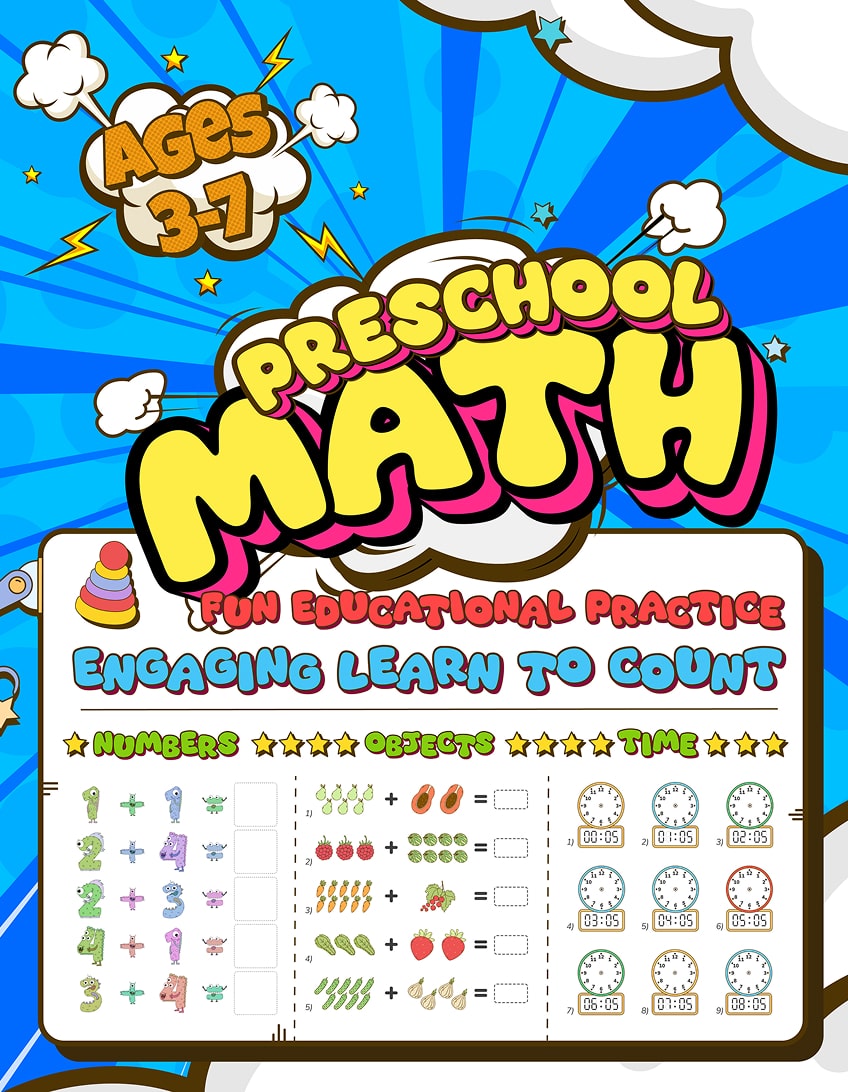
If you want to keep the same practice going on paper, take a look at our preschool and kindergarten math workbook.
Simple equations on paper, low-pressure
Paper equations come after object play, and that order matches how young children build meaning. Speech-language pathology practice often highlights that children need repeated language exposure, so you can introduce the symbols gently while the objects are still nearby. For example, after a split game, write the pair as an equation while your child points to the objects.
Write each pair as a full sentence with numbers and symbols, like 1 + 7 = 8, 2 + 6 = 8, 3 + 5 = 8, and 4 + 4 = 8. Then write the remaining pairs, 5 + 3 = 8, 6 + 2 = 8, and 7 + 1 = 8. The first time your child sees + and =, treat it like a new label, not a trick.
Keep the paper time short, and use a “point and read” routine. Your child can point to the + sign and say “and,” then point to the = sign and say “makes” or “is.” If your child gets wiggly, switch back to objects for one more round, then return to paper for just one equation.
To connect math to everyday life, count eight in familiar places without making it a lesson. You can notice eight legs on an octopus, eight legs on a spider, or eight slices in a typical pizza. These quick counts help number sense feel normal, not scheduled.
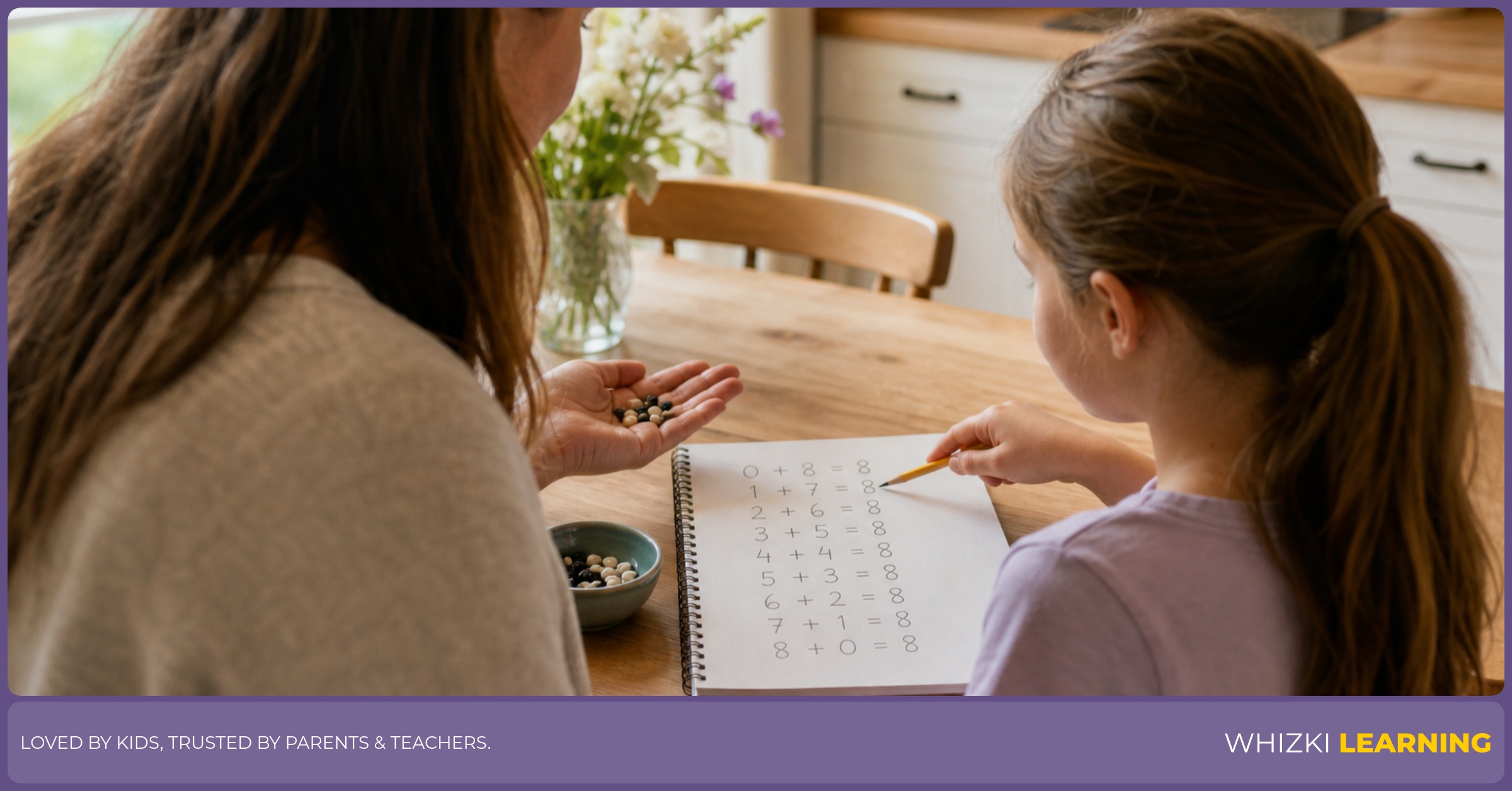
When your child practices making 8 with objects, hands, and a couple of simple equations, school feels familiar instead of scary. At school, your child will hear language like, “Break 8 into two parts,” and “Show different ways to make 8,” which lines up with Common Core K.OA.A.3.