
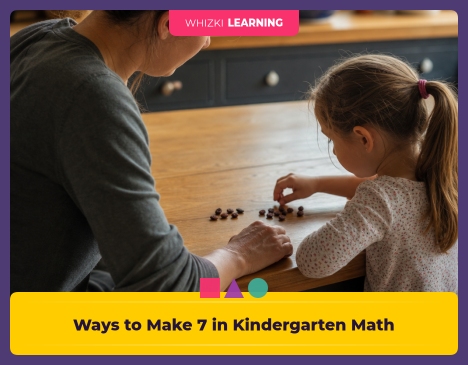
If your child melts when math turns into a quiz, grab seven raisins or buttons and make one tiny "how can we split 7?" game before the table gets cleared. The goal is calm practice with real objects, because ages 3 to 7 learn number relationships best when hands can move, count, and check.
Common Core K.OA.A.3, in plain English, means your kindergartener will be asked to break 7 apart in different ways, and kitchen-table practice gets your child ready for that school language.
Reviewed by Whizki Editorial Team, Early Childhood Education Editors.
Number bonds that make 7
A number bond is just a whole number broken into two parts. In Orton-Gillingham-style math support, the adult moves from real objects to spoken words to written symbols, because many young children need to feel the count before a mark on paper means anything.
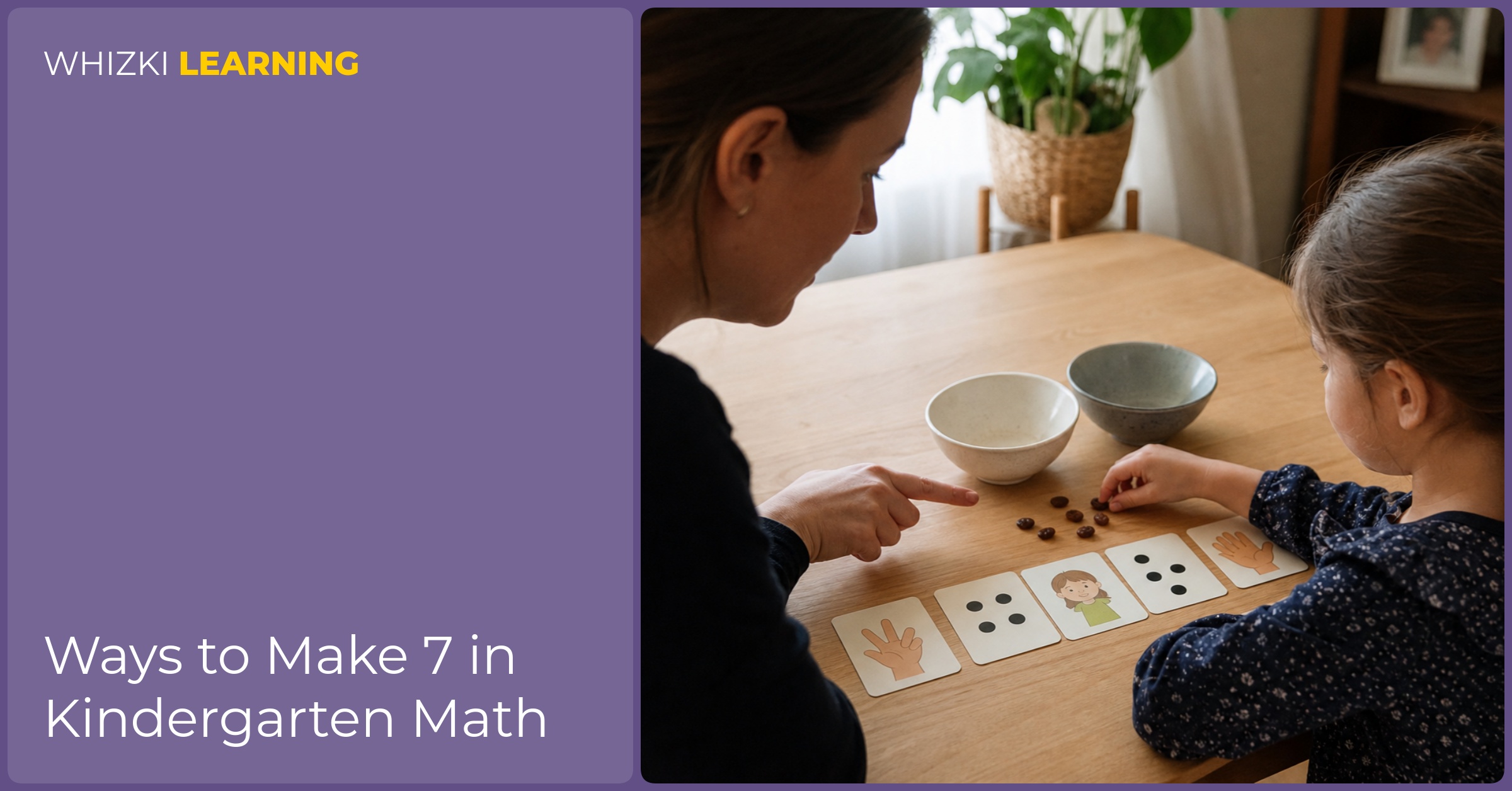
The six kid-readable pairs for 7 are easy to show on the table. Put 1 raisin on a napkin and 6 raisins beside the napkin, then say, "1 and 6 make 7." Move the raisins again for 2 and 5, 3 and 4, 4 and 3, 5 and 2, and 6 and 1.
The reversal matters, because 3 and 4 feels different in little hands than 4 and 3, even though the total stays 7. If your child is still working on recognizing the numeral, start with our number 7 learning page, then come back to the split-apart games. For broader counting practice, the numbers learning hub keeps number work organized by skill.
Three 5-minute kitchen-table games
Hands-on math should feel short, visible, and repeatable. NAEYC guidance for early childhood learning points adults toward playful, meaningful practice rather than long drill, and the kitchen table gives your child enough structure without turning math into a worksheet battle.
The two-bowl raisin game starts with exactly 7 raisins. Your child puts some raisins in the first bowl and the rest in the second bowl, then the adult names the bond: "2 in the blue bowl and 5 in the white bowl make 7." After the count, your child pours the raisins back and tries a new split.
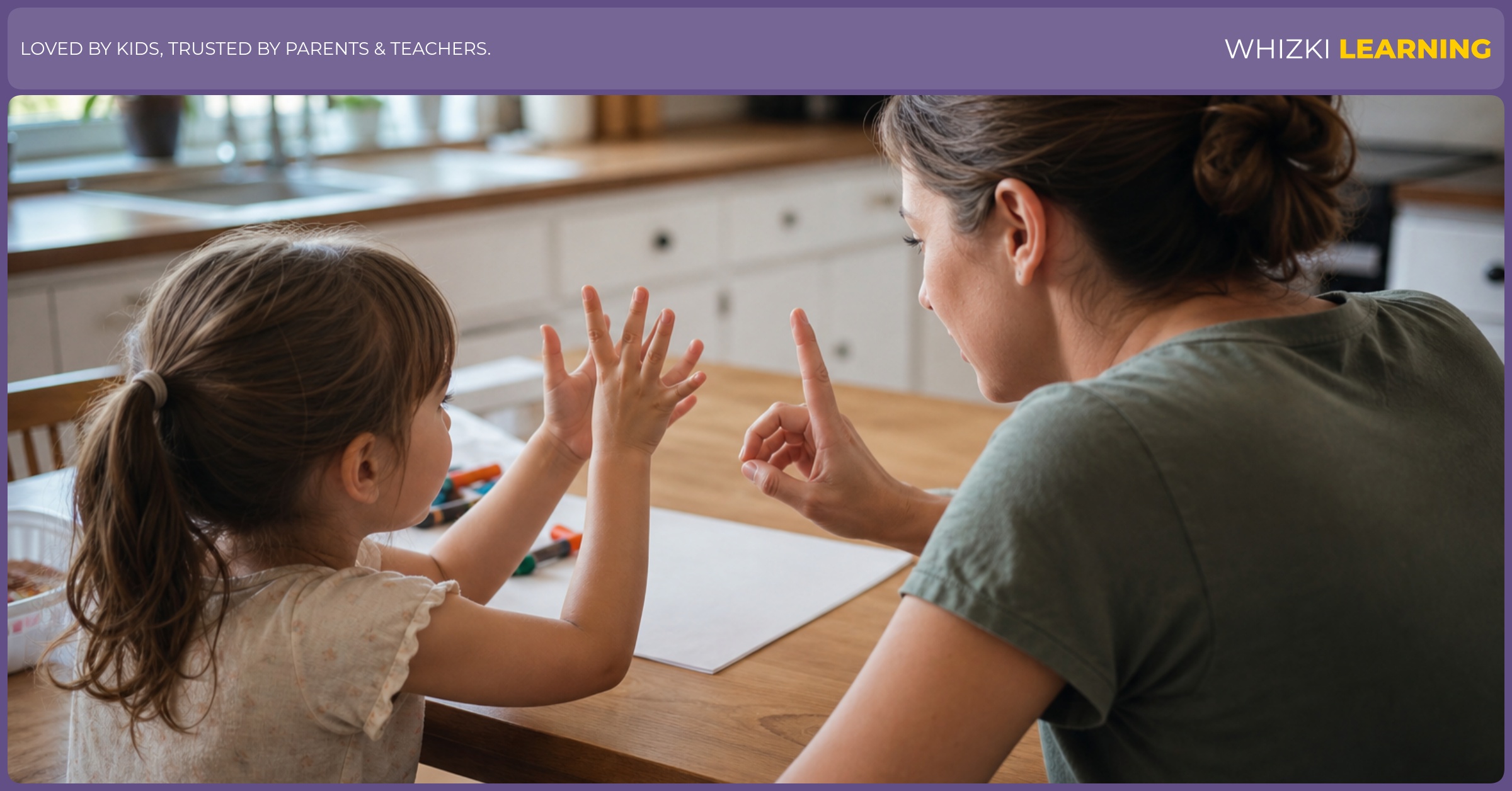
The finger-bond game uses two hands as a built-in math tool. Occupational-therapy basics remind adults that finger awareness and hand movement are real early learning supports, so ask, "Show me 7 fingers. How many fingers are on the left hand, and how many fingers are on the right hand?" Your child may show 5 and 2 first, then 4 and 3, then another split.
The snack-time share 7 game works best with crackers, grapes, or cereal pieces. Give 7 pieces to one child and ask, "How could two people share 7?" A sibling may get 3 while your child keeps 4, and the adult can say the math out loud without making fairness the main lesson.
When a ready page would make the day easier, choose one calm counting sheet from our counting printables and stop after a few minutes. The printable should support the raisin and finger work, not replace the hands-on counting that makes 7 feel real.
If you want to keep the same practice going on paper, take a look at our preschool and kindergarten math workbook.
Simple equations on paper
Paper comes after objects, because written symbols make more sense once your child has already built the total. In Orton-Gillingham lesson flow, the adult connects concrete work, spoken language, and written marks in that order, so the plus sign and equal sign arrive as names for something familiar.
Write the first equation slowly: 1 + 6 = 7. Say, "One raisin plus six raisins equals seven raisins," and point to each part while your child looks at the objects. The plus sign can mean "put together," and the equal sign can mean "same amount as."
After the first equation, write 2 + 5 = 7, 3 + 4 = 7, 4 + 3 = 7, 5 + 2 = 7, and 6 + 1 = 7. Keep the page loose, because the first meeting with + and = signs should be exposure, not a timed drill. If your child wants to draw raisins or circles under the numbers, the drawing is useful proof of thinking.
Everyday sevens your child will notice
Everyday counting gives 7 a place in family life. Reggio-inspired teaching asks adults to notice what children already care about, so seven days in a week, seven colors in a rainbow, or the seven dwarfs can become quick counting moments instead of formal lessons.
The everyday count should stay light. A parent might say, "Today is the third day we marked on the calendar, so how many days are left in our seven-day week?" Your child does not need to solve every moment perfectly, because the repeated noticing builds comfort with the number.
Ways to make 7 practice can be five minutes long and still count as real kindergarten preparation. What your kid will hear at school: Common Core K.OA.A.3 asks children to decompose numbers like 7 into pairs in more than one way.