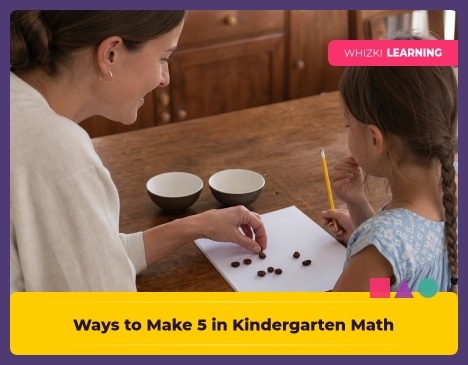
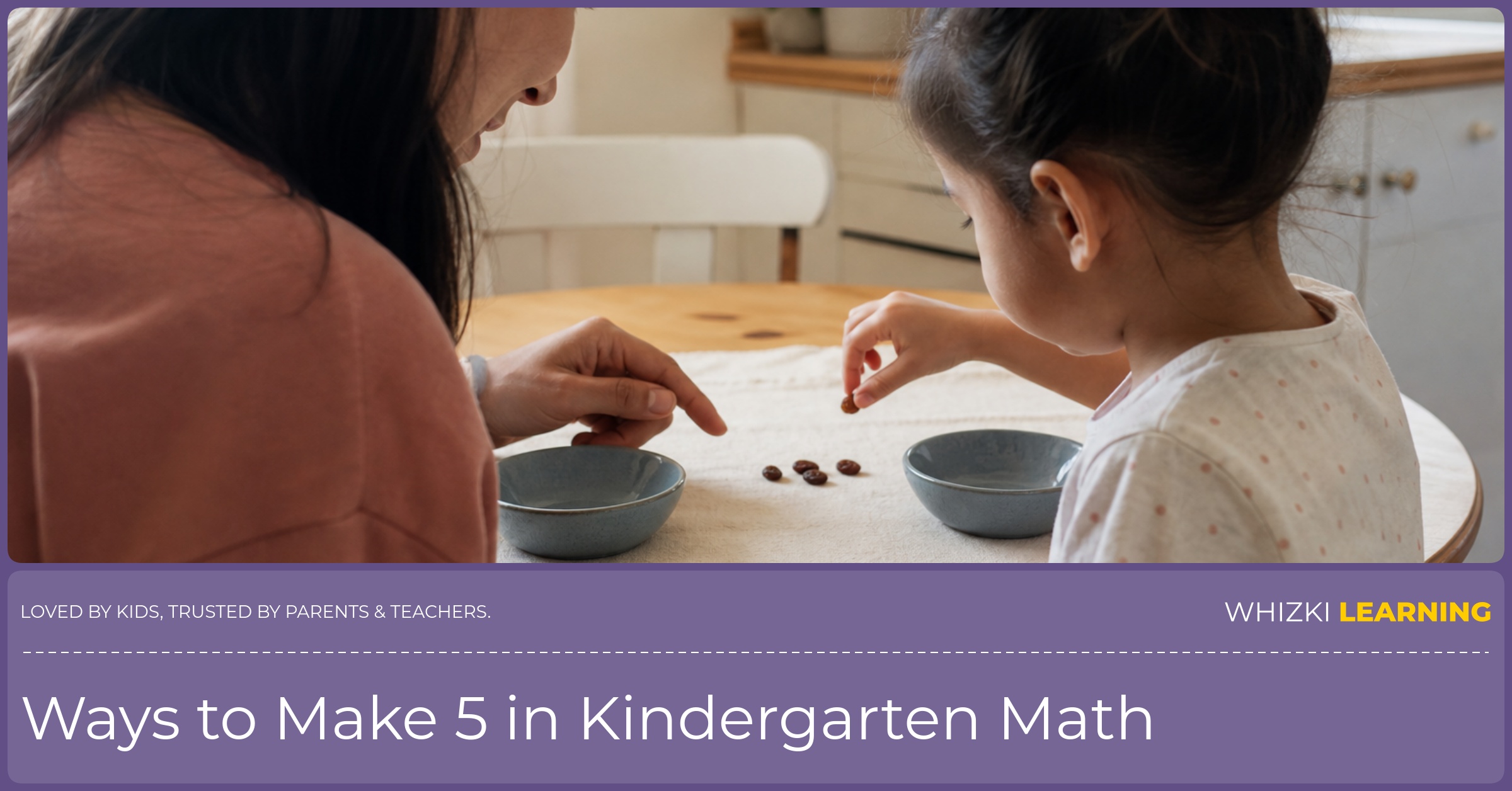
If your child shuts down when a math page lands on the table, start by putting five raisins on a napkin and asking, “Can we split these into two bowls?” Ways to make 5 feel much kinder when the math starts in small hands instead of on a worksheet. Common Core K.OA.A.3 simply means your kindergartener will be asked to break 5 apart in different ways, and kitchen-table practice gets your child ready.
Reviewed by Whizki Editorial Team, Early Childhood Education Editors.
Number bonds that make 5
A number bond is just a whole number split into two smaller parts. In a Reggio-inspired or Montessori-style math moment, real objects come first because children learn the pattern by seeing, touching, moving, and naming the parts.
The whole is 5, and the parts can be 1 and 4, 2 and 3, 3 and 2, or 4 and 1. Say the pair as a tiny story: one raisin in the left bowl and four raisins in the right bowl make five raisins altogether.
The next pair can be two crackers on one napkin and three crackers on another napkin. The swap also matters, so three crackers on one napkin and two crackers on another napkin still make five, and four blocks beside one block still make five.
Hands-on games with 5 objects
The raisin bowl game takes about five minutes and works well for a wiggly child. Occupational therapy basics remind parents that small finger movements, pinching, placing, and sliding objects can help a child stay with a task longer than sitting still with a pencil.
The split-5 game starts with five raisins and two bowls. Your child moves the raisins into the bowls in different ways while the adult says the math out loud: one and four make five, two and three make five, three and two make five, four and one make five.
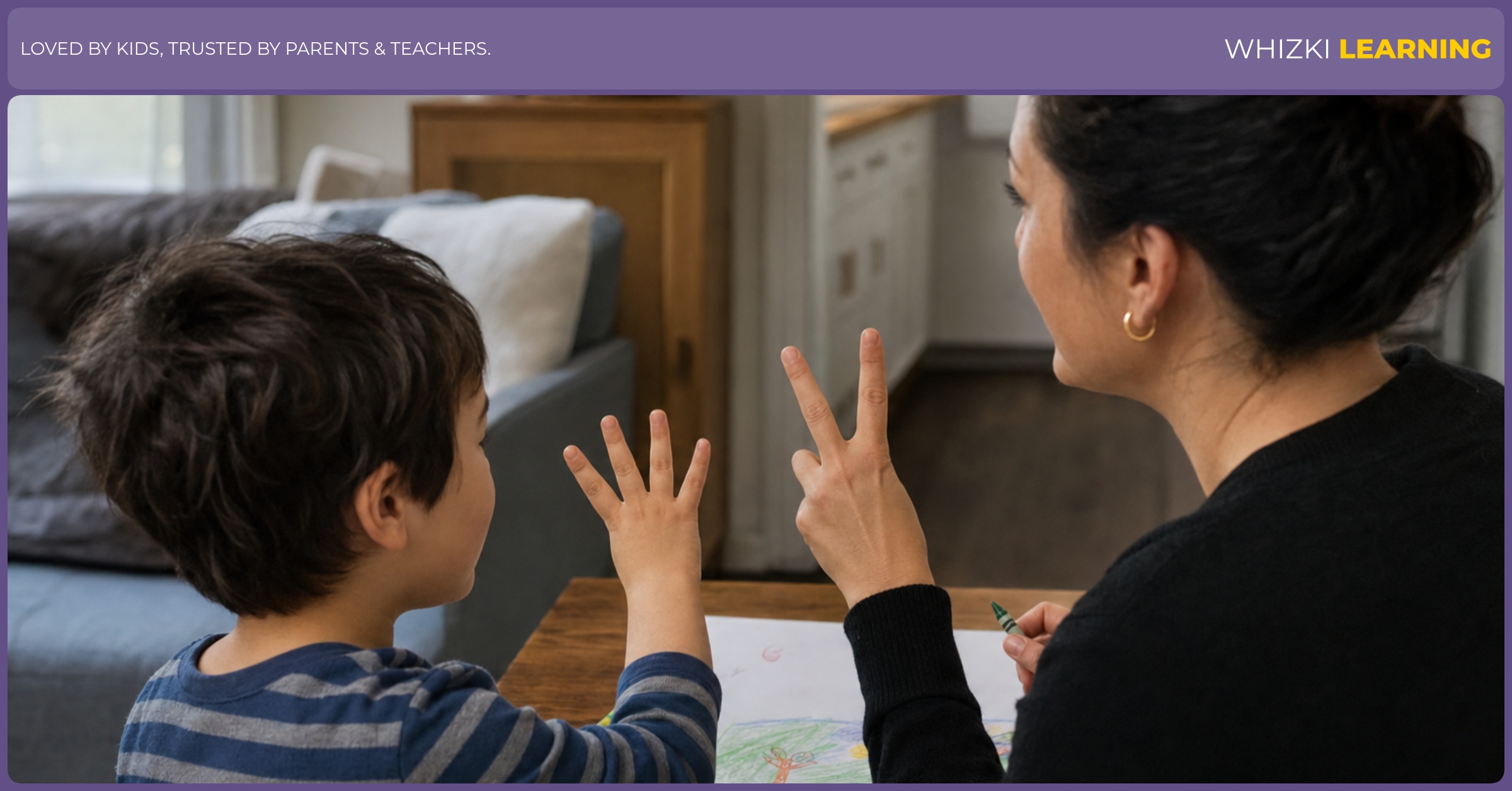
The finger-bond game uses two hands and no supplies. Hold up five fingers across both hands, then ask, “How many fingers are on the left hand, and how many fingers are on the right hand?” before changing the split.
The snack-time share game works best when the tone stays playful and fair. Give one child five apple slices to share with a sibling or grown-up, then talk through the split without correcting every move; for recognition and counting before the bonds, use our number 5 learning page or browse the numbers learning hub for more early number practice.
When a printed page would help, our counting printables can give your child a quiet follow-up after the bowls and fingers. A printable should come after real objects, not before, so the symbols connect to something your child already touched.
If you want to keep the same practice going on paper, take a look at our preschool and kindergarten math workbook.
Simple equations on paper
Simple equations on paper should feel like labeling a picture, not taking a test. The Orton-Gillingham approach uses clear, multisensory steps, and the same idea helps early math when a child touches the objects, says the parts, and then sees the symbols.
Write the first pair as 1 + 4 = 5 after your child has already placed one raisin in one bowl and four raisins in another bowl. Then write 2 + 3 = 5, 3 + 2 = 5, and 4 + 1 = 5, while your child points to the matching groups.
The plus sign can mean “put together,” and the equal sign can mean “same amount as.” If the signs feel new, keep the pencil in the adult hand at first and let your child trace, circle, or simply watch without pressure.
Everyday counts that support making 5
Everyday counts help a child notice that 5 shows up all over family life. NAEYC guidance encourages math in meaningful routines, so five fingers on one hand, five toes on one foot, five senses, and the five points on a star can become quick counting moments.
A short observation from Reggio practice helps here too: watch which object holds your child’s attention, then use that object for the next math minute. A child who loves snack math can split five blueberries, and a child who loves drawing can make a star and count the points.
Small, repeated experiences with 5 build comfort faster than a long drill session. School language: Common Core K.OA.A.3 asks children to break 5 apart in different ways and put 5 back together.