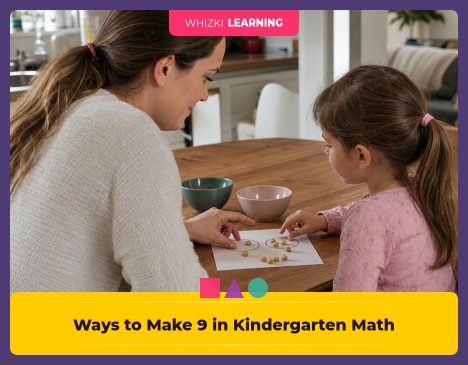
If your child groans when math comes up, put nine tiny snacks on the table and say, “Let’s see how many ways we can split 9,” because a small real object is easier than a big worksheet. Common Core K.OA.A.3 simply means your kindergartener will be asked to break 9 apart in different ways, and kitchen-table practice gets your child there. Nine also shows up in everyday life, like nine innings in baseball, nine squares on a tic-tac-toe board, and the nine planets many parents remember from school.
Reviewed by Whizki Editorial Team, Early Childhood Education Editors.
Number bonds for 9, using kid-readable pairs
A number bond is just a friendly way to say, “Two parts make one whole.” In my kindergarten small groups, the Orton-Gillingham habit of saying, seeing, touching, and moving the pieces helps children remember the pairs without turning math into a chant they do not understand.
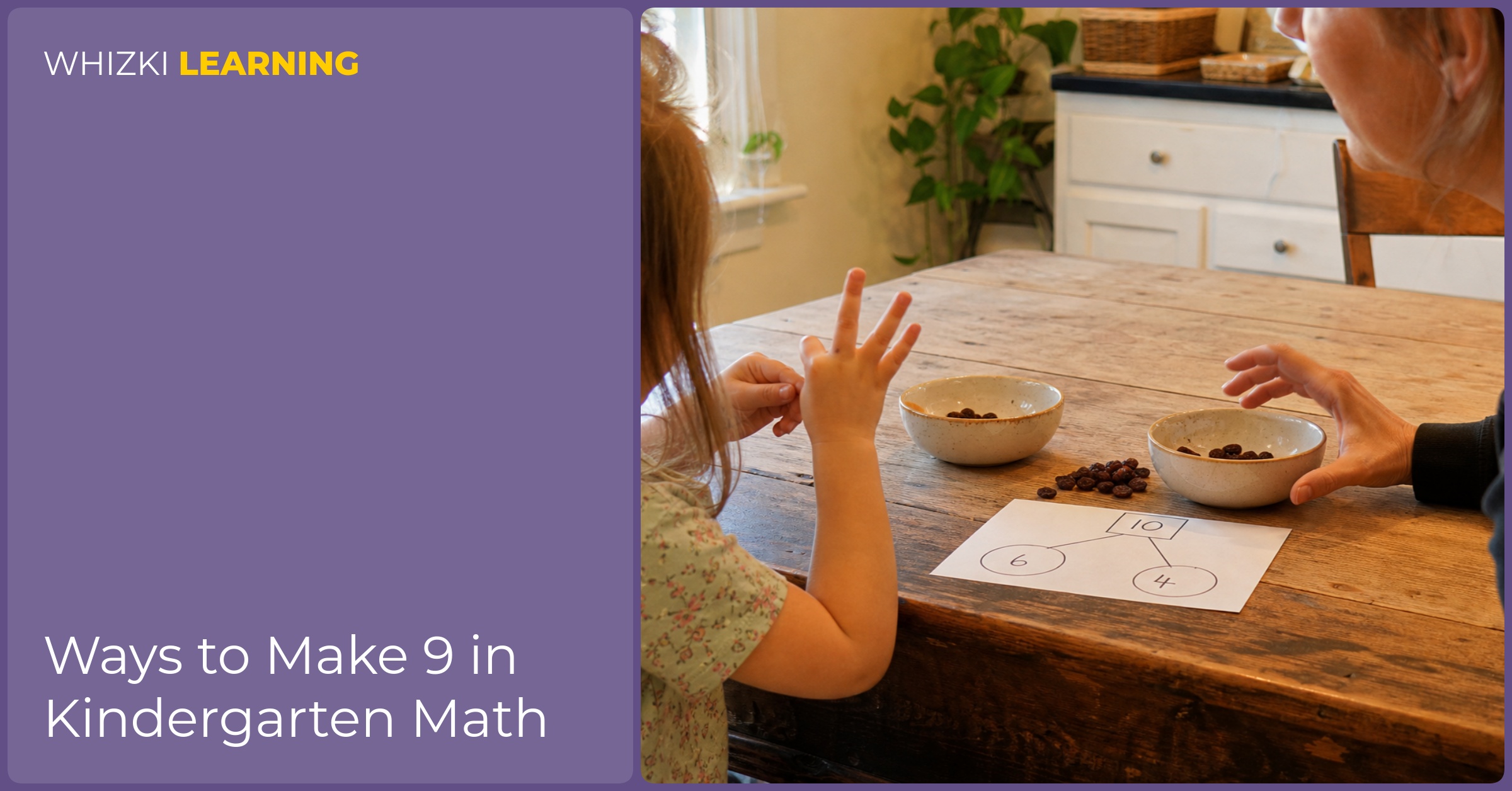
The number bonds for 9 can sound like real objects: 1 raisin and 8 raisins, 2 buttons and 7 buttons, 3 crackers and 6 crackers, 4 blocks and 5 blocks, 5 blocks and 4 blocks, 6 crackers and 3 crackers, 7 buttons and 2 buttons, 8 raisins and 1 raisin. A child does not need to call the idea a “number bond” on day one. A child only needs to notice that both bowls still have 9 altogether.
The pair order matters because kindergarten math asks children to see that 4 and 5 make 9, and 5 and 4 also make 9. Reggio-inspired teaching gives children time to arrange, tell, and revise their thinking, so a child can move the crackers and say, “Now the big pile is on the other side.” If counting 9 still feels new, start with recognition and one-to-one counting on our number 9 learning page before asking for all the pairs.
Three 5-minute object games for making 9
The raisin bowl game is the easiest place to begin: count 9 raisins together, slide some into one bowl, slide the rest into another bowl, and say the two parts out loud. NAEYC guidance supports playful, meaningful math for young children, and a snack-sized task keeps the work short enough for a preschooler or kindergartener to stay with the idea.
The finger-bond game uses two hands, which is perfect for a child who needs movement before pencil work. Ask, “Show me 9 fingers, with some on the left hand and some on the right hand,” then name the split: “4 on the left and 5 on the right make 9.” Occupational-therapy basics remind teachers and parents that finger awareness, hand use, and counting can grow together during everyday play.
The share-9 snack game works well with a sibling, cousin, or stuffed animal at the table. Put 9 small crackers in the middle and ask, “How many crackers for you, and how many crackers for bear?” A child may make an uneven share first, and that uneven share is still good math when the total remains 9.
The kitchen-table rule is simple: stop before the game turns sour. Five happy minutes with real objects teaches more than fifteen dragged-out minutes, because young children learn best when the adult notices focus, fatigue, and curiosity in the moment. For more number play beyond 9, the numbers learning hub keeps the same early-math language across number pages.
When a parent wants paper support without turning the table into test prep, our counting printables offer hands-on counting and number-sense pages for ages 3 to 7. Choose one page after a raisin or finger game, and keep the page short, social, and calm.
If you want to keep the same practice going on paper, take a look at our preschool and kindergarten math workbook.
Simple equations on paper, without pressure
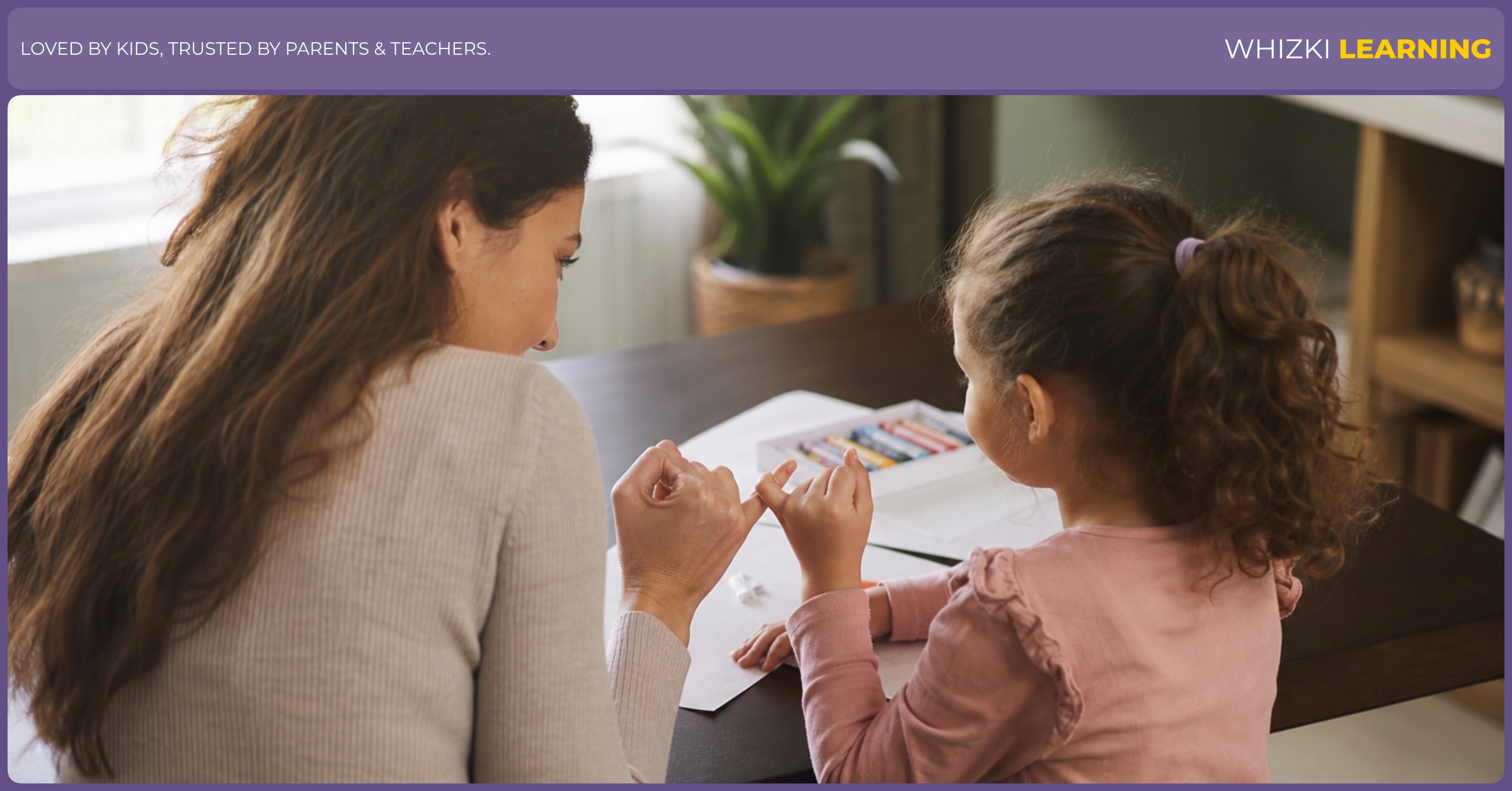
Paper equations come after the child has touched and moved the objects. The Orton-Gillingham approach reminds me to connect the symbol to a sound, a movement, and a meaning, so the plus sign can mean “put together” and the equals sign can mean “the same total.”
The first paper version can be a parent writing while the child points to the bowls: 1 + 8 = 9, 2 + 7 = 9, 3 + 6 = 9, 4 + 5 = 9, 5 + 4 = 9, 6 + 3 = 9, 7 + 2 = 9, 8 + 1 = 9. A child can read the equation as a sentence, such as “two and seven make nine,” before a child is ready to copy every mark.
The pencil part should stay loose for ages 3 to 7. NAEYC-aligned early math does not need speed drills, timed pages, or red marks to build number sense. A parent can write one equation, let the child draw the two bowls, and call the practice finished while the mood is still good.
Ways to make 9 are small enough for a kitchen table and important enough for school math. At school, Common Core K.OA.A.3 sounds like, “Show me more than one way to make 9.”