
PreschoolKindergartenFirst Grade

Roman Numeral IV for Kids: Meaning, Examples, and Easy Ways to Remember It

May 31, 2026
Roman Numeral IV for Kids: Meaning, Examples, and Easy Ways to Remember It

Roman numerals can feel like “why are we doing this” at breakfast, especially when your kid points at IV and expects an instant answer. The good news is that Roman numeral IV is simple to spot and easy to remember, and kindergarteners usually just need to read what they see.

Reviewed by Whizki Editorial Team, Early Childhood Education Editors.

Roman numeral IV in real life

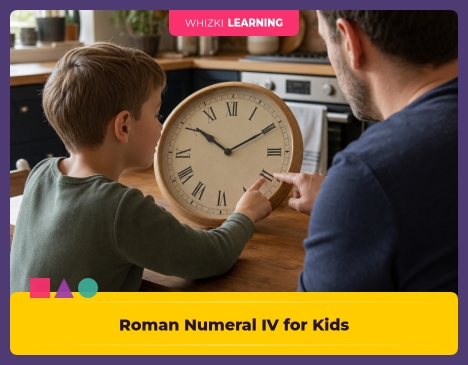
Roman numeral IV shows up where kids already look, on a Roman-numeral clock, on sports history, and in names. When your child sees IV by the hour hand, that sign is just telling time for 4 o’clock, not asking for Roman-numeral math. A quick parent win is to point and say, “That one is IV, and it means 4.”

Roman numeral IV also appears in Super Bowl history, like Super Bowl IV, and in real-world names such as Henry IV. If your child asks about “World War IV,” use it as a fun myth-buster and say, “World War IV does not exist, but people love making up number names for stories.”

A parent and child sit at a kitchen table with a screen-free Roman numeral clock, pointing to IV on the clock face and saying the number together

The one rule that makes IV equal 4

Roman numeral IV uses the subtractive idea, which Orton-Gillingham style teaching treats as a simple pattern to practice, not a puzzle to fear. The rule is: when I shows up before V, it means “one less than five,” so IV = 5 - 1. Say it out loud with your child: “IV is one less than five, so IV is 4.”

Roman numeral IV is easiest when your child can connect the symbols to a sentence. Use the memorize trick, and point at the clock: “I before V means take one away,” then tap the IV hour marker and repeat, “So IV is 4.”

A parent guides a child’s pencil to trace the Roman numeral IV on a napkin, with fingers holding the paper steady

Screen-free spot-and-say game for IV

Roman numeral IV does not need a worksheet, it needs noticing, which matches NAEYC guidance for learning through play and everyday experiences. Try a quick “spot and say” round while you move through the day, and keep it short, like one or two finds. Ask your child to hunt for IV on a clock face, in a book chapter number, or in a movie title, then say, “IV is 4,” together.

Roman numeral IV also benefits from a tiny tactile moment, like a once-through trace, because occupational-therapy basics often point to steady hand control and comfortable pencil grip. After your child finds IV, grab a napkin and trace the shape once with a finger, then once with a pencil, slow enough to feel the lines. If your child wants to do it again, let them, and keep the focus on reading the symbol, not speed.

Roman numeral IV at bedtime can be a gentle cue, not a test. When bedtime is 4 o’clock, say, “Let’s look for IV on the clock,” and celebrate the find with, “You spotted it, IV means 4.”

For extra practice that stays screen-free, use our Roman numeral IV learning page and pair it with our counting printables for more “spot it and say it” moments at home.

What kindergarteners need most (and what to skip)

Roman numeral IV is a reading symbol, not a math unit, and that matters for kindergarten readiness. NAEYC guidance reminds us that young learners do best with meaningful exposure, so the goal is for children age 3-7 to recognize IV and connect it to 4 when they see it. If your child asks “why,” the subtractive rule answer is enough, “I before V means take one away.”

Roman numeral IV does not require Roman-numeral arithmetic practice drills, and it is okay to keep the learning practical. The next time your child sees IV on a clock, a book page, or a name, treat it like a sight word moment, read it together, and move on with your day. For more number talk at home, visit the numbers learning hub for simple activities that match everyday routines.

Roman numeral IV practice can be one last, quick win before you close the day. Open our Roman numeral IV learning page, trace the glyph shape once with your finger, and say, “IV means 4,” the same way you did at the clock.

Independent Picture Spelling, Say It, Spell It, Done Worksheet Cover BackgroundIndependent Picture Spelling, Say It, Spell It, DoneIndependent picture spelling practice with a simple routine, say it, spell it, then read it back to check.
Trace, Copy, and Write, Practice Short-Word Spelling Patte... Worksheet Cover BackgroundTrace, Copy, and Write, Practice Short-Word Spelling PatternsTrace, copy, then write short picture words with support, building fine-motor control and more confident spelling.
Build and Blend, Make Short Words from Sound Steps Worksheet Cover BackgroundBuild and Blend, Make Short Words from Sound StepsUse a build-and-blend routine with picture cues to make short words, then say them smoothly to lock in spelling.

Frequently asked questions

What does Roman numeral IV mean for kids?

Roman numeral IV means the number 4. The symbol uses subtractive writing, where I before V means one less than five. If your child is consistently mixing up symbols even with daily spotting, ask the child’s teacher for targeted support.

Why does I before V mean “take one away”?

I before V means subtract one from five. Roman numeral IV is written as 5 minus 1, so IV equals 4. If your child seems overwhelmed by explanations, keep it to the sentence and focus on reading what they see.

How can I help my child spot IV quickly?

You can help your child spot IV by looking at a Roman-numeral clock during routine moments. The clock makes IV meaningful because IV sits right by the 4 o’clock hour. If spotting never sticks, try shorter sessions and ask a teacher or therapist about fine-motor or attention supports.

When should we practice Roman numerals at home?

Practice Roman numerals at home when your child naturally encounters them, like on a clock or in a book. Short, repeated noticing works better than long lessons for ages 3-7. If your child is anxious about schoolwork, keep practice playful and stop before frustration starts.

Limited Time Sale
Kids’ Workbooks!

Boost your child’s skills with our discounted workbooks. Engaging activities for preschool, kindergarten, and grade 1 - now at special sale prices!

June Summer Learning Workbook for Kindergarten to 1st Grad... Workbook Cover BackgroundJune Summer Learning Workbook for Kindergarten to 1st Grade: Math, Reading, Writing, Science, Brain QuestsA workbook for the slow weeks of June. Reading, math, writing, science, and brain quests for kids stepping from kindergarten into 1st grade.

-27% $10.99

List Price: $14.99
Buy Now
July Summer Learning Workbook for Kindergarten to 1st Grad... Workbook Cover BackgroundJuly Summer Learning Workbook for Kindergarten to 1st Grade: Alphabet Tracing, Math, Numbers, Preschool ActivitiesA July workbook for the middle of summer. Alphabet tracing, early math, number practice, and pencil work for kids moving from kindergarten i...

-27% $10.99

List Price: $14.99
Buy Now
August Summer Learning Workbook for Kindergarten to 1st Gr... Workbook Cover BackgroundAugust Summer Learning Workbook for Kindergarten to 1st Grade: Numbers Tracing, Alphabet, Writing, Science, Social StudiesAn August workbook for the last stretch of summer. Number tracing, alphabet review, writing, science, and gentle social studies for the week...

-27% $10.99

List Price: $14.99
Buy Now
Animal Coloring Adventures Workbook for Kids Ages 3-7: Fac... Workbook Cover BackgroundAnimal Coloring Adventures Workbook for Kids Ages 3-7: Facts, Mazes, Quizzes, and Coloring ActivitiesAn animal-themed coloring and brain-quest book for ages 3 to 7. Facts, mazes, and quizzes about jungle, ocean, and backyard animals.

-31% $8.99

List Price: $12.99
Buy Now

Join the Screen-Free Movement.

Get exclusive activities, expert tips, and inspiration for a more meaningful, offline family life.

Copyright © 2025 - 2026 Whizki Learning. All rights reserved.