
Roman numeral XI can feel like “extra homework” when your child is just trying to count and read what they see. The good news is that XI is one simple symbol for 11, and you can practice it in everyday moments without turning bedtime into a math lesson.
Reviewed by Whizki Editorial Team, Early Childhood Education Editors.
Where kids see XI in real life
For Roman numeral XI, the most familiar “real-world” match is the clock face, because 11 o'clock is literally XI on many clocks. For a preschooler or kindergartener, seeing XI near the hour hand helps the symbol feel like a label, not a puzzle.
For Roman numeral XI, you can also point out the “eleventh hour” idea in everyday language, like “We are leaving at the eleventh hour” when something is last-minute. For many families, movie and TV listings also use Roman numerals, so you can play a quick, playful question like, “What season is this, XI?”
For Roman numeral XI, this is a reading moment too, because young kids learn best when a symbol shows up in a familiar context. For early math guidance, NAEYC reminds us that children learn number concepts through meaningful, everyday experiences.

The easy rule: X + I = 11
For Roman numeral XI, the rule is simple and additive: X + I = 10 + 1 = 11. For kids, you do not need a whole Roman numeral chart, because XI is just one “ten” symbol plus one “one” symbol.
For Roman numeral XI, you can make the rule feel like a story, “X is ten, I is one, and together they make eleven.” For Orton-Gillingham-inspired teaching, short, consistent language plus repeated exposure helps children connect symbols to meaning.
For Roman numeral XI, keep expectations realistic, because kindergarteners do not need Roman-numeral math. For many children, the win is reading the symbol they actually see, like XI on a clock or in a book.
Want more practice without extra prep? Try our Roman numeral XI learning page for quick, kid-friendly number recognition. You can also browse the numbers learning hub when your child asks, “What does this symbol mean?”
If you want to keep the same practice going on paper, take a look at our number tracing workbook for preschool and kindergarten.
Memorize it fast with “X and one more”
For Roman numeral XI, the memorize trick is “X and one more.” For a parent-friendly script, say it like this at the breakfast table, “Ten fingers is X, and one more finger is XI, which is eleven.”
For Roman numeral XI, you can do the finger move once and then let your child “hold the answer” with their hands. For occupational-therapy basics, using a concrete, body-based cue like fingers supports attention and recall during everyday routines.
For Roman numeral XI, this is also a great time to celebrate recognition, not accuracy, because the goal is “I can spot it” and “I can say it.” For Reggio-inspired learning, the child’s curiosity drives the next practice moment.
A screen-free spot-and-say game for XI
For Roman numeral XI, try this quick game: pick one place in the house where you can see numbers, like a clock, a book chapter number, or a movie title card. Then do a “spot and say” round, where you and your child find XI and say, “XI is 11,” one time each.
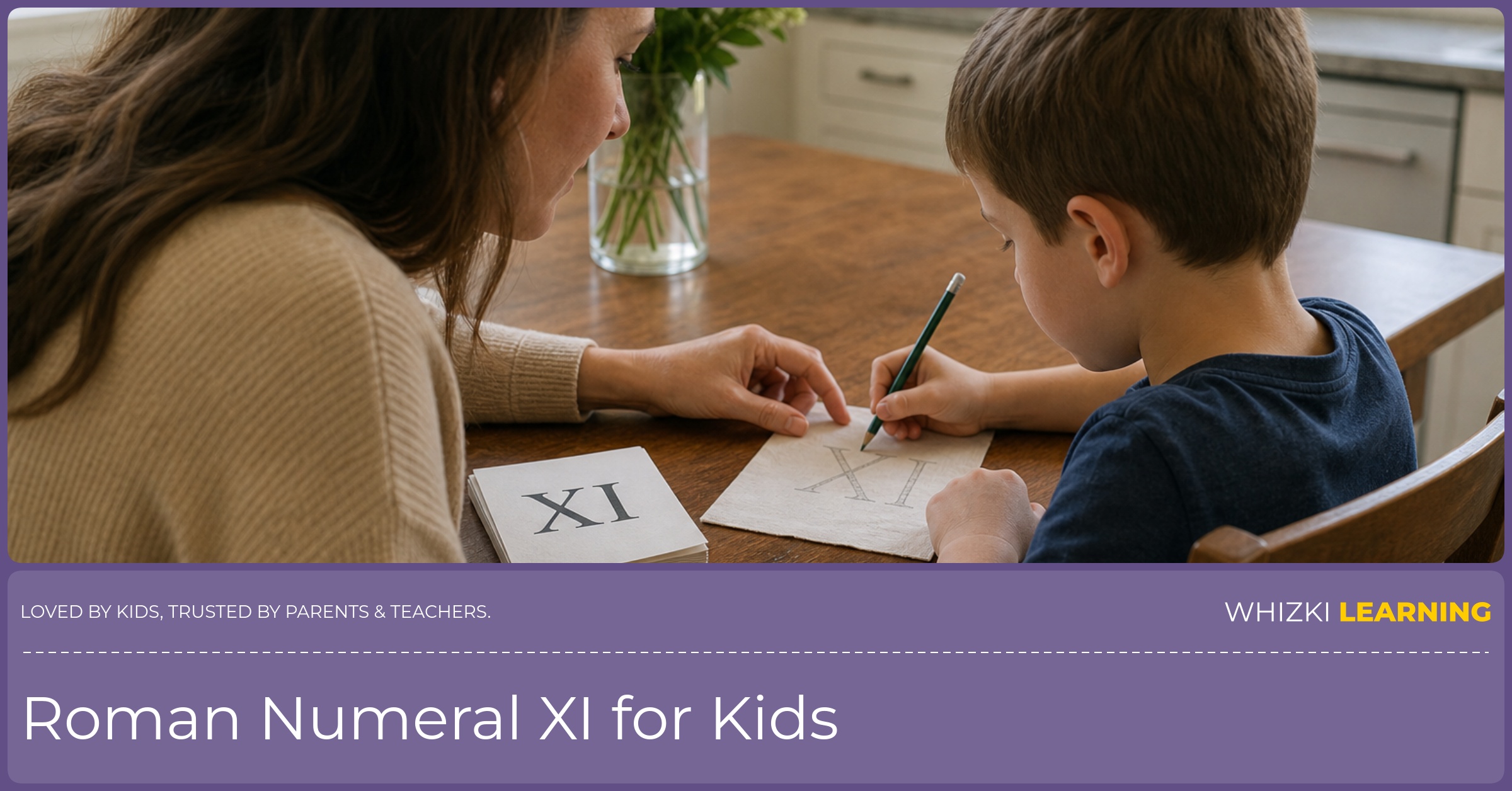
For Roman numeral XI, you can add a tiny tracing moment with a napkin, because tracing once helps the shape stick. For a simple routine, trace the X shape, then add the I, and say “X and one more” as the pencil moves.
For Roman numeral XI, keep it short, because the best practice is the kind your child will repeat tomorrow. For NAEYC guidance, play-based learning works best when it stays light and responsive to the child’s energy.
Bedtime cue: look for XI at 11 o'clock
For Roman numeral XI, use a bedtime cue that matches the routine, “When the clock gets to 11 o'clock, we look for XI.” For speech-language pathology practice, pairing a consistent phrase with a predictable event builds a helpful habit and reduces power struggles.
For Roman numeral XI, you can make the cue gentle and brief, “Find XI, then we are done.” For many families, this keeps bedtime calm while still giving the child a meaningful number-reading job.
For Roman numeral XI, if your child is not ready to read the symbol yet, that is okay, because recognition can come in small steps. For early math and counting printables, you can also use our counting printables for extra practice with number meaning.
For Roman numeral XI, the next step is to practice the glyph shape with confidence, not pressure. For parents who want a quick, repeatable routine, visit our Roman numeral XI learning page and practice tracing the X and I shape together one time before you move on to the next bedtime book.