
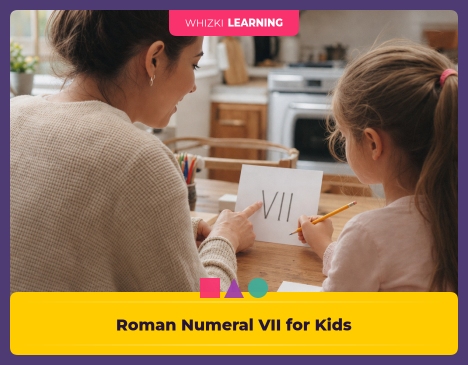
When your child squints at VII on a clock or book spine and asks, "What number is that?", say, "VII is 7," then hold up five fingers and two more. Roman numerals can feel like a surprise because children already worked hard to learn 7. A calm ten-second answer is enough for ages 3-7.
Reviewed by Whizki Editorial Team, Early Childhood Education Editors.
Where children actually see VII
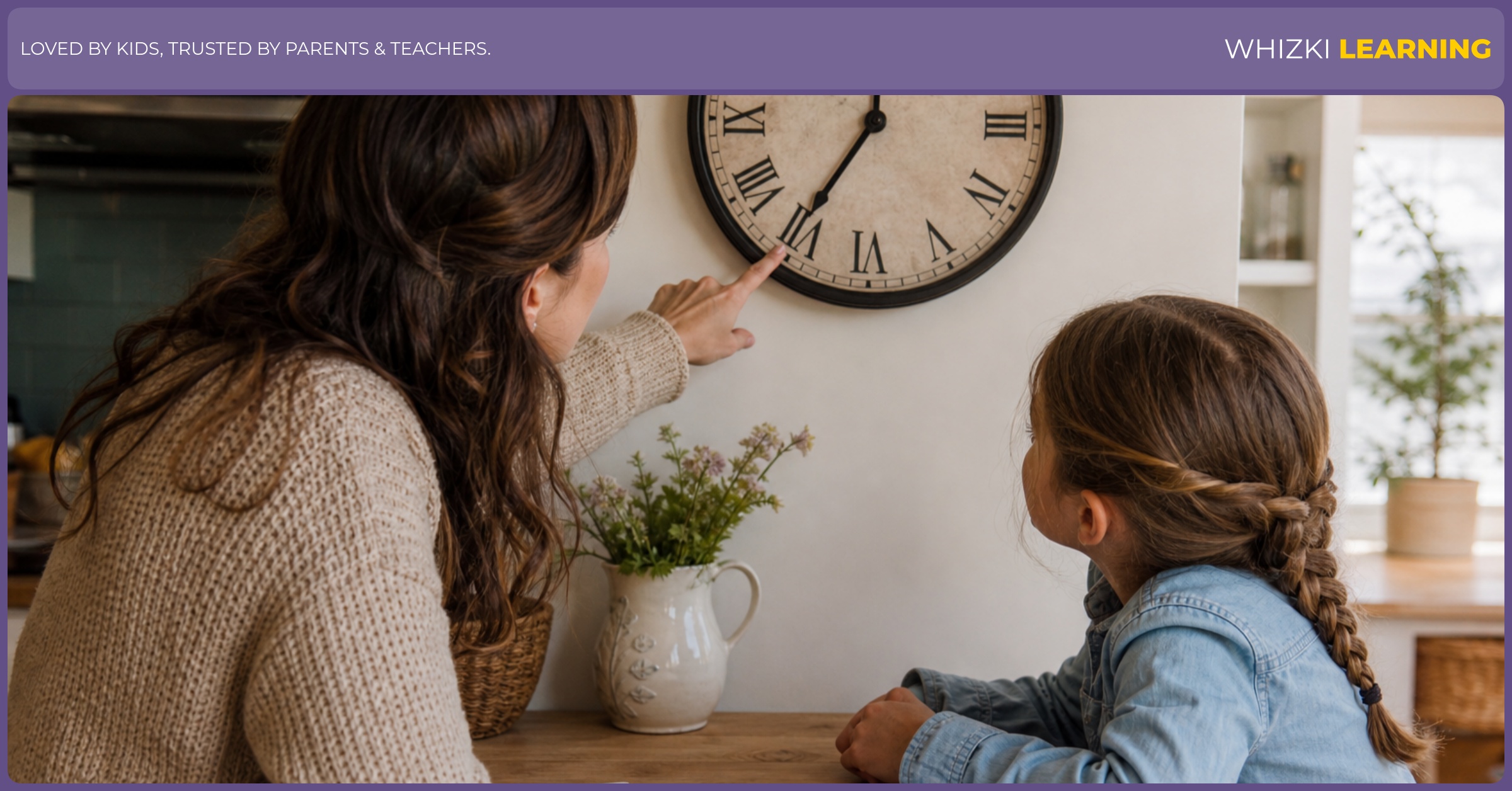
VII shows up in the real world before VII shows up on a worksheet. A child may see VII at 7 o'clock on a clock face, in a story about the seven dwarfs, or on a chapter heading that uses Roman numerals. Reggio-inspired teaching starts with what children notice, so a found VII at home is a better first lesson than a chart.
VII can also appear in grown-up places a child overhears, such as Harry Potter and the Deathly Hallows Part VII, the seventh book in a set, or the name Henry VII in a castle book or museum label. The parent job is not to explain every king or every series title. The parent job is to give the child one clean sentence: VII is 7.
What VII means in one small rule
VII follows the additive rule: V + I + I = 5 + 1 + 1 = 7. Additive means the marks are added from left to right when the smaller marks come after the bigger mark.
The Orton-Gillingham habit of naming, seeing, and touching a symbol works nicely here: say V, say I, say I, then tap each mark. The Roman numeral VII is a picture of five plus one plus one, not a brand-new number for a young child. A child who can count seven objects already has the meaning of VII in place.
Regular number practice still matters more than Roman numeral rules at this age. For more everyday counting, numeral naming, and quantity work, keep the numbers learning hub nearby when your child wants another short number activity.
The breakfast-table memory trick
The easiest line to repeat is: "V and two more makes VII, five fingers plus two fingers makes seven." Hold up one hand for V, then add two fingers from the other hand. The child sees the five, sees the two, and hears the total in one tiny routine.
An occupational-therapy rule of thumb is to use large, comfortable movement before asking for small pencil work. Fingers in the air, a fingertip trace on the table, or a big crayon line gives the child body information first. The memory trick works because the child's hands are doing the math before the child's pencil has to write the marks.
A screen-free spot-and-say game
The screen-free game is simple: find VII on a clock face, in a book chapter, or in a movie title, say "VII is 7," and trace VII one time on a napkin. The whole game should take less than a minute. Short practice protects the fun and keeps Roman numerals from turning into a lecture.
A Montessori-style setup keeps the materials real and touchable, so a clock, napkin, and pencil are plenty. The adult can model one slow trace while saying V, I, I. The child can copy the shape once, then move on to breakfast, books, or pajamas.
The bedtime cue is simple when bedtime is 7 o'clock: "Look for VII on the clock because VII is 7." The clock gives the child a reason to read the symbol again without a worksheet. A familiar nightly cue often sticks better than a longer daytime lesson.
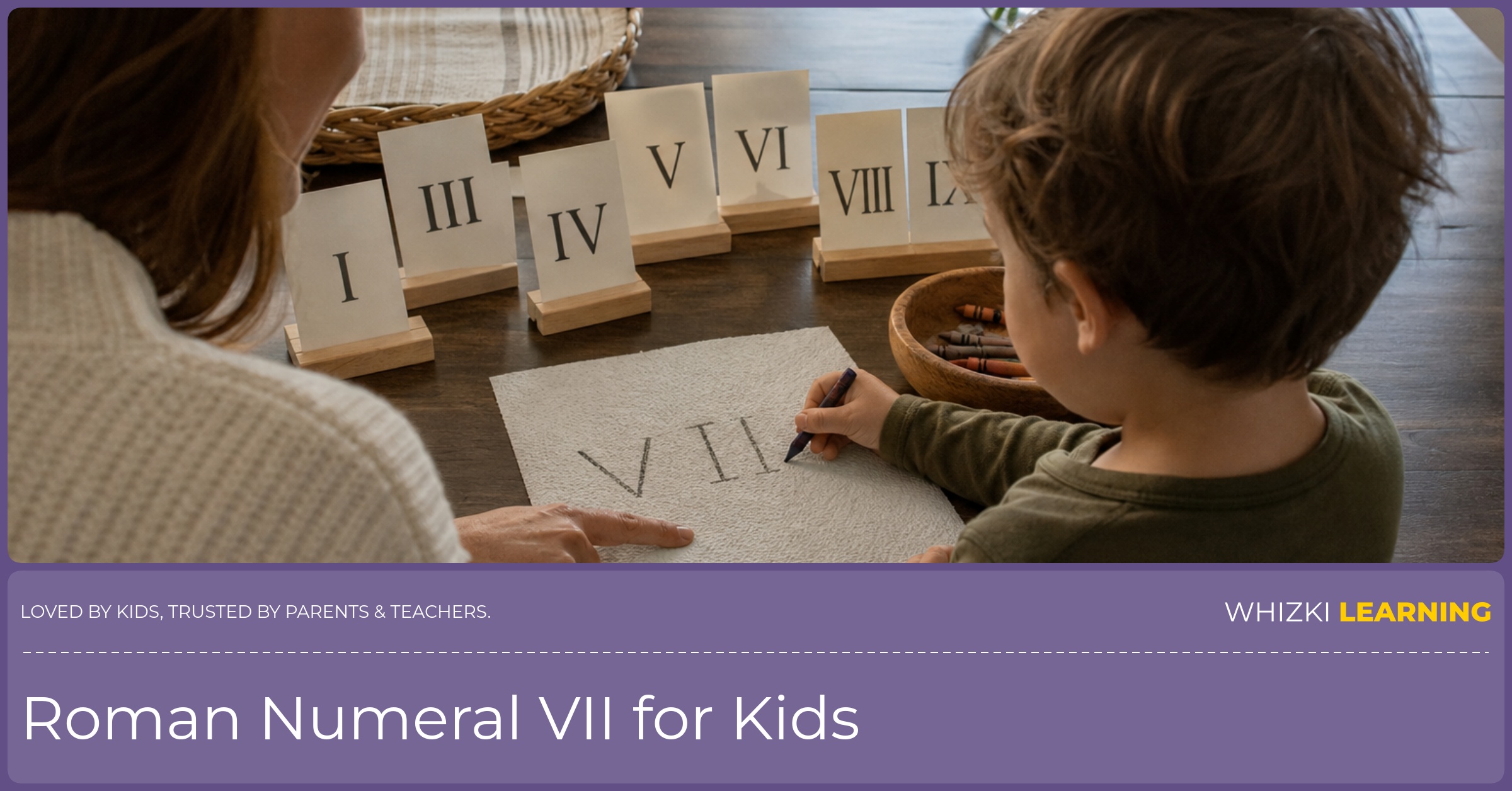
What kindergarten children need to know
Kindergarteners do not need to do Roman-numeral math. Kindergarteners need to read the Roman numerals that show up in daily life, especially I, V, and VII when a clock or book uses those marks. NAEYC guidance for early math points us toward meaningful number sense, not extra symbol pressure.
A preschool or kindergarten child can treat VII as a word the child recognizes by sight. If the child asks why some Roman numerals come before a V, the adult can say, "That is a later rule, and today VII is 7." A short answer respects curiosity without pulling a young child into work meant for older learners.
The printable library keeps number practice concrete with counting, matching, and quick pencil tasks for young learners. When regular counting needs a little extra practice, try our counting printables beside real objects like cereal pieces, buttons, or toy animals.
If you want to keep the same practice going on paper, take a look at our number tracing workbook for preschool and kindergarten.
For a quick shape practice, open our Roman numeral VII learning page and let your child trace the glyph once with a finger. The page gives the child one more chance to see V and two more, say VII is 7, and move on while the learning still feels light.