At breakfast, it can feel like Roman numerals come out of nowhere and your child wants you to explain them again and again. The good news is that Roman numeral VIII is simple and you can teach it with everyday sightings, one quick memory cue, and a short screen-free game.
Reviewed by Whizki Editorial Team, Early Childhood Education Editors.
Roman numeral VIII in real life (8 sightings)
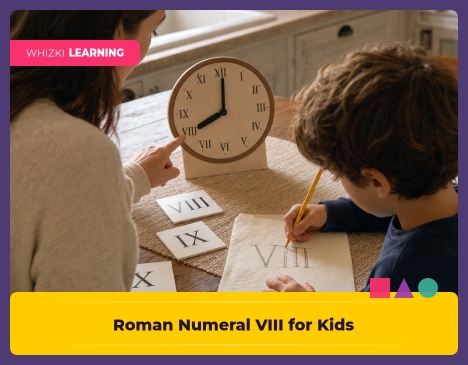
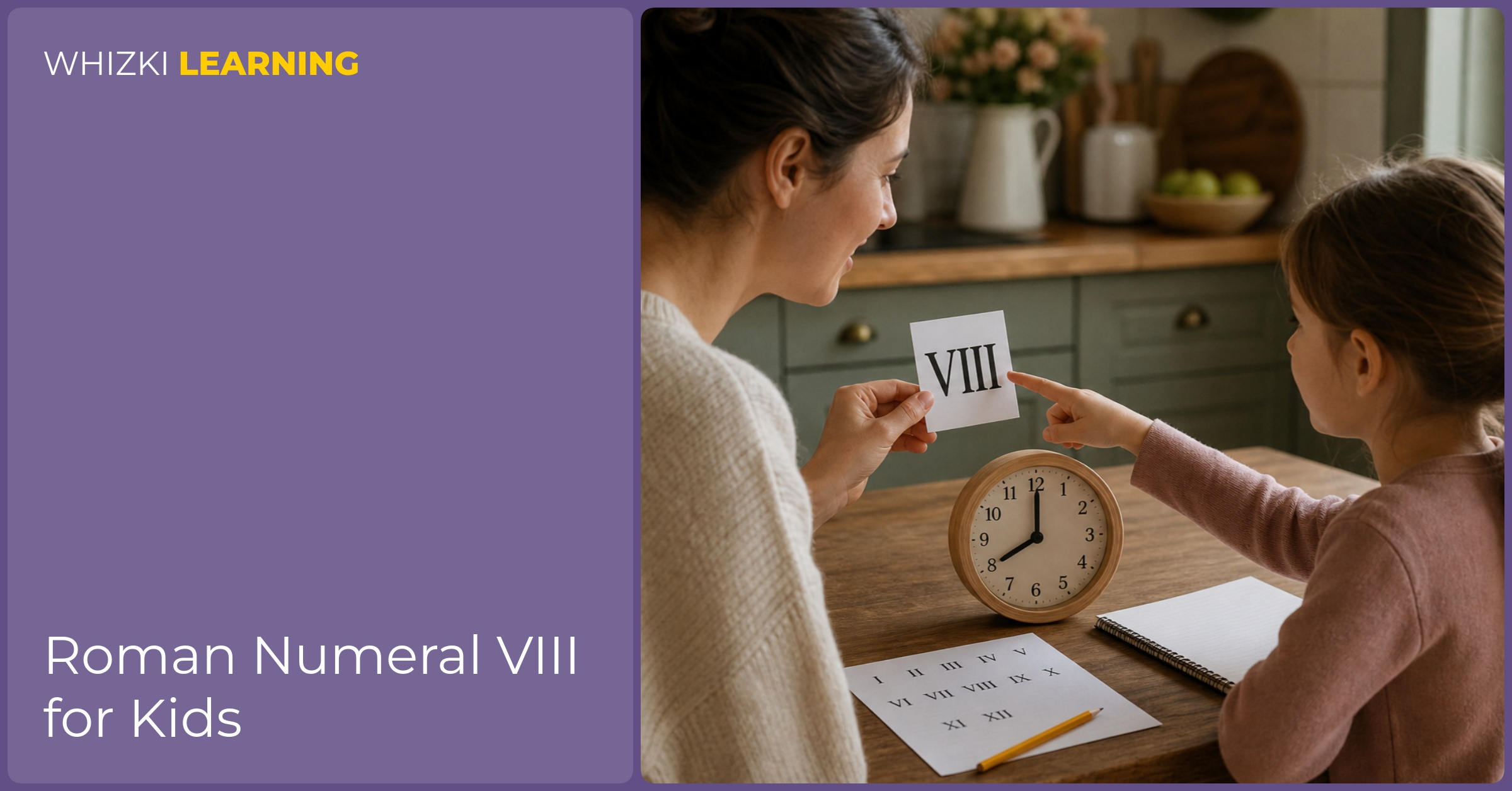
Roman numeral VIII shows up as the number 8 in places kids already notice, like 8 o’clock on a clock and in stories and pictures. At home, point out 8 o’clock when you check bedtime or snack time, because the brain learns best from what it sees often (NAEYC guidance on meaningful, everyday learning).
Roman numeral VIII also pops up in kid-friendly “eight” examples, like an octopus with eight arms, and you might even count “eight legs” when a spider is in the yard. For kids who like history, Roman numeral VIII can appear in Henry VIII, which gives you an easy, curiosity-friendly connection.
Roman numeral VIII can also show up in big-event ways, like Super Bowl VIII, and that makes the symbol feel real instead of worksheet-only. When a kindergarten teacher or preschool teacher introduces symbols this way, the symbol becomes a label for a number, not a mystery shape.
The rule for VIII, explained in one short way
Roman numeral VIII uses an additive idea, which means you add the parts together: V + I + I + I = 8. Roman numeral V stands for 5, and each I stands for 1, so three more ones make 8 (this matches how early math models build number meaning).
Roman numeral VIII is not about memorizing a big table. Roman numeral VIII is about seeing the shape as “five plus three more,” and then connecting that to the real value your child already understands.
When a child asks, “Why does it look like that?” you can answer in the same calm routine every time. Orton-Gillingham style teaching supports success when you use a consistent, repeatable explanation and then practice it with a quick action.
Memorize-trick: “V and three more”
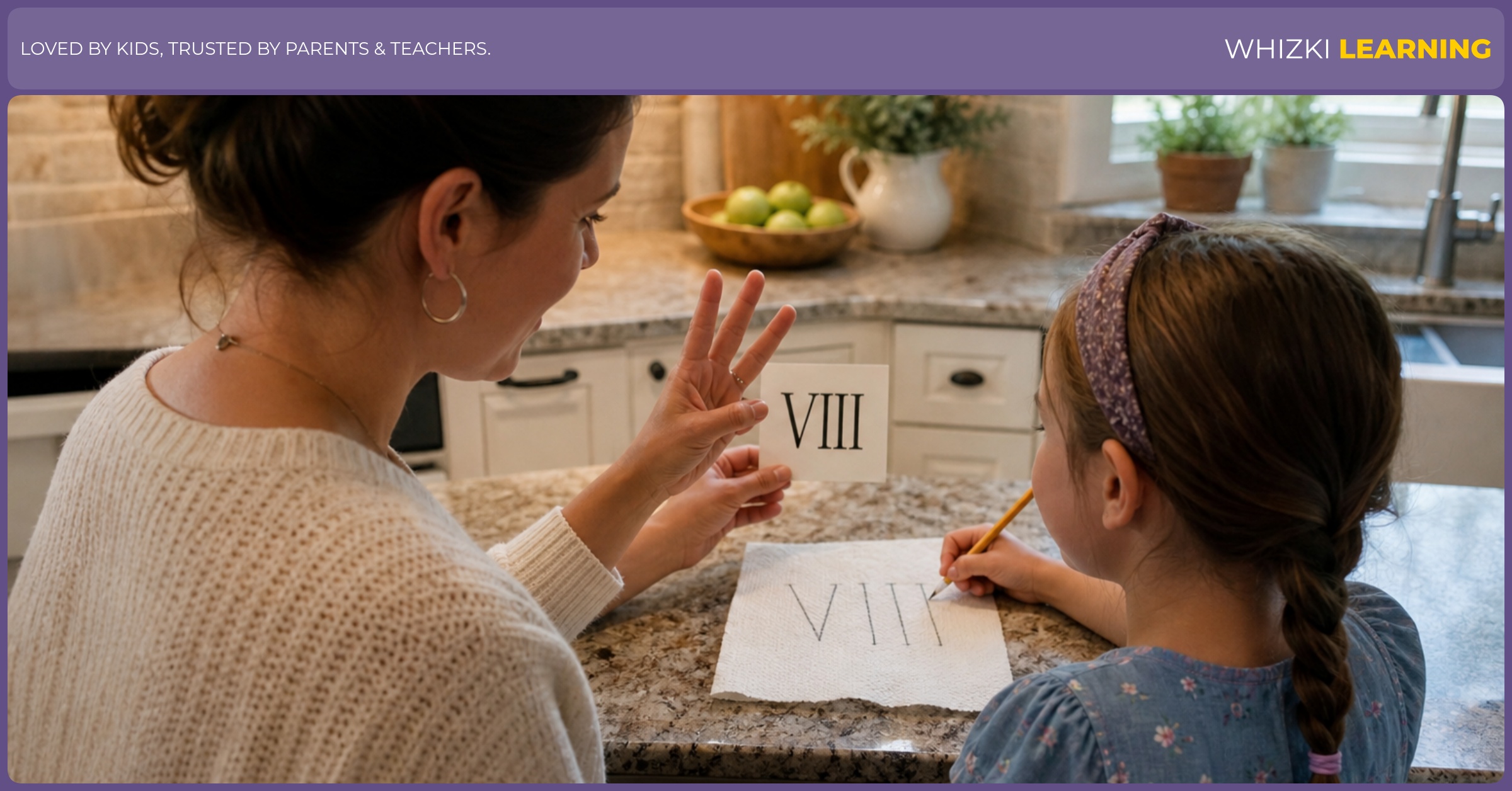
Roman numeral VIII is easy to remember with a body cue: V and three more. Make an open hand and raise three fingers, then say, “VIII is 8,” while you point to your hand, because children remember better with movement and multi-sense practice (occupational-therapy basics for attention and motor planning).
Here is a parent script you can repeat at the breakfast table: “Roman numeral VIII is V and three more, so VIII is 8.” Then let your child try the hand cue once, even if they already “know it,” because repetition with a low-pressure routine is what sticks.
Kindergarteners do not need Roman-numeral math. Kindergarteners need reading practice for the ones they see, like VIII on a clock, a book chapter, or a sports poster, and then a quick connection to the number sense they already have.
One screen-free spot-and-say game
Roman numeral VIII spot-and-say works best when it is short and playful. Pick one place for the next few minutes, like a clock face, a book chapter number, or a movie title with a Roman numeral, and ask your child to find where VIII appears.
When your child spots Roman numeral VIII, say the line together: “VIII is 8.” Then trace Roman numeral VIII once on a napkin with a pencil, slow enough for the child to feel the shape, because motor practice supports symbol recognition (speech-language pathology friendly pacing and clear modeling).
If your child gets stuck, you can point first, “Look right here,” then ask the child to try the trace one time. This keeps the focus on reading the symbol, not on perfect handwriting.
Practice Roman numeral VIII with our numbers printables from our Roman numeral VIII learning page, plus extra counting-and-number-sense pages in our counting printables. For families who want a calm, screen-free routine, these activities give kids quick, repeatable chances to recognize the glyph and connect it to the number 8.
If you want to keep the same practice going on paper, take a look at our number tracing workbook for preschool and kindergarten.
Bedtime cue: look for VIII at 8 o’clock
Roman numeral VIII is a perfect bedtime cue because it ties directly to a time you already use. When bedtime is coming, say, “Let’s look for Roman numeral VIII on the clock when it shows 8 o’clock,” and then point once so the symbol becomes part of the routine.
If the clock you have does not show Roman numerals, you can still use the cue with a book or a simple print you keep nearby, because the skill is recognizing VIII as 8. This kind of predictable cueing is a common strategy in early childhood classrooms to reduce power struggles and keep learning calm.
When your child asks for the explanation again, repeat the same short rule, V plus three more, and invite one hand cue. A quick reset beats a long lecture every time.
Roman numeral VIII is most learnable when the symbol comes with a clear job, “VIII means 8.” When you have an extra moment, practice the VIII glyph shape with our Roman numeral VIII learning page, and use the numbers learning hub for more quick sightings with the numbers learning hub. Even one mindful trace and one “VIII is 8” during the day helps Roman numeral VIII feel familiar.