
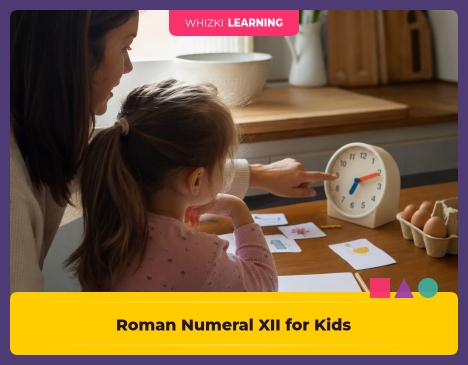
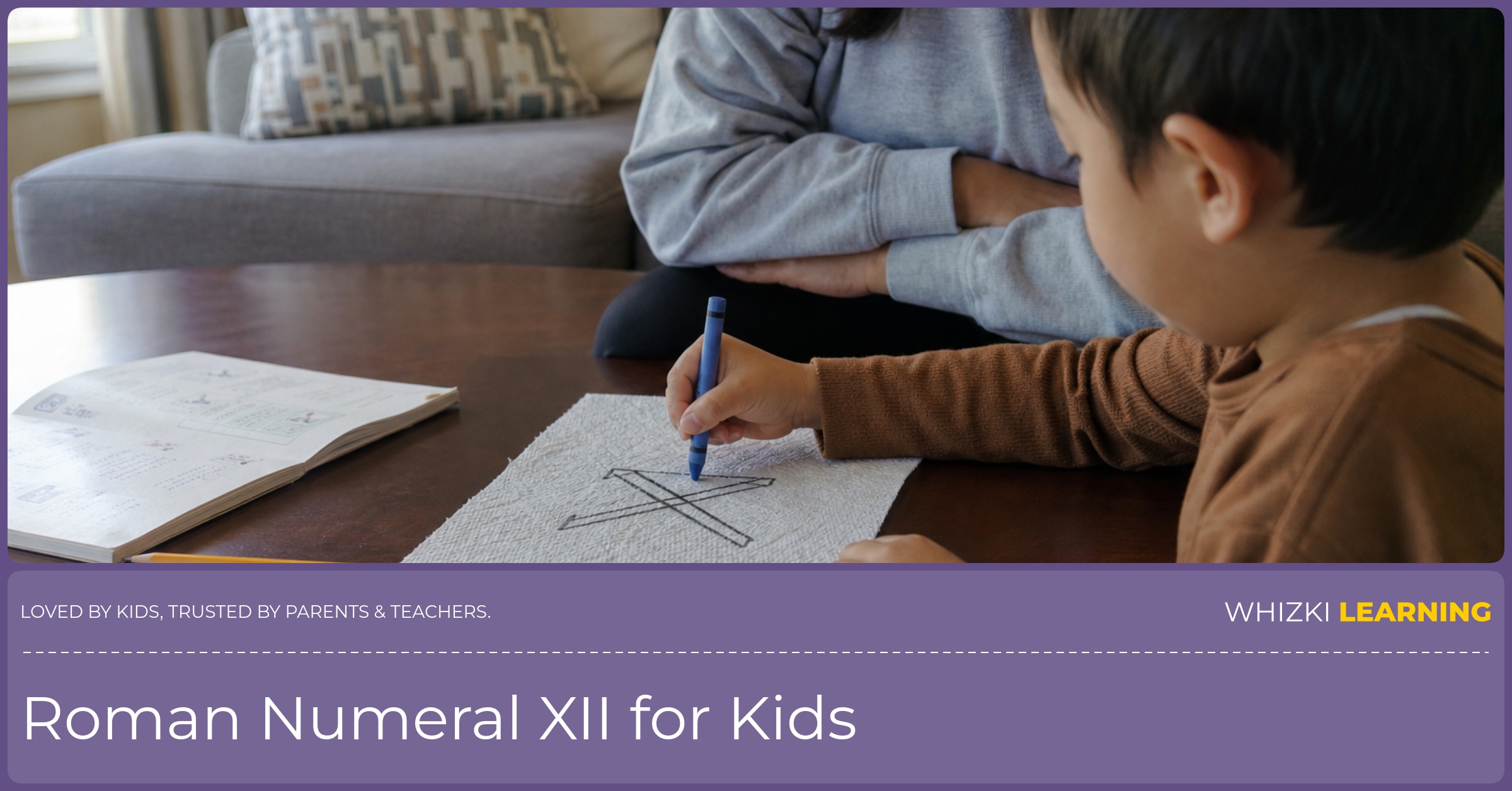
When a child asks why the clock has XII instead of 12, breakfast can turn into a mini argument fast; point to the top of the clock, say XII is 12, and have the child trace X-I-I once on a napkin. Roman numerals feel fancy to adults, but young children usually need a friendly label for a symbol seen in real life. A calm ten-second answer works better than a long lesson before shoes, cereal, or school bags.
Reviewed by Whizki Editorial Team, Early Childhood Education Editors.
Where kids actually see XII
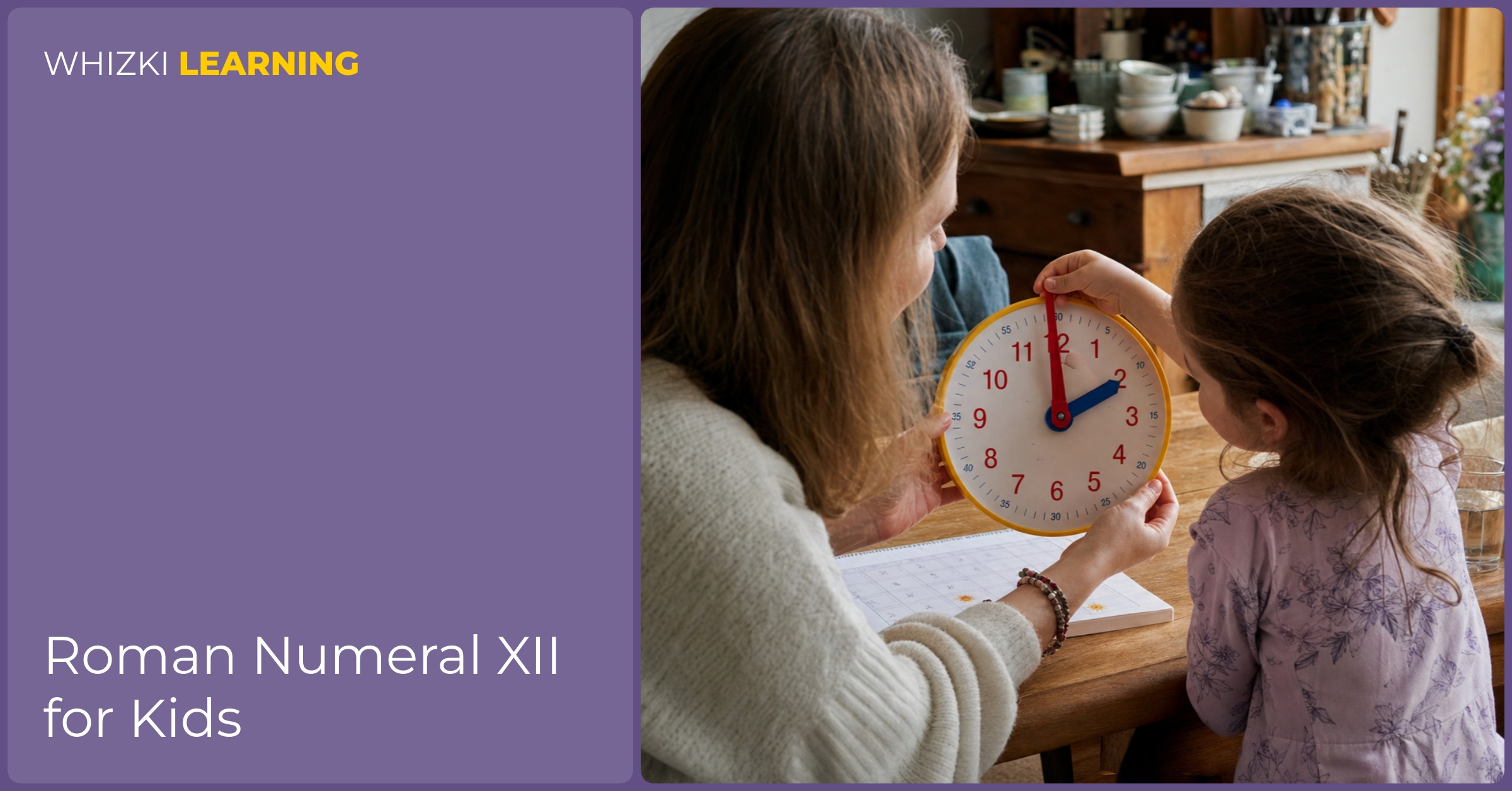
Roman numeral XII shows up most often at the top of an analog clock, where noon and midnight live. NAEYC guidance reminds early-childhood teachers to connect math language to everyday routines, and the clock face is one of the easiest routines to notice. When a child sees XII above the clock hands, the parent script can be simple: XII is 12, and 12 sits at the top.
Roman numeral XII also connects to familiar twelves around the house and year. Twelve months make a year, the Twelve Days of Christmas appear in songs and books, and twelve eggs fit in a common carton. Reggio-inspired teaching starts with what a child notices, so a carton, calendar, or clock can become the whole lesson.
The number 12 belongs in a larger early-math world of counting, matching, and naming symbols. For families who want more nearby number practice, the numbers learning hub gives children a place to revisit number shapes without turning breakfast into a worksheet battle. The goal for ages 3 to 7 is recognition first, with lots of chances to say the number out loud.
What XII means, in one short rule
The rule for XII is additive: X + I + I = 12. In kid language, the X gives ten, and the two I marks add one and one, so XII equals twelve. That short rule is enough for a young child who only needs to read the symbol when the symbol appears.
The Orton-Gillingham approach gives children a strong model for learning odd-looking symbols: see the symbol, say the name, trace the shape, and connect the symbol to meaning. Roman numeral XII can use the same multisensory rhythm without making the lesson formal. A child can say “XII is 12,” trace X-I-I with a finger, and tap twelve little beats on the table.
A preschooler or kindergartener does not need a Roman-numeral chart to understand XII. A full chart can add clutter before the child has a reason to care about the symbol. The useful classroom move is to teach the symbol that the child is actually seeing, then stop while the child still feels successful.
The memory trick: X and two more
The breakfast-table line I use is: X and two more makes twelve. The line is short enough for a child to repeat while looking at a clock or a book chapter. A parent can say the same line next time the child asks, “What does X-I-I mean?”
The clock face gives the trick a second hook because twelve numbers sit around the clock. Roman numeral XII sits right at the top, where the 12 would be on a number clock. Montessori-style concrete work often starts with a real object in the child’s hands, and a toy clock or wall clock makes XII feel useful instead of abstract.
Occupational-therapy basics also matter because young children learn symbols through eyes, hands, and small movements. The child can make a big X in the air, draw one straight I, draw another straight I, and say “X and two more.” That quick motor pattern helps the child remember the glyph shape without doing Roman-numeral math.
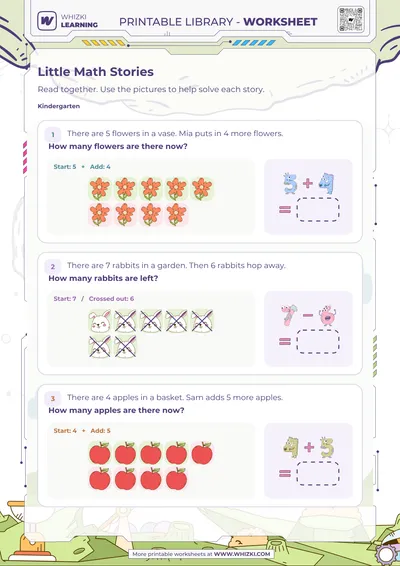
For a quiet table activity, pair clock spotting with our counting printables so children can count real sets, circle quantities, and come back to twelve with a pencil in hand. The printable work is best after a real-life sighting of XII, because the child already has a reason to care about the number.
If you want to keep the same practice going on paper, take a look at our number tracing workbook for preschool and kindergarten.
A screen-free spot-and-say game
The screen-free game is called spot-and-say: find XII on a clock face, a book chapter, or a movie title printed on a case, then say “XII is 12” and trace X-I-I once on a napkin. Speech-language practice often uses short repeatable phrases because clear language helps a child attach words to a symbol. The phrase “XII is 12” is short, accurate, and easy to use in a busy kitchen.
The spot-and-say game works best when the adult waits a moment and lets the child search. Reggio observation teaches adults to notice what the child notices, so the parent can follow the child’s eyes instead of rushing the answer. If the child points near the top of the clock, the adult can celebrate the looking before correcting the exact symbol.
A classroom or homeschool version can use a paper clock, a library book with Roman numeral chapters, or a printed holiday song page. The adult says the phrase once, the child repeats the phrase once, and the napkin trace finishes the turn. The whole game can end in under a minute, which is often the right length for ages 3 to 7.
Bedtime cue and right-sized expectations
At bedtime, use a playful cue: “Look for XII on the clock when bedtime is 12 o’clock.” Most family bedtimes are not midnight, so the cue works best during pretend play, holiday nights, or a toy-clock routine rather than as a real bedtime plan. NAEYC-aligned practice keeps early math playful, concrete, and connected to the child’s day.
Kindergarteners do not need to do Roman-numeral math. Kindergarteners need to read the Roman numerals that appear on clocks, chapter headings, and familiar titles. The early goal is, “I know XII means 12,” not, “I can calculate with Roman numerals.”
Orton-Gillingham teachers often protect confidence by keeping symbol practice short and successful. If a child writes I-X-I or flips the order, the adult can gently point back to the model and say, “X first, then two I marks.” If a child avoids many symbol tasks, an occupational therapist or classroom teacher can suggest hand-strength and visual-tracking activities that fit the child’s needs.
For a little extra practice with the glyph shape, open our Roman numeral XII learning page and let your child trace X-I-I with a finger before using a pencil. The parent goal is simple: connect the symbol XII to twelve, then let the child meet the numeral again on clocks, cartons, and stories.