Some mornings it feels like Roman numerals pop up everywhere, and your kid wants an answer right now, while you are trying to get breakfast on the table. You do not need Roman-numeral math for ages 3 to 7, you just need a clear way to spot and read IX when it shows up.
Reviewed by Whizki Editorial Team, Early Childhood Education Editors.
Roman numeral IX, where kids actually see it
Roman numeral IX shows up in everyday places, so preschool and kindergarten kids can learn it by noticing, not by doing complicated number work. A kid sees IX at 9 o'clock on a clock, in planet talk from school (nine planets), and sometimes in sports history like Super Bowl IX. When Roman numeral IX is tied to a familiar picture, the symbol feels less like “extra homework” and more like a label that matches what kids already know.
For early math guidance, NAEYC reminds us that learning sticks when it connects to real experiences and language children use daily. The worksheet can wait, the conversation starts now. If your child points at a clock, a book cover, or a sports page and asks “What is that?”, you can answer with the same short script every time.
Meaning of IX, the subtractive rule in one short paragraph
Roman numeral IX uses the subtractive rule: when I comes before X, it means one less than ten. That is why IX = 10 - 1, so Roman numeral IX equals 9. You can say it plainly like, “I before X means one takes away,” and then finish with, “IX is 9.”
Orton-Gillingham style teaching is all about clear, repeated patterns, and Roman numeral IX has one strong pattern just like Roman numeral IV. When you keep the explanation short and consistent, the symbol becomes something your child can recognize quickly, even if the child is not ready for formal math.
A memory trick you can repeat at breakfast
Roman numeral IX is easy to remember because I before X takes one away, same pattern as IV, just bigger. Here is a parent script you can literally reuse: “Look at the letters, I is before X, so I takes one away from ten, and IX is 9.” That script is fast enough for a busy kitchen moment, and it gives your child a rule to hold onto.
Occupational-therapy basics for learning readiness also point to using brief language and one concrete action, like pointing to the symbol while you say it. When your child is restless, you can keep the focus on the symbol itself, not on worksheets or long explanations.
- Point to IX and say, “I before X takes one away.”
- Point to a nearby number of 9 in real life, like nine o'clock.
- Repeat, “IX is 9,” once, then move on to the next part of the day.
Screen-free “spot and say” game for IX
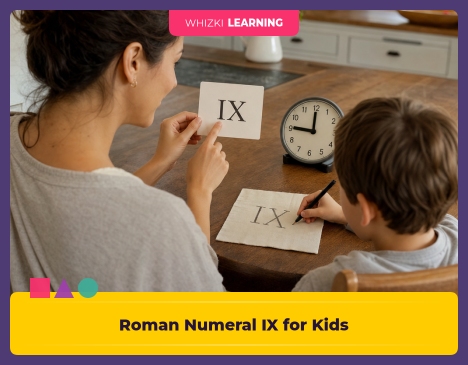
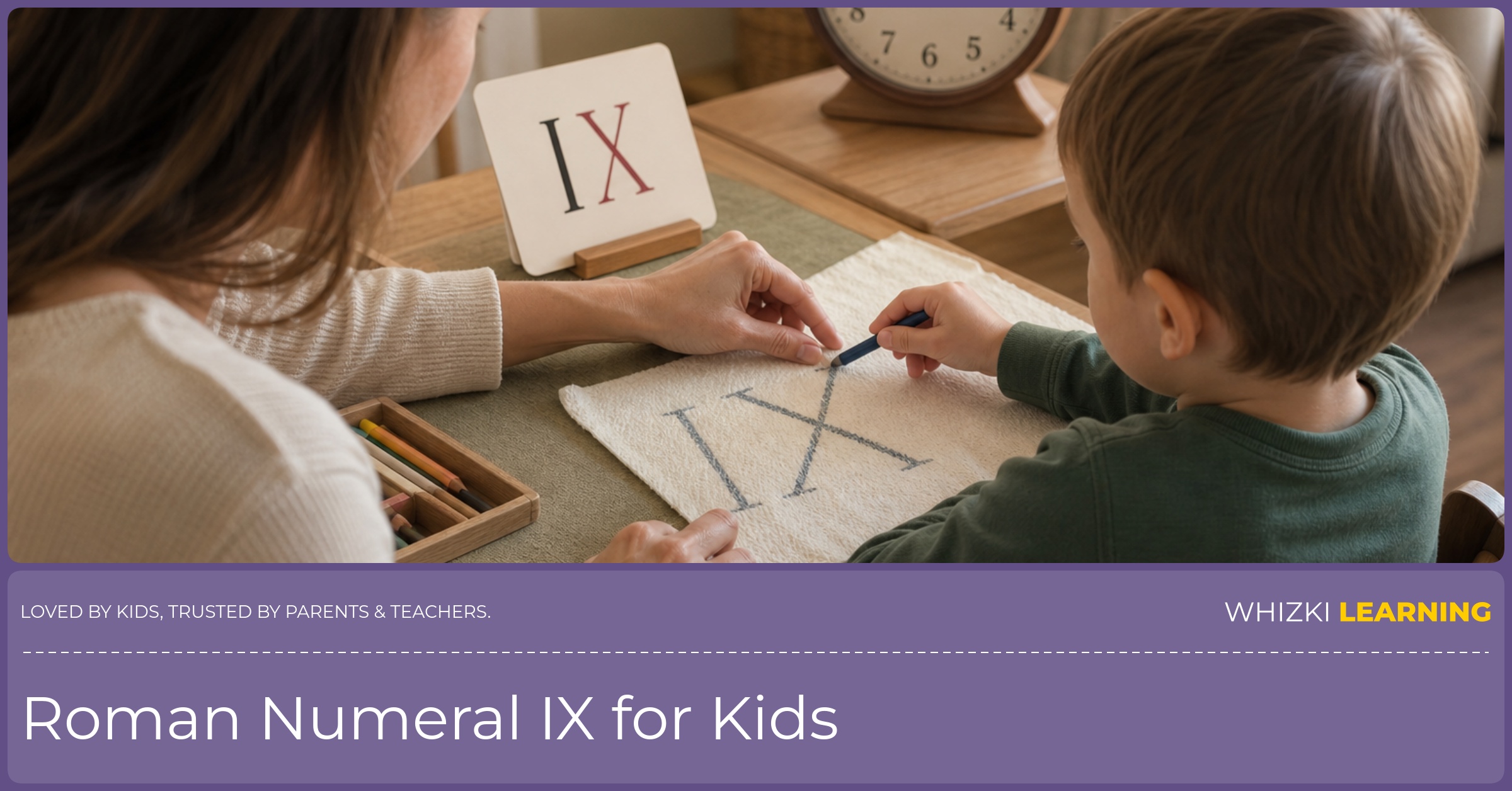
Roman numeral IX practice works best as a quick game, not a long lesson. Try this screen-free spot-and-say game: pick one place to search, like a clock face in the kitchen, a book chapter number, or a movie title with Roman numerals, then have your child find IX and say, “IX is 9,” out loud. When your child finds it, you can trace the symbol once on a napkin with a finger or a crayon, slow and steady.
Reggio-inspired observation fits well here, because the game follows what the child notices. If your child cannot find IX right away, you can model the search once and then let your child take the next turn, which keeps the confidence high without pressure.
Want a little extra practice that still feels calm and hands-on? Check out our Roman numeral IX learning page and pair it with our counting printables for short, doable sessions that match what kids already know about 9.
If you want to keep the same practice going on paper, take a look at our number tracing workbook for preschool and kindergarten.
Bedtime cue for IX, look at the clock at 9
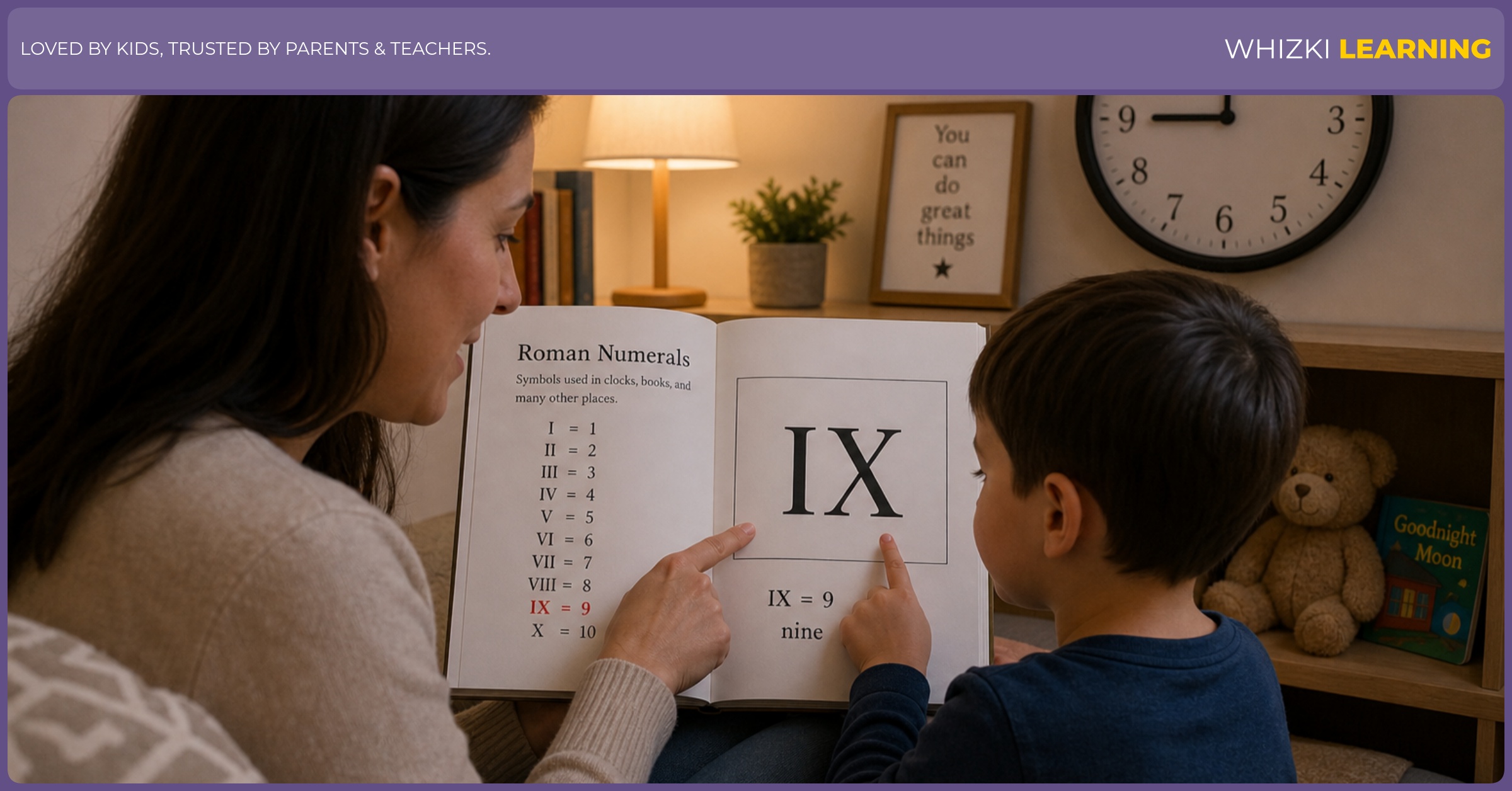
Roman numeral IX learning can be woven into bedtime without turning the routine into a math lesson. When bedtime is 9 o'clock, make it a tiny tradition: “When the clock gets to 9, we’ll look for IX.” Then, at the moment the clock hits 9, point at the clock face and say, “IX is 9,” while your child looks at the symbol.
NAEYC guidance about play-based learning supports using predictable, low-pressure routines. If your child asks why the symbol looks like letters, you can repeat the same subtractive line, “I before X takes one away,” and keep the moment warm, quick, and done.
Kindergarteners do not need to do Roman-numeral math, they need to read the ones they see. Use the symbol, match it to 9, and keep the rule short enough to remember when your child is in motion. If you want one place to practice the exact shape and meaning, visit our Roman numeral IX learning page, and browse more number ideas in the numbers learning hub when you are ready.