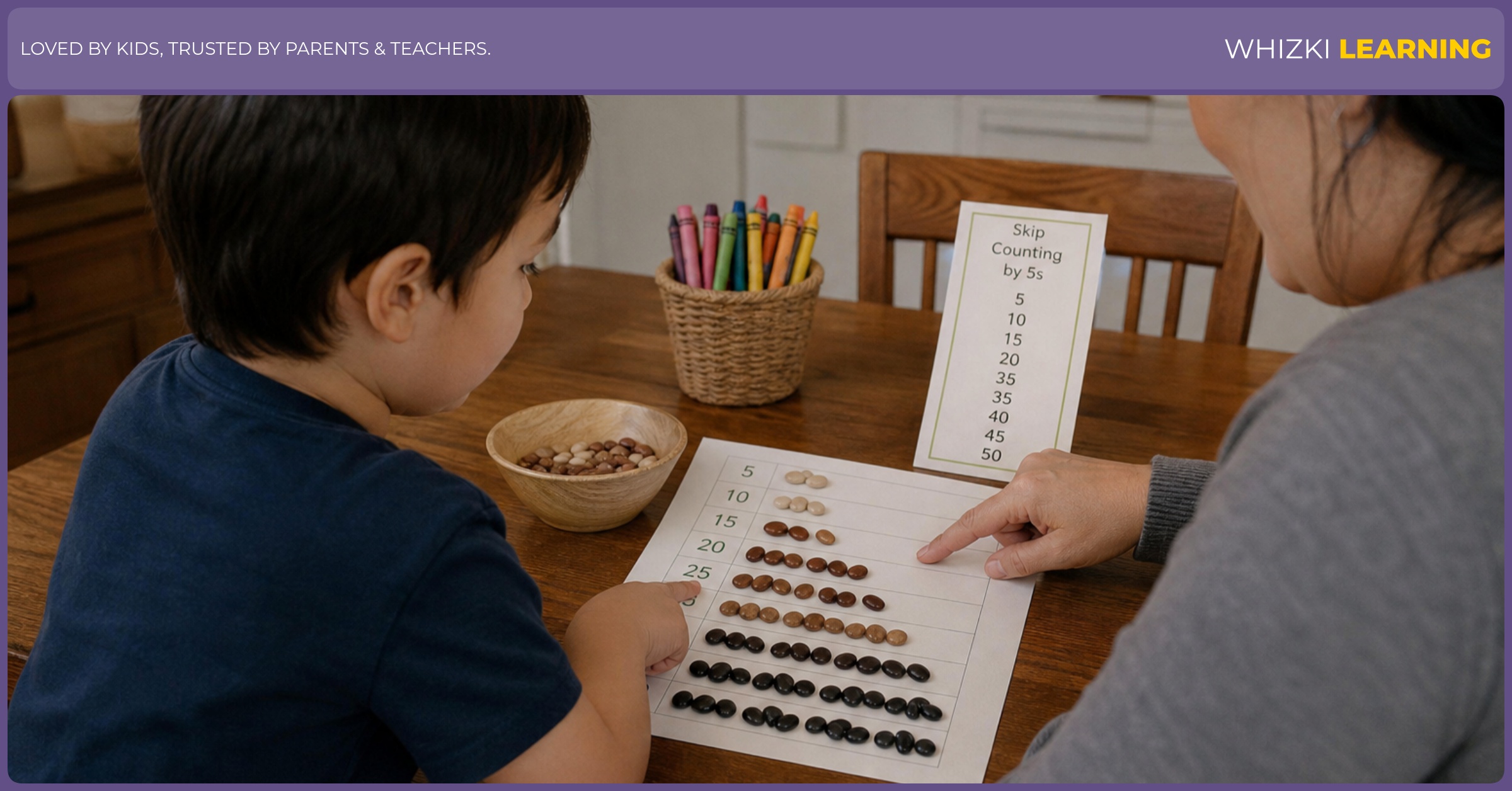
If your child can chant 5, 10, 15 and then suddenly blank out, put five beans in a small pile, touch each pile together, and say the next number out loud. Skip counting by 5s is a pattern children learn best with eyes, hands, and rhythm working together, especially when a grown-up slows the pace and keeps practice short.
Reviewed by Dr. Anna Klein, EdD, Early Childhood Curriculum Specialist.
Why skip counting by 5s clicks for young children
Skip counting by 5s gives children a friendly bridge between counting every object and seeing a group as one countable unit. In an Orton-Gillingham-style lesson, the child says the number, sees the number, taps the group, and writes the number, because multisensory practice helps the pattern stick.
The 5s pattern also feels useful because children meet groups of five in real life. A hand has five fingers, a nickel is worth five cents, and the minute hand on a clock moves in fives, so the count has a job beyond reciting numbers.
NAEYC guidance reminds teachers to connect math to play, conversation, and familiar routines rather than rushing toward paper drills. For a child who has already tried skip counting by 2s, the 5s pattern can feel calmer because the ending digits alternate between 5 and 0.
Use a skip counting by 5s chart first
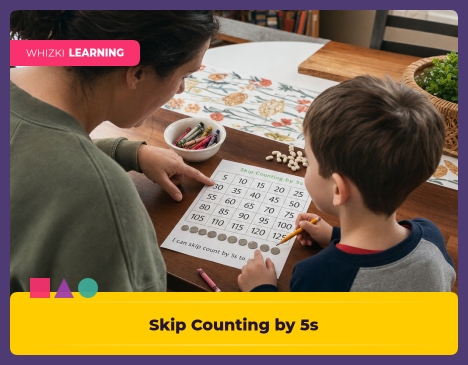
A skip counting by 5s chart should start with a clear line such as 5, 10, 15, 20, 25, and 30 before the chart asks for missing numbers. Reggio-inspired teaching starts with observation, so watch whether the child points steadily, skips a space, or says the next number faster than the finger can track.
The printable chart works best when the child marks each number with a crayon dot or small sticker. Occupational-therapy basics favor stable paper, a relaxed hand, and a short pencil, because a comfortable body position leaves more attention for the number pattern.
Parents can keep one chart in a breakfast basket and one chart with our printable library pages for quick practice. The numbers learning hub is a good place to pair the 5s chart with number recognition pages when a child still mixes up 15 and 50.
Teach nickel counting with real coins
Nickel counting turns skip counting by 5s into a money lesson that still feels concrete for ages 5 to 7. A Montessori-style setup keeps the coins lined up from left to right, and the child moves one nickel at a time while saying 5, 10, 15, 20.
The nickel worksheet should ask for small totals before larger totals, because four nickels are easier to track than twelve nickels. Speech-language practice often uses a steady model, so the adult can say, “One nickel is five cents,” and the child repeats the full sentence before adding another coin.
Printable money practice can sit beside real nickels, toy coins, or paper coin circles when loose change is not available. Families who want extra pages can add money counting pages from the same printable space and keep the lesson hands-on.
The premium Skip Counting by 5s Worksheet Set keeps the chart, missing-number pages, nickel practice, high-five game, and clock activity together on the store page. The complete pack lives in Whizki Plus.
Play high-five games for fast practice
A high-five game makes the 5s count physical without turning math into a long sit-down lesson. Occupational-therapy heuristics support crossing the midline and using big arm movement when a child needs body input before pencil work.
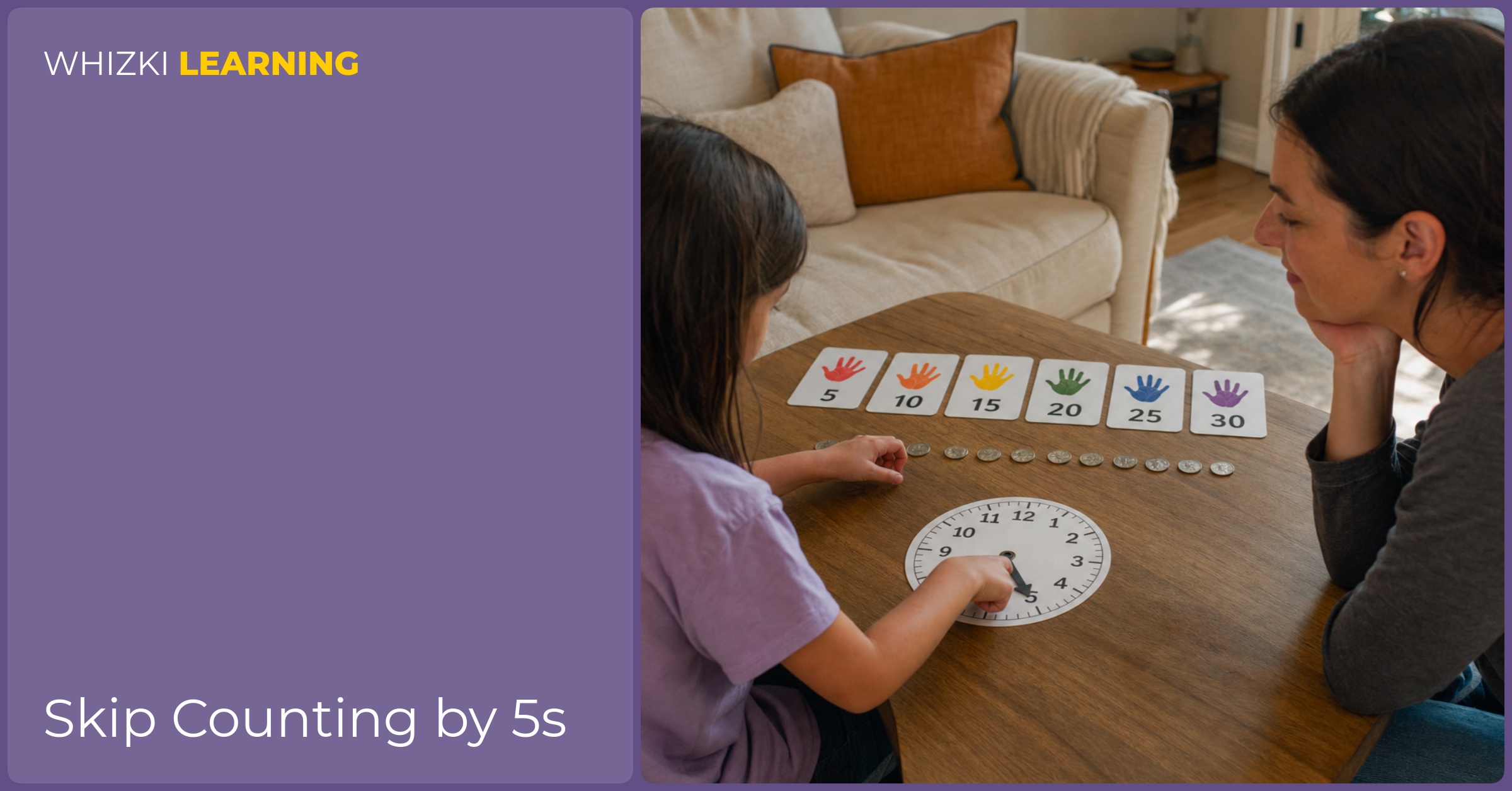
The adult can hold up one hand and say 5, then the child gives a high five and says 10, then the adult offers another hand or a drawn handprint and says 15. The game stays light when the grown-up stops after ten handprints, because short practice protects attention for the next activity.
A classroom teacher can place handprint cards around a rug and invite children to step from card to card while counting by 5s. The same game also works at home with sticky notes on the floor, and number practice printables can extend the activity after movement time.
Connect skip counting by 5s to the clock
The clock connection helps children see why the 5s pattern matters, but the clock should stay simple at first. NAEYC-aligned math practice favors real meaning, so a paper clock with only the minute numbers, 5 through 60, is enough for early work.
The adult can move the minute hand to the 1 and say 5 minutes, move the minute hand to the 2 and say 10 minutes, then keep going around the clock. The clock lesson should focus on counting minutes, because reading full time can wait until the child has a steady count by 5s.
Orton-Gillingham-style review can close the loop by asking the child to say the number, trace the number on the chart, and move the clock hand to match. Families can add clock practice sheets when the child is ready to match 5, 10, and 15 to the clock face.
What to print and practice this week
The best first week uses one chart, one nickel page, one high-five game, and one clock page rather than a thick stack of worksheets. Reggio practice values watching the child, so the grown-up can notice whether the child needs more movement, more coin handling, or more quiet tracing.
A simple weekly rhythm might be chart work on Monday, nickels on Tuesday, high-five play on Wednesday, clock practice on Thursday, and a mixed review on Friday. The rhythm matters less than the response, because a child who is guessing needs smaller groups and a child who is chanting smoothly needs a missing-number challenge.
Teachers and homeschoolers can keep the 5s chart near a calendar, coin jar, or pretend store to make practice feel useful. A parent can also tuck one review page into a busy morning, because two calm minutes often teach more than a forced twenty-minute session.
Skip counting by 5s grows from the same small moves that help children count, touch, see, and say numbers with confidence. Keep the lesson concrete, stop while the child still has energy, and return to the pattern through nickels, high fives, and the clock all week.