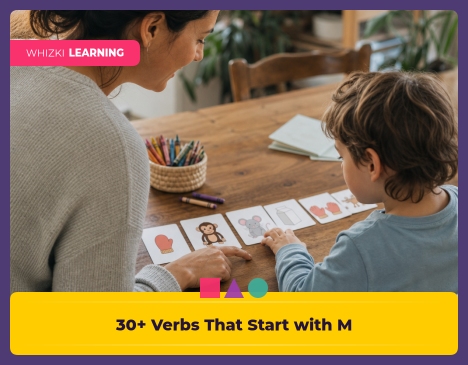
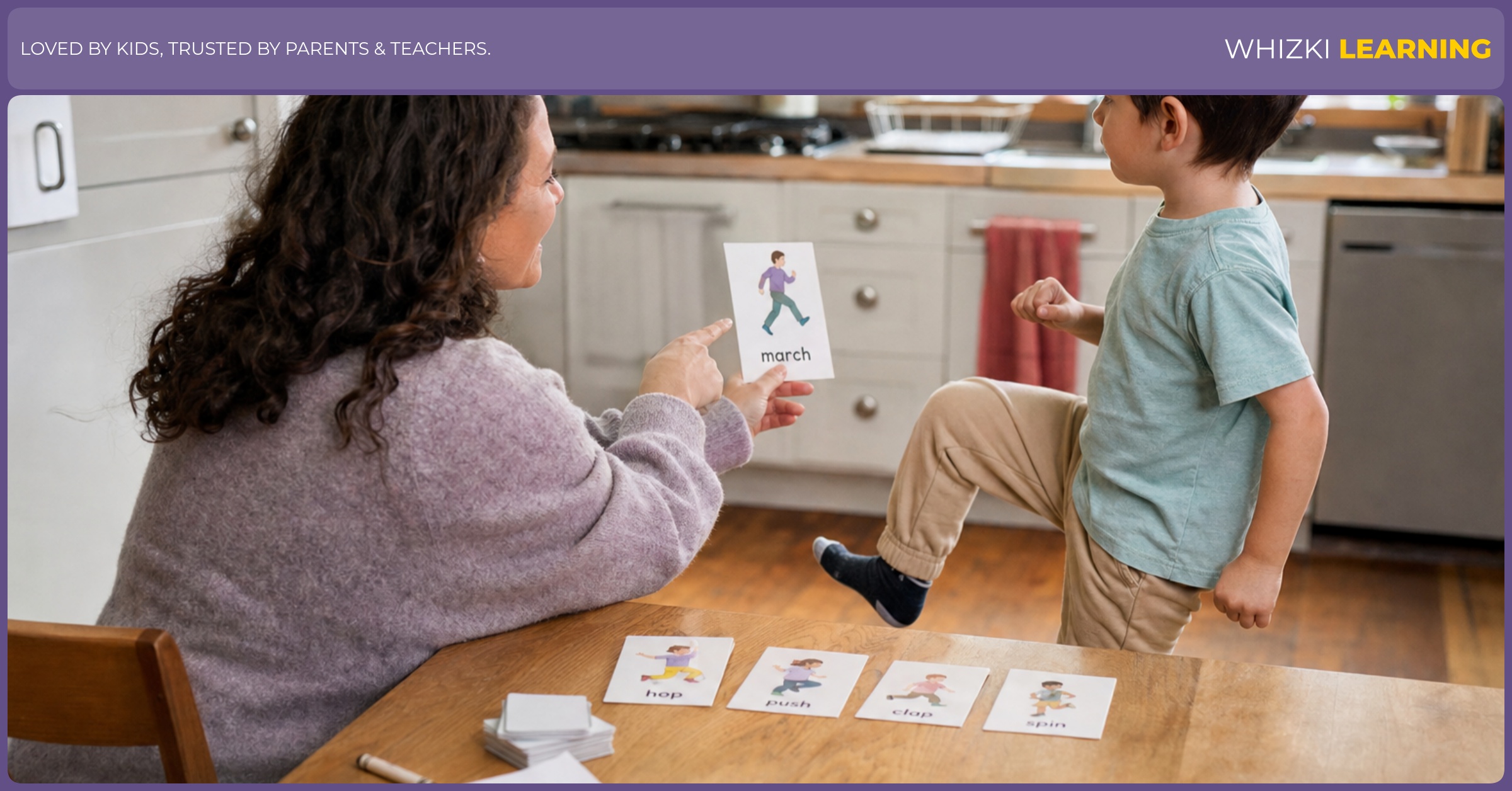
If your child can chant letter names but freezes when you ask for an M word, start with an action: say "march," do big knees, and let the body carry the sound. The verb becomes something your child can feel, not another answer to pull from memory. The next few minutes can be playful, short, and useful during breakfast, cleanup, or circle time.
Reviewed by Whizki Editorial Team, Early Childhood Education Editors.
Why M verbs help young readers
The letter M sound is friendly for young mouths because the lips close and hum before the word opens. In Orton-Gillingham lessons, teachers often pair a sound, a mouth movement, and a body action so the brain gets more than one path to the word. For extra sound practice, keep our letter M learning page nearby while your child acts out the verbs below.
The M verb list stays with action words, not object names or describing words. For object names, use first words starting with M; for labels like messy or mild, use describing words starting with M. NAEYC guidance reminds early-childhood teachers to connect new language with play, movement, and real routines because preschool and kindergarten children learn best through meaningful use.
Body actions that start with M
Body verbs are the easiest M words to start with because a child can show the meaning right away. Occupational-therapy basics often use big movement before small pencil work because core movement, balance, and hand awareness support calmer table practice.
Say one M verb, act out the sentence, and ask your child to copy your movement. A kindergarten teacher can use the same list for a two-minute transition, and a homeschool parent can use the list before reading time.
- March: March past the chair.
- Move: Move your arms slowly.
- Munch: Munch a crunchy carrot.
- Mouth: Mouth the quiet word.
- Mumble: Mumble into your mitten.
- Murmur: Murmur to your teddy.
- Mimic: Mimic Dad’s silly walk.
- Mime: Mime brushing your teeth.
- Massage: Massage your sleepy hands.
- Meet: Meet me by the rug.
- Melt: Melt down like ice.
- Motion: Motion your friend closer.
- Mosey: Mosey around the couch.
Household actions that start with M
Household verbs make vocabulary feel useful because the action already lives inside the family day. Montessori practical-life work and NAEYC play guidance both value real tasks, such as pouring, sorting, and cleaning, because young children build language while doing purposeful work.
Choose one safe household job and add the M verb out loud before the job begins. The spoken word, the hand motion, and the finished task help the child remember the verb without a lecture.
- Make: Make your small bed.
- Mop: Mop the kitchen spot.
- Mix: Mix batter with Grandma.
- Measure: Measure one cup carefully.
- Mash: Mash soft bananas.
- Match: Match socks from basket.
- Mark: Mark your name card.
- Mail: Mail the thank-you note.
- Mist: Mist the thirsty plant.
- Mend: Mend the paper tear.
- Mold: Mold dough into balls.
- Moisten: Moisten the dry sponge.
- Manage: Manage your backpack zipper.
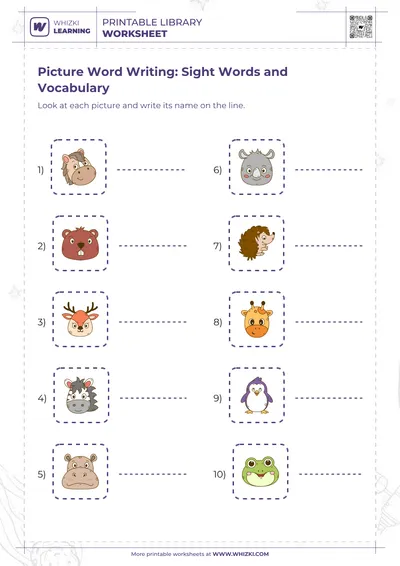
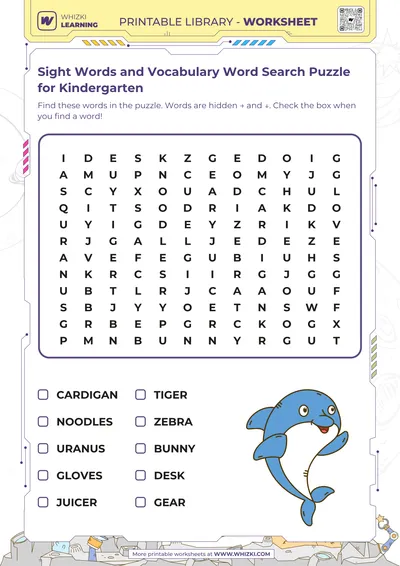
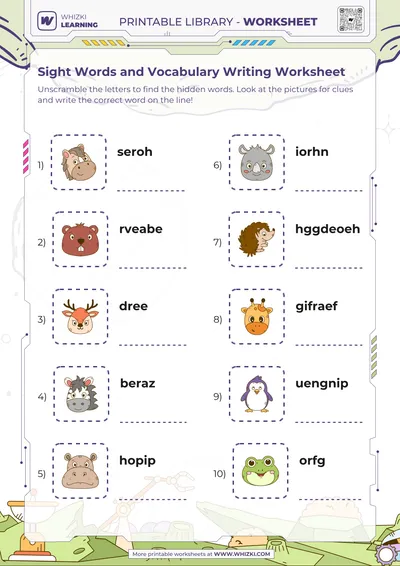
Print a quick M action sheet from our sight-words printables, tape the page near the kitchen wall, and ask your child to act out one word before snack. A wall reminder keeps practice short, visible, and easy to repeat during a real day.
Play actions that start with M
Play verbs invite imagination, and imagination gives children a reason to repeat a word. Reggio-inspired teaching treats the child’s play choices as information, so a parent or teacher can watch which M actions the child chooses before adding new ones.
Keep the play sentence short enough for a child to copy without losing the action. A preschool teacher can place two toy choices on the rug, and a parent can say the M verb while the child moves the toy.
- Map: Map a pretend road.
- Mine: Mine blocks like jewels.
- Mask: Mask your superhero eyes.
- Mess: Mess with finger paint.
- Mound: Mound sand into hills.
- Mount: Mount the toy horse.
- Mow: Mow with toy mower.
- Moonwalk: Moonwalk across the carpet.
- Motor: Motor the boat around.
- Muddy: Muddy the toy truck.
- Muffle: Muffle the drum sound.
- Magnify: Magnify the tiny leaf.
- Model: Model a clay snake.
M charades and tracing tip
The M charades game needs slips of paper, a bowl, and five quiet minutes. Speech-language pathology practice often pairs a spoken word with a gesture, so the adult says the verb once, the child acts without talking, and the group guesses the action.
For the game, write six M verbs from the lists on small slips and fold the slips into the bowl. The child picks one slip, acts out the word, and earns a smile or high-five after the guess instead of a score.
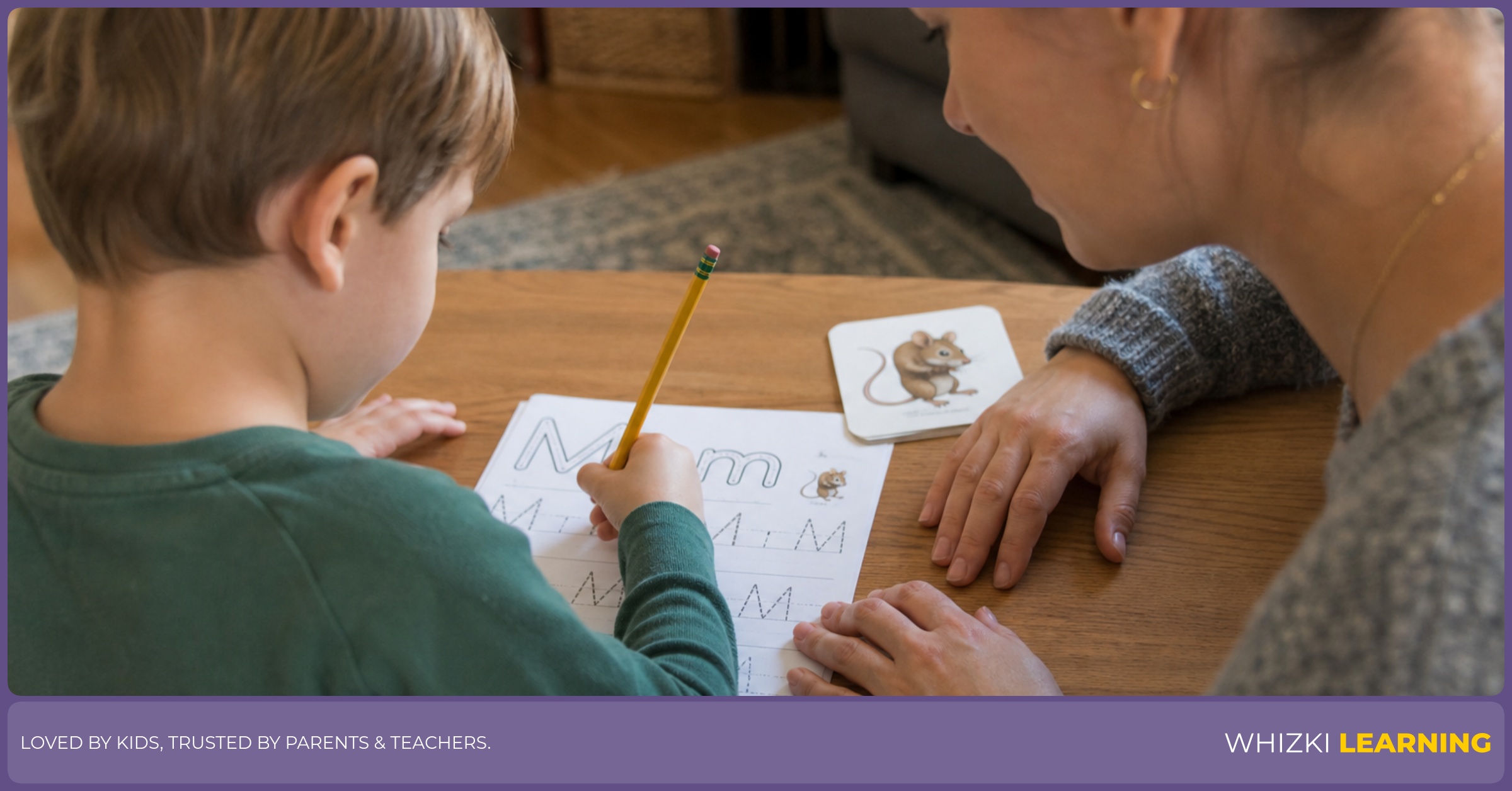
The trace-the-word tip is simple: have your child sky-write the big M with a whole arm, trace the printed word with a finger, then copy the word with a crayon. Orton-Gillingham handwriting practice often moves from large movement to touch tracing to pencil work because the order gives young hands a clear path.
M verbs do not need a long lesson to matter. A child can march, mix, and model while the grown-up names the action with warmth and clarity. Keep the practice short, repeat favorite words often, and let the movement do part of the teaching.