When your child can sing the alphabet but freezes at letter Q, choose five Q action words, act each one out, and let the body do half the remembering. Q is a tricky letter because young children hear fewer Q words in daily talk than B, M, or S words. A short movement routine keeps Q practice light, playful, and doable between snack, cleanup, and bedtime.
Reviewed by Whizki Editorial Team, Early Childhood Education Editors.
How to teach Q verbs without making practice stiff
The letter Q usually travels with U, so I teach the pair as a buddy sound before asking a child to read a whole word. The Orton-Gillingham approach starts with sound, touch, and movement, so a child says /kw/, traces Q, and acts out one verb. For a broader sound routine, use our letter Q learning page alongside the action words below.
The vocabulary boundary matters because a young reader needs to know what kind of word the child is using. This post stays with verbs, which are action words a child can move, do, or pretend. If the child is collecting objects, point the child to first words starting with Q, and if the child is describing a thing, use describing words starting with Q.
The kindergarten teacher move is simple: say the word, model the action, let the child copy, then read the tiny sentence. NAEYC guidance reminds teachers and parents to keep early literacy active and meaningful, not a seatwork marathon. A three-minute Q routine usually teaches more than a long worksheet when a child is hungry, wiggly, or almost done for the day.
Body actions that start with Q
Body verbs are the easiest Q words to teach first because a child can feel the word in muscles and balance. Occupational-therapy basics often use heavy work, crossing the midline, and controlled movement to help a child attend, so the body list includes loud, quiet, fast, and still actions. The adult goal is not perfect reading on the first try, the adult goal is a clean sound, a clear motion, and a happy repeat.
The body action list works well on a rug, in a hallway, or beside the kitchen table. Read one sentence, let the child act for three seconds, then freeze and point to the first letter. The freeze is the teaching moment because the child can look back at Q while the body is calm.
Body Q verbs for acting out
- Quack: Quack like a little duck.
- Quiver: Quiver like chilly spaghetti.
- Quake: Quake like a pudding cup.
- Quiet: Quiet your stomping feet.
- Quieten: Quieten your tapping fingers.
- Queue: Queue behind the blue chair.
- Quit: Quit before your body crashes.
- Quick-step: Quick-step across the rug.
- Quick-hop: Quick-hop to the couch.
- Quick-clap: Quick-clap three soft beats.
- Quick-stomp: Quick-stomp on the mat.
- Quick-spin: Quick-spin, then freeze.
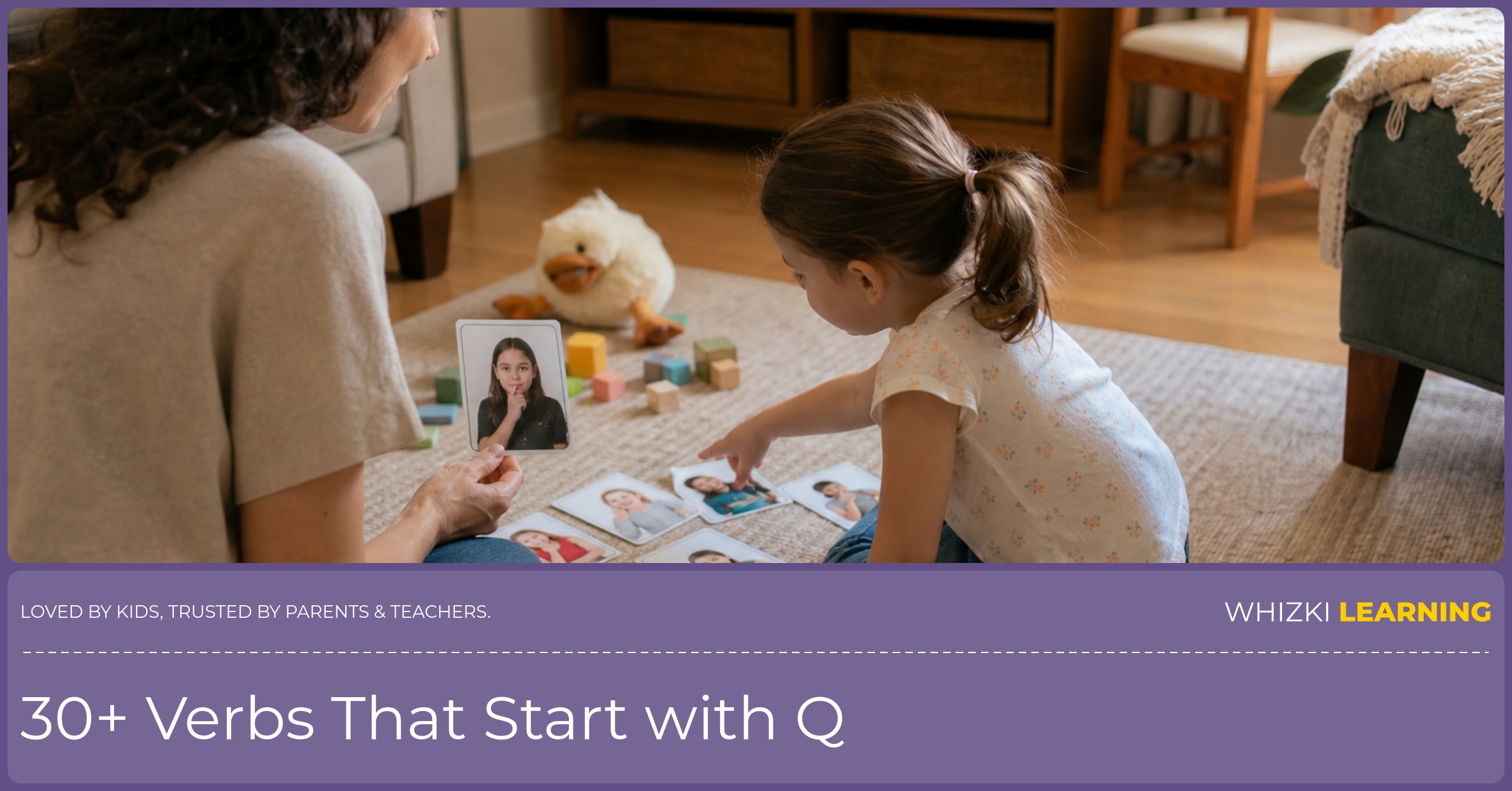
Household actions that start with Q
Household verbs give Q practice a real job, and real jobs stick for many young children. Montessori practical-life work and NAEYC play-based guidance both value tasks a child can touch, repeat, and finish with pride. A child who wipes, sorts, and packs while saying Q words is building language during ordinary family work.
The household action list includes a few playful compound verbs because true everyday Q verbs are rare for ages 3-7. I use those compounds in teaching the same way I use classroom phrases like tiptoe-walk or crab-crawl: the child hears the target letter first, then performs a familiar action. Keep scissors, knives, and hot water out of the routine unless an adult is close and the task is already safe for the child.
Print a Q action word page from our sight-words printables and tape the page to the wall where cleanup happens. Point to one word before handwashing, snack, or pajamas, then let the child act the sentence before moving on.
Household Q verbs for daily routines
- Quench: Quench thirst with cool water.
- Quilt: Quilt paper squares together.
- Quarter: Quarter a soft banana.
- Question: Question Mom about lunch.
- Quote: Quote Dad's silly song.
- Quell: Quell the kitchen clatter.
- Quick-wipe: Quick-wipe the sticky table.
- Quick-sort: Quick-sort the clean socks.
- Quick-fold: Quick-fold a small towel.
- Quick-rinse: Quick-rinse your snack cup.
- Quick-pack: Quick-pack the crayon box.
- Quick-sweep: Quick-sweep under your chair.
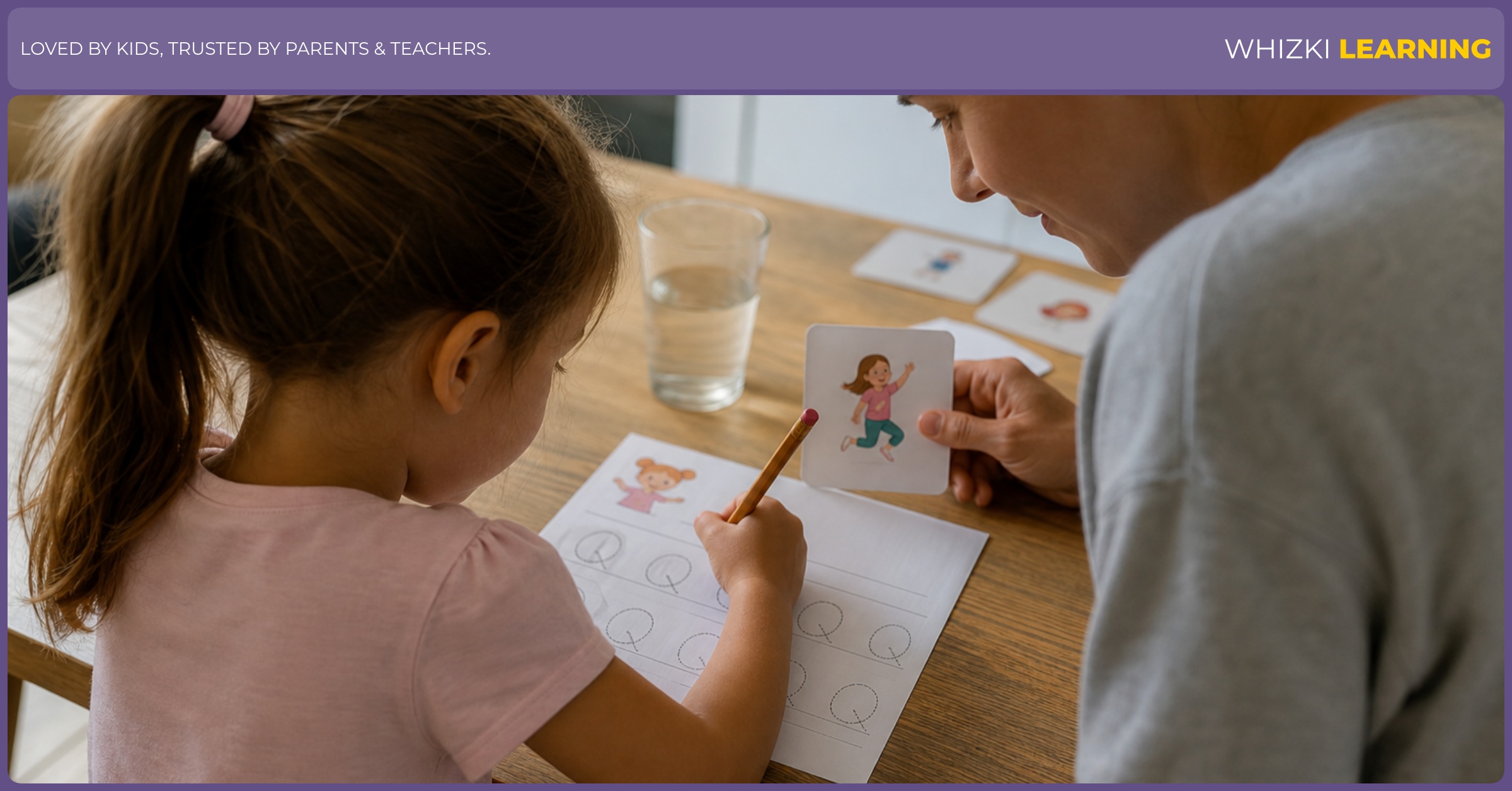
Play actions that start with Q
Play verbs help Q feel social, silly, and worth saying again. Reggio-inspired observation asks adults to notice the child's interests, so a block builder can quest, a puppet lover can quarrel safely, and a checker player can queen a piece. Speech-language practice also favors short, repeatable phrases because the child can hear the sound pattern without carrying a long sentence.
The play action list is best for pretend play, block play, puppet play, and quick turn-taking games. Read the sentence once with a lively voice, then let the child choose a prop and act. The adult can write the verb on a card after the play, because meaning comes before neat handwriting for most preschool and kindergarten learners.
Play Q verbs for pretend games
- Quiz: Quiz me on animal sounds.
- Quest: Quest for hidden blocks.
- Quarrel: Quarrel, then shake hands.
- Quibble: Quibble over pretend rules.
- Quip: Quip with a silly grin.
- Queen: Queen your checker piece.
- Quick-build: Quick-build a block tower.
- Quick-draw: Quick-draw a round sun.
- Quick-kick: Quick-kick the foam ball.
- Quick-roll: Quick-roll the toy car.
- Quick-toss: Quick-toss the beanbag gently.
- Quick-paint: Quick-paint two blue dots.
Charades and tracing routines for Q verbs
The act-it-out charades game needs six small cards, a bowl, and about four minutes. Write one Q verb on each card, fold the cards, and let the child pick without looking. The child acts, the adult guesses, and both players say the /kw/ sound before checking the printed word.
The trace-the-word tip is to keep the tracing path big, slow, and multisensory before asking for pencil work. In an Orton-Gillingham-style routine, the child sky-writes Q, traces Q in salt or on carpet, and then traces the printed word with two fingers. The occupational-therapy heuristic is simple: large arm movement usually comes before small pencil control.
The kindergarten teacher can add one small reading step after the movement step. Point to the first letter, say the sound, slide a finger under the word, and read the tiny sentence together. If the child loses interest, stop after one clean turn because a warm ending makes the next practice easier.
Q verbs are not the biggest word family in early reading, so a small, active set is enough for ages 3-7. Choose three body words, three home words, and three play words for the week, then rotate new cards when the child starts reading the first set with confidence. The best Q practice is short, concrete, and easy to repeat in real family life.