Learning Outcomes
Missing number sequences → Counting forward within zero to eighteen → Children place skipped numbers in order with fewer counting slips.
Addition equations → Part-whole number sense → Children find a missing addend by checking the total and known part.
Subtraction equations → One less relationships → Children connect neighboring numbers with simple subtraction facts and clearer number sense.

Find the Missing Numbers Worksheet

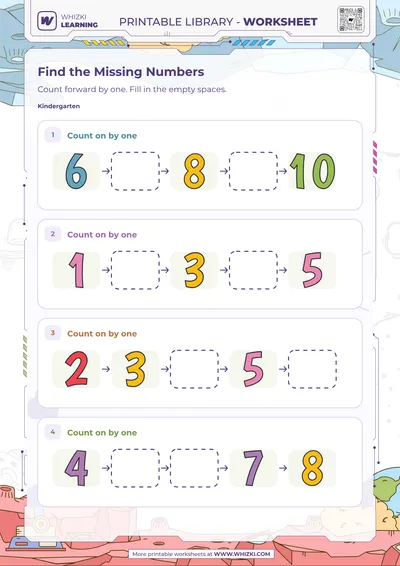
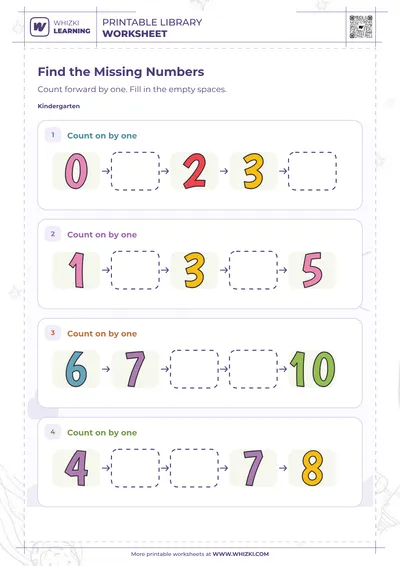
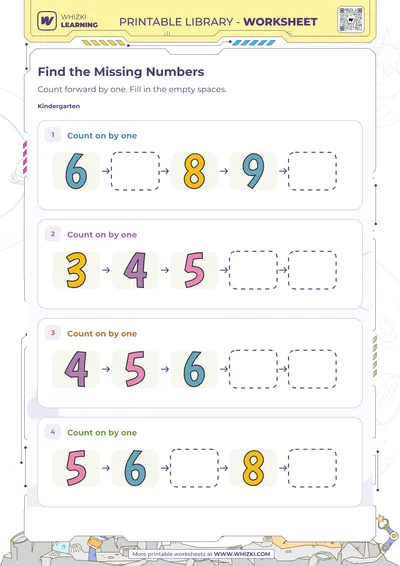
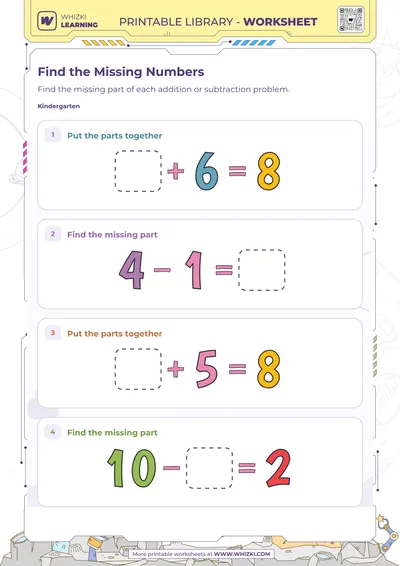
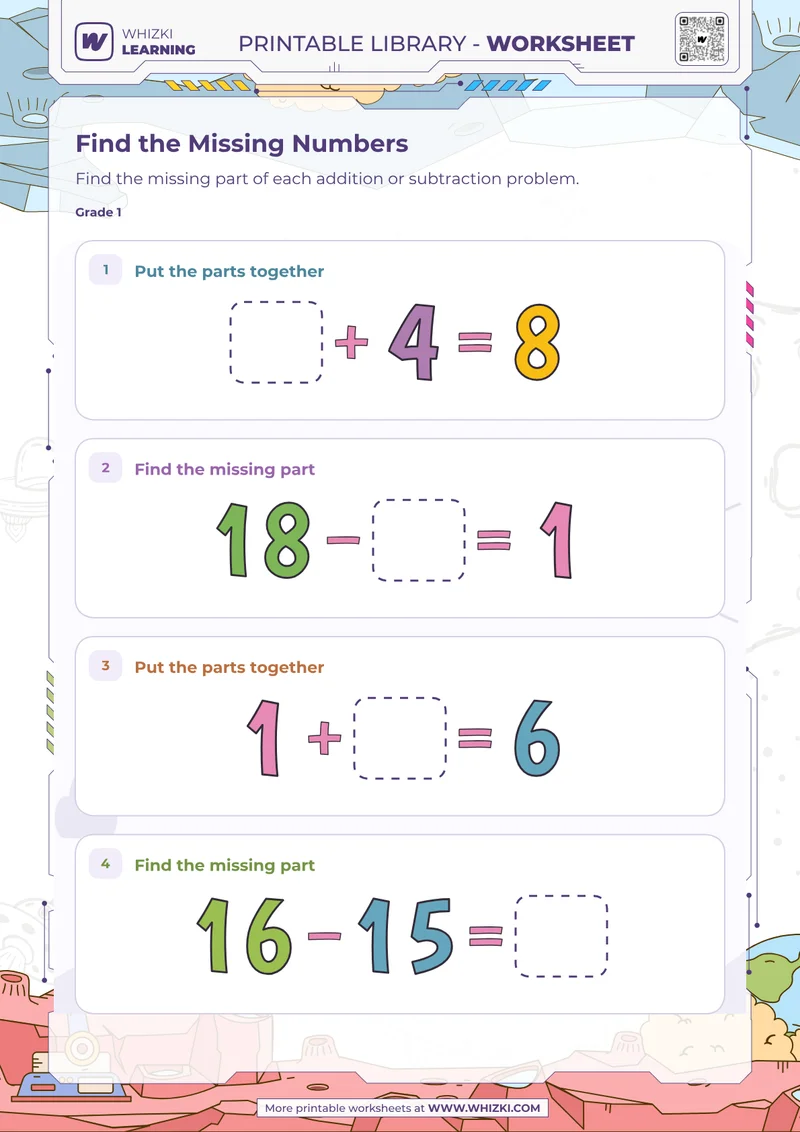
The Find the Missing Numbers worksheet gives first graders short number rows and simple equations with blanks to fill. Children practice counting forward from 0 to 18, then use addition and subtraction facts such as 4 plus 4 equals 8 and 18 minus 17 equals 1 to find the missing part.
At age seven, many children can count by memory, but skipped spaces can make number order feel shaky. Missing number work matters because first graders need to see what comes before, what comes after, and how nearby numbers help with early addition and subtraction.
Use the page as a short sit-together activity. Start with the 0 to 4 row, then move to 6 to 10, 11 to 15, and 14 to 18. Ask your child to read each full sequence, point to each blank, and say which number belongs before writing. For the equations, ask which number makes the number sentence true.
The worksheet mixes counting rows with matching equation practice, so the page is more than a plain fill-in number chart. The small set of four problems keeps the work short, clear, and ready for shared off-screen practice.
Limited-time savings
on Whizki workbooks.
Boost your child’s skills with our discounted workbooks. Engaging activities for preschool, kindergarten, and grade 1 - now at special sale prices!


Fast shipping
Secure Payment
Licensed Teachers
For the planet
Printed in the USA
Find fresh ideas
To help your little learners grow!
Helpful guides for parents and teachers, and tips for making learning at home super fun.

A seven-minute apple observation helps children compare color, stem, skin, weight, smell, and a cut surface, then draw what children noticed before any craft begins.
Sunny Hedge
A field note on why Ukrainian-English workbook pages need fresh design choices for letters, examples, space, and language-specific skills.
Sunny Hedge
A fast weather window journal helps ages 3-7 notice sky and temperature feeling with simple symbols, compare a few days, and learn observation versus forecast.
Sunny Hedge
A five-minute snack sort turns crackers, berries, or allergy-friendly objects into early data practice as children sort, count, compare, and clean up.
Sunny HedgeJoin the Screen-Free Movement.
Get exclusive activities, expert tips, and inspiration for a more meaningful, offline family life.