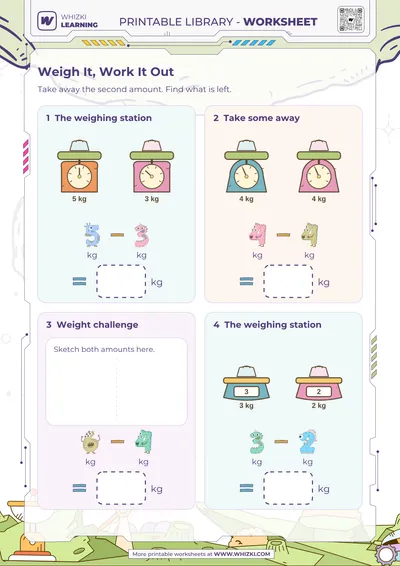
Pound measurements → Subtract labeled quantities → Finds the remaining or compared amount and records the answer with lb.
Picture models → Connect visual quantities to equations → Uses the illustration to check which pound amounts are being subtracted.
Unit labels → Read and compare measurements → Notices that answers need both a number and the pound unit.

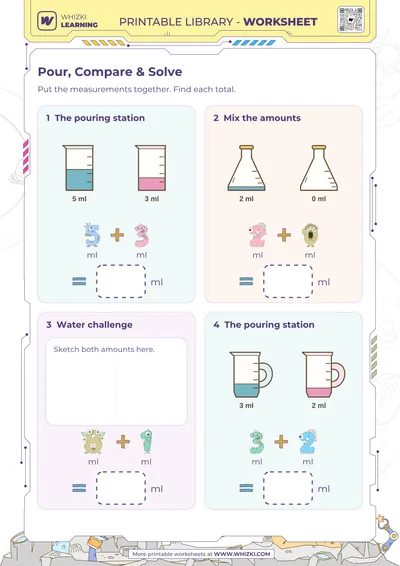
Six-year-olds can subtract small numbers one day and stall the next when a unit label shows up. This printable gives them four lb subtraction problems on one page. The pictures match the quantities in each problem, so your child can connect the written numbers to a simple visual model.
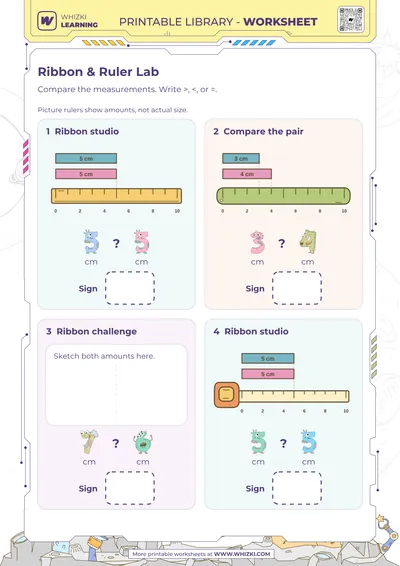
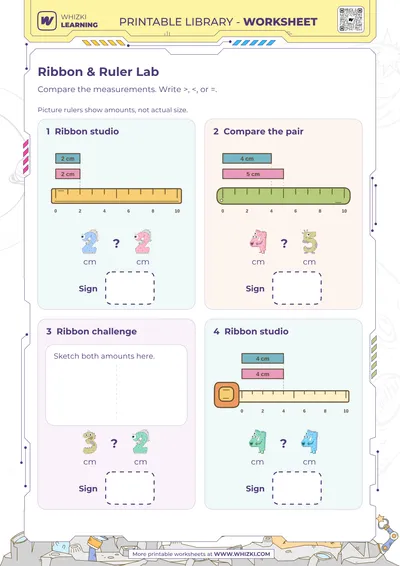
This is a good fit when a child can subtract basic numbers and is ready to keep track of units. The illustrated ruler, scale, or measuring container is a model for the problem, not a life-size measuring tool. It is there to help kids read the amount, compare quantities, and remember that the answer is still measured in pounds.
Sit beside your child for the first problem and ask, “What are we subtracting?” Then point to the lb label and have them say “pounds” before they write the answer. If they rush to write only the number, gently circle back and ask what unit belongs with it. That small pause builds the habit of writing a complete measurement answer.
After this page, a simple next step is to practice the same subtraction idea with a different kind of unit. The feet measurement subtraction worksheet helps children see subtraction with length, while the pint measurement subtraction worksheet gives them another chance to keep the unit label with the answer.
Boost your child’s skills with our discounted workbooks. Engaging activities for preschool, kindergarten, and grade 1 - now at special sale prices!


Fast shipping
Secure Payment
Licensed Teachers
For the planet
Printed in the USA
Helpful guides for parents and teachers, and tips for making learning at home super fun.

A practical guide for inviting family stories about names, language, music, routines, celebrations, and places without putting children on display.

Turn a quick room search into early geometry talk by asking about sides, corners, curves, and shapes inside everyday objects.

Use a child’s own drawing and spoken words to build a first sentence through adult dictation, shared writing, or optional child writing.

Turn one borrowed book into five short learning moments for ages 3 to 7, with choosing, rereading, drawing, counting, memory, and returning.
Get exclusive activities, expert tips, and inspiration for a more meaningful, offline family life.